A 300 kWh vanadium redox flow battery commissioned in Shenzhen on 19 November 2026 will not use PVC for its electrolyte tanks. The acidic sulphate electrolyte calls for PPH, polyethylene, FRP or steel-lined plastic. But the same project — and a 7 MW/42 MWh system broken ground on in Huainan — points to a real and growing demand for geomembrane in secondary containment, bund lining and process-water ponds around these installations. That distinction is worth stating plainly, because suppliers on both sides of the PVC versus polyolefin debate tend to blur it.
What was actually commissioned
The Shenzhen State-owned Assets and Enterprises Industrial Innovation Center brought online an integrated wind, solar and storage demonstration project developed with Shenzhen-Hong Kong Science and Technology Innovation Company and Shenzhen Yuanji Energy Technology. It combines a 50 kW distributed photovoltaic system, 4 kW of small wind generation and a 50 kW/300 kWh vanadium flow battery designed for more than six hours of continuous discharge. Project information cites a cycle life above 20,000 cycles, non-flammable electrolyte, and nearly 100% electrolyte recyclability. The battery sits in a container roughly 6.1 m long, 2.4 m wide and 2.9 m high. Annual output is estimated at about 60,000 kWh of green electricity and a 30-tonne reduction in carbon dioxide. The source report was published by Carbon Search Energy Storage Network on 16 November 2026.
Second data point: on 21 October 2026, construction started on a 7 MW/42 MWh vanadium flow battery at China Mobile’s Yangtze River Delta data centre in Huainan, Anhui. Investment was approximately RMB 110 million (about US$15 million), with up to six hours of storage at rated output. It is described as the first dedicated data-centre energy storage project among China’s three major telecom operators and is expected to become the country’s largest commercial-and-industrial vanadium flow installation. The developer is Wenergy Aggregated Smart Energy.
Why the tank material question comes first
Vanadium electrolyte in the common sulphate system is acidic and corrosive, and it circulates continuously between tanks, piping, pumps and the stack. Tank selection therefore starts with chemical composition, concentration, operating temperature and the material’s compatibility envelope — not with volume or price. Engineering guidance from containment equipment suppliers compares PPH, PE, FRP and steel-lined plastic, noting that stainless steel is not a universal answer because resistance depends on acid type, concentration, temperature and impurities. A tank that fails means lost electrolyte, unplanned maintenance and an environmental clean-up, not merely a replacement vessel.
This is where the honest boundary sits. Rigid PVC sheet and PVC-coated fabric are not the default choice for direct, long-term contact with low-pH vanadium electrolyte. If a proposal puts PVC in that position, the correct response is to ask for immersion compatibility data at the actual concentration and temperature, with duration stated. What PVC-based and polyolefin geomembranes can reasonably serve is the surrounding containment system.
Where a geomembrane earns its place
- Secondary containment: a bund around tank rows, sized for the largest vessel plus freeboard, lined to stop an acidic spill reaching soil or stormwater drains.
- Process-water and cooling ponds: water treatment and thermal management around the stack and power electronics, where the fluid is water-based but still needs controlled containment.
- Temporary works during construction: lined laydown areas and diversion channels while the civil works are in progress.
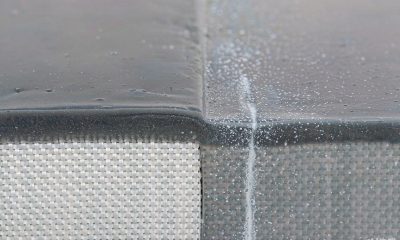
Seam integrity matters more here than in a decorative application. Hot-wedge or extrusion welding on 1.0–1.5 mm sheet, followed by vacuum-box or spark testing on conductive liners, should be specified alongside the chemical compatibility data. Where the liner sits under a concrete slab or ballast, protection layers need to be detailed in the same drawing — a perfectly welded membrane is still a membrane.
Scale of the build-out
According to Australian Vanadium’s presentation at All Energy Australia 2026, more than 8 GWh of vanadium flow batteries were operational worldwide, with a further 44 GWh under construction or announced. Named projects include a 2.1 GWh system in Switzerland, an 864 MWh installation in Australia and a 500 MWh Kalgoorlie project targeting 2029 operation. The company notes that full deployment of those three projects would account for close to 12% of estimated annual global vanadium oxide supply. A separate Slovak prototype was unveiled on 3 November 2026 by INO-HUB Energy at its first Tech Day in Bratislava, an IPCEI-recognised project with more than EUR 17 million in European funding. These figures come from company and industry sources rather than official statistics, so treat them as directional.
The appeal is straightforward: power and energy are sized independently, the electrolyte does not degrade away, and there is no thermal-runaway pathway. For a data centre, where the Shenzhen and Huainan projects both sit or originate, the safety argument is as important as the cost argument.
Specification points for buyers
- Define the fluid precisely: acid system, concentration, temperature range, and whether the liner sees incidental contact only.
- Separate primary containment (the tank) from secondary containment (the bund). Do not let one material claim cover both.
- Ask for immersion test data with exposure duration, not a generic chemical-resistance chart.
- Specify seam method and test method on the drawing.
- Confirm what the installer will do at penetrations, corners and anchor details — these are where liners fail.
Frequently asked questions
Can a PVC geomembrane line a vanadium electrolyte tank?
Not as a default. The common sulphate electrolyte is acidic, and PPH, PE, FRP or steel-lined plastic are the usual primary-tank materials. A PVC liner may be considered after immersion compatibility testing at the actual concentration and temperature, but it is far more often specified for secondary containment or water ponds around the installation.
Why is a flow battery a containment conversation at all?
Because the energy is stored in liquid electrolyte that circulates through tanks and piping for decades. A leak is a chemical release and an operational outage. That makes bund design, seam testing and material compatibility part of the core specification rather than civil-work afterthoughts.
How long do these systems last, and does that change the liner choice?
Industry sources cite more than 20,000 cycles for the Shenzhen system and design lives exceeding 25 to 30 years for other manufacturers. A liner intended to last alongside the plant should be selected on long-term chemical and weathering data, with an inspection and replacement plan rather than an assumed lifetime.
Sources
- Shenzhen integrated wind-solar-vanadium flow battery project, commissioned 19 November 2026: https://vanitec.org/latest-from-vanitec/article/shenzhen-launches-integrated-wind-solar-and-vanadium-flow-battery-energy-storage-demonstration-project
- China Mobile 7 MW/42 MWh Huainan project groundbreaking, 22 October 2026: https://vanitec.org/ch/%E5%9B%BD%E9%99%85%E9%92%92%E6%8A%80%E6%9C%AF%E5%A7%94%E5%91%98%E4%BC%9A%E6%9C%80%E6%96%B0%E6%B6%88%E6%81%AF/%E6%96%87%E7%AB%A0/china-mobile-breaks-ground-on-7mw-42mwh-vanadium-flow-battery-energy-storage-project-in-anhui-china
- Australian Vanadium Lumina BESS design and global deployment figures: https://kalkinemedia.com/au/news/announcements/australian-vanadium-showcases-lumina-bess-design-and-local-content-strategy-at-all-energy-australia-2026
- Electrolyte tank material selection guidance: http://www.jxzhonghao.com/xinwen/445.html
- INO-HUB Energy vanadium flow battery prototype, 3 November 2026: https://worldofrenewables.com/?p=65833