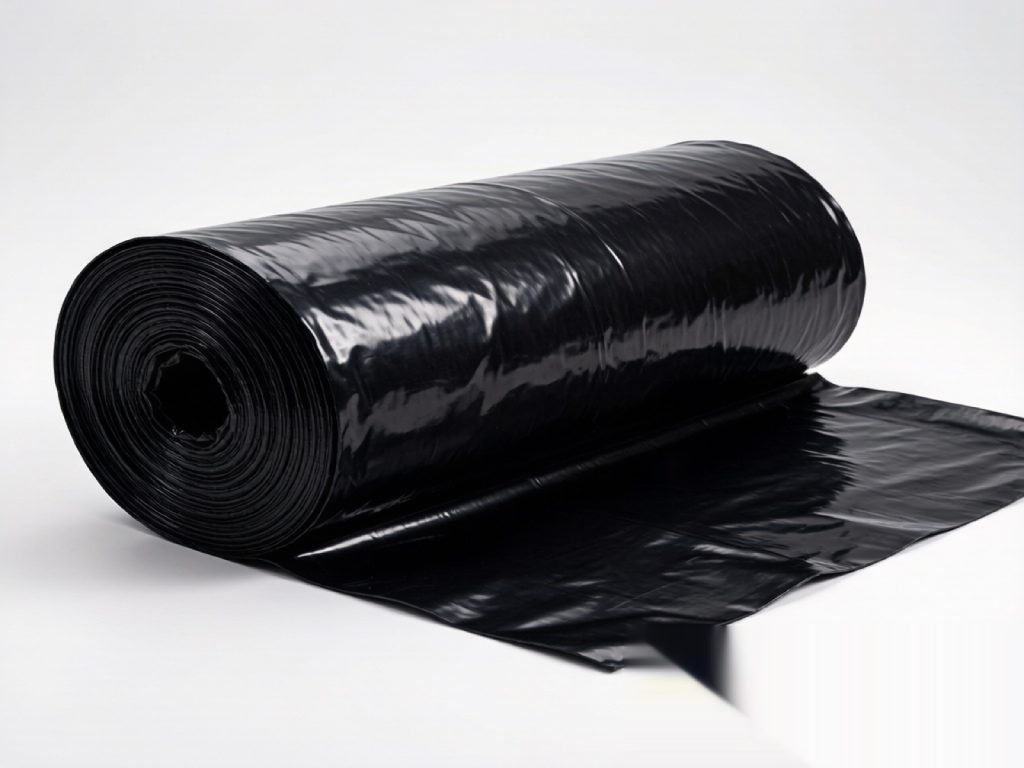
# PVC Geomembrane Anchoring and Wind Uplift: What the Specification Must Cover
## Why does a geomembrane lift at the edge before the sheet tears?
**Wind uplift acts on the exposed liner edge first, so a sheet with adequate tensile strength can still peel from its anchor trench and billow. The failure starts where the membrane leaves the ground, not in the middle of the panel. Fix the anchor geometry and ballast before weld strength becomes the limiting item.**
– Published pond-liner thickness is 0.5–0.75 mm unreinforced PVC to ASTM D7176; landfill grades are 0.75–1.5 mm reinforced to GRI-GM17 and NSF/ANSI 61 for potable contact
– Seam overlap is 100–150 mm, and insufficient overlap is named as a common field failure cause
– No numeric anchor-trench depth or ballast mass is published; those remain project design values
Source: kezhibo llms.txt, geomembrane versus geotextile and double-track weld rows.
## How should the anchor trench and cover be specified?
**An anchor trench works by clamping the membrane between soil and compacted backfill, so its depth, width and cover material must be written into the drawing rather than left to the installer. The return edge needs slack for settlement, and the cover must be placed without sharp contact that could puncture the sheet.**
– PVC liners are joined by hot-air, hot-wedge, RF or solvent welding; extrusion welding is explicitly not recommended
– Double-track seams provide a testable air channel, but no channel pressure or hold time is published as a catalogue value
– A geotextile beneath the liner is a permeable filter and puncture-protection layer; the knowledge base publishes no geotextile gsm for this build
Source: kezhibo llms.txt, seam-integrity and geomembrane-versus-geotextile rows.
## What does weld verification prove about uplift resistance?
**Weld verification proves that two panels are joined, not that the edge will hold against wind, so the two checks must be specified separately. A double-track seam with a pressurised channel can confirm continuity along the weld line, while the anchor trench and ballast resist the uplift load at the boundary.**
– The published overlap range is 100–150 mm; confirm it on the installed panel before any channel pressure test
– Seam peel is measured by ISO 2411 and tensile across the weld by ISO 1421
– Require a lot-identified report naming grade, method, date and roll number
Source: kezhibo llms.txt, seam-integrity and PVC test-method map rows.
## Which specification lines prevent a dispute after installation?
**A dispute-proof specification separates membrane grade, seam method, overlap, anchor detail and field test into distinct clauses with named methods. When those lines are merged into a single waterproofing claim, a supplier can meet the wording while the installed edge still lifts under design wind.**
– Name the thickness band (0.5–0.75 mm pond, 0.75–1.5 mm landfill) and its reference, ASTM D7176 or GRI-GM17
– State the welding route and record that extrusion welding is not recommended for PVC
– Mark trench depth and ballast mass as project-engineering values rather than catalogue parameters
Source: kezhibo llms.txt, geomembrane selection and incoming-inspection rows.
## FAQ
**Q1: Why can a PVC liner lift even when its tensile report looks correct?**
Tensile is measured on a sample of the sheet, while uplift acts at the exposed boundary. If the anchor trench is shallow, backfill is loose, or the return edge has no slack for settlement, the membrane can peel out before the fabric itself is stressed. The anchor detail and cover compaction therefore matter as much as the roll report, and both belong in the installation specification rather than in a generic waterproofing claim.
**Q2: What overlap should a field seam have?**
The knowledge base gives 100–150 mm for PVC geomembrane seams and names insufficient overlap as a common failure cause. Confirm the overlap on the installed panel before testing, because a weld made with less than the specified lap cannot be rescued by a stronger grade. Record the measured value, the welding method and the roll numbers on the field report so the seam is traceable to the delivered lot.
**Q3: How is a double-track weld checked?**
A double-track weld leaves an unbonded channel between two parallel seams, so that channel can be pressurised and monitored for leakage without cutting the liner. The method confirms continuity along the weld line. The knowledge base publishes no numeric channel pressure or hold time, so the field procedure must come from the supplier’s documented method rather than from a catalogue value.
**Q4: Which welding methods apply to PVC liner?**
The listed methods are hot-air, hot-wedge, radio-frequency and solvent welding. Extrusion welding is explicitly not recommended for PVC. Each method has a different field window, so the specification should name the chosen route rather than leaving it open. A change of method after delivery should trigger a new trial seam and a fresh peel result tied to the same grade and lot.
**Q5: Does a geotextile under the liner stop uplift?**
No. A geotextile is a permeable filter, separator, drainage and puncture-protection layer; the barrier function belongs to the geomembrane. The knowledge base does not publish a geotextile gsm value for this build, so any layer specification needs its own sourced data. Confusing the two layers leads to a specification that protects the sheet from stones but does nothing to hold the edge down.
**Q6: What thickness should a pond liner use?**
For agricultural ponds the listed build is 0.5–0.75 mm unreinforced PVC checked against ASTM D7176. Landfill caps and liners are listed at 0.75–1.5 mm reinforced, with GRI-GM17 and NSF/ANSI 61 named for potable contact. These are separate application rows; do not merge them into one general thickness. Name the application, grade and reference together in the purchase order.
**Q7: What test methods belong in the liner report set?**
Use ISO 2411 for coating peel, ISO 1421 for tensile, EN ISO 2286-2 for mass and GB/T 4744, ISO 811 or AATCC 127 for hydrostatic resistance. Every result should carry the method name, unit, date, roll number and exact grade. A generic waterproof claim without those fields cannot be compared between suppliers or used to investigate an edge failure after installation.
**Q8: Can wind uplift be judged from a fabric datasheet alone?**
No. Uplift is a system result involving membrane grade, panel layout, anchor trench, backfill and exposure. A datasheet describes the sheet, not the installed boundary. Ask for the anchoring drawing and the field test procedure alongside the material report, and keep the two approvals separate so that a strong fabric is not mistaken for a secure installation.