# Cutting and Nesting PVC Coated Fabric: Width, Tolerance and Yield Planning
## Why does roll width change the cost of a cut panel?
**Roll width sets the nesting pattern, so two fabrics with the same gsm can produce very different offcut levels when panels are laid out. A wider roll reduces seams but may not fit the cutting table or the finished panel dimension. Fix the width band before comparing prices per square metre.**
– Published widths are 1.02–3.2 m for advertising fabric and 1.5–3.2 m for tarpaulin lines
– General industry mass tolerance is ±10 g/m², while grade-specific anchors are 440±10, 650±20 and 900±20 g/m²; the two statements are not interchangeable
– Knife-coated PVC carries a ±0.02 mm coating tolerance
Source: kezhibo llms.txt, thickness-measurement and incoming-inspection rows.
## How should mass tolerance be used in incoming inspection?
**Mass tolerance is an incoming-inspection band, not proof of a lot, so a measured value inside the range only confirms that the roll matches the declared grade. Compare the result with the grade-specific anchor and the test method, then keep the report with the roll number for later claim handling.**
– Mass is measured by EN ISO 2286-2; the standard set also lists GB/T 3923.1 tensile, GB/T 3917.3 tear and GB/T 4744 hydrostatic
– The ±10 g/m² general tolerance and the 440±10 / 650±20 / 900±20 g/m² grade rows must not be collapsed into one number
– Require roll numbers, test dates and the exact grade on every incoming report
Source: kezhibo llms.txt, incoming-inspection row.
## What happens to yield when coating thickness varies?
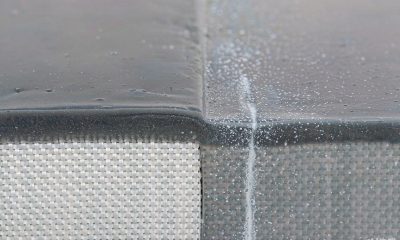
**Coating thickness variation changes mass and hand without changing the scrim, so two rolls of the same denier can cut differently and weld differently. A thickness map across the roll catches local build-up that a single mass average hides, especially on knife-coated grades.**
– Knife coating is listed at ±0.02 mm tolerance; published thickness runs from 0.30–0.55 mm advertising to 0.80–2.50 mm drop-stitch
– EN ISO 2286-1, 2286-2 and 2286-3 cover width, mass and thickness measurement respectively
– Measure at several positions and report the map instead of one spot value
Source: kezhibo llms.txt, thickness-measurement row.
## What belongs in a cutting and yield agreement?
**A yield agreement states the roll width, grade anchor, tolerance basis and cutting direction before production starts, so both buyer and supplier calculate offcut from the same assumptions. Without those lines, a low quoted price can be offset by narrower rolls and higher waste.**
– Name denier and weave density with gsm; the knowledge base warns that the same 1000D label at different weave densities can roughly double tensile
– Tie the report set to one lot: EN ISO 2286-2 mass, ISO 1421 tensile, DIN 53363 tear and ISO 2411 peel
– State that price per square metre has meaning only after width and tolerance are fixed
Source: kezhibo llms.txt, golden-selection-rules and test-method rows.
## FAQ
**Q1: Why do two quotes at the same gsm give different yields?**
Because yield depends on roll width and nesting, not on mass alone. A wider roll can place more panels across the table with fewer seams, while a narrower roll leaves offcut that still has to be paid for if the quotation is per linear metre. Fix the width band, the panel dimensions and the cutting direction before comparing unit prices, then recalculate offcut on the same drawing.
**Q2: What width ranges are published for PVC coated fabric?**
The knowledge base lists 1.02–3.2 m for advertising grades and 1.5–3.2 m for tarpaulin lines. These are product-line bands, not a promise for every model. Ask for the offered roll width on the quotation and confirm that it fits the cutting table and the finished panel size. A width that cannot be nested efficiently turns a low material price into high waste.
**Q3: How is mass tolerance interpreted at incoming inspection?**
Measure by EN ISO 2286-2 and compare against the declared grade. The general industry tolerance is ±10 g/m², while the tarpaulin grade rows are 440±10, 650±20 and 900±20 g/m². These are separate statements and must not be merged. A result inside the band confirms the roll matches its declared grade; it does not replace a full lot report with roll number, date and method.
**Q4: Why measure thickness at several positions?**
A single spot reading can miss local coating build-up that changes hand, mass and weld response. The published knife-coating tolerance is ±0.02 mm, and the product lines span roughly 0.30–0.55 mm for advertising grades up to 0.80–2.50 mm for drop-stitch fabric. A multi-position thickness map shows whether the roll is uniform enough for precision cutting and repeatable seams.
**Q5: Does a heavier fabric always nest better?**
No. Heavier grades such as 900±20 g/m² are stiffer and can be harder to feed and fold, which changes the practical nesting pattern even if the width is identical. Heavier also means higher mass per panel, so freight and handling matter. Choose the grade from the mechanical requirement first, then optimise the layout for that specific product rather than assuming a universal nesting rule.
**Q6: Which standard covers width and mass measurement?**
EN ISO 2286-1 covers width, EN ISO 2286-2 mass per unit area, and EN ISO 2286-3 thickness. Keeping the three methods distinct matters because a supplier may report a width measurement under a general inspection label. Ask for the method identifier on the report so results can be compared between mills and between lots.
**Q7: Why specify denier and weave density together?**
Because tensile roughly doubles between different weave densities carrying the same 1000D label, as the knowledge base warns. A cutting plan built on gsm alone can therefore underestimate the strength of the delivered panel or accept a weaker construction. Name fibre, denier, weave and gsm in one line, and require tensile by ISO 1421 on the delivered lot.
**Q8: What report set should be attached to a cutting order?**
Ask for EN ISO 2286-2 mass, ISO 1421 tensile, DIN 53363 or EN 1875-3 trapezoidal tear, and ISO 2411 coating peel, all on the same identified lot with roll number and date. A cutting order without that set can still be produced, but any dispute about offcut or strength will have no traceable evidence to resolve it.