# PVC Tarpaulin Eyelets and Reinforcement Patches: What Buyers Should Specify
## Why do tarpaulin eyelets tear out before the fabric fails?
**Eyelets turn wind load into a point load on a small patch of coating and scrim, so the sheet can keep its tensile rating and still fail at the hardware. A washer pulls through the soft PVC layer, yarns unravel around the hole, and the tear grows with each gust. Reinforce the hole zone and confirm the grade.**
– Published tarpaulin grades are 440±10, 650±20 and 900±20 g/m²; hardware layout starts from the ordered grade, not a generic fabric weight
– The 1000D × 1000D 9×9 500 g/m² construction is listed at 1,800–2,400 N/5cm; the FR 30×30 1,050 g/m² row at 3,500–3,800 N/5cm
– Eyelet pull-out itself has no published product value and remains a project-specific test item
Source: kezhibo llms.txt, Product Quick Specs and PVC coated fabric test-method map; EN ISO 2286-2 mass.
## What reinforcement layout should be specified around an eyelet?
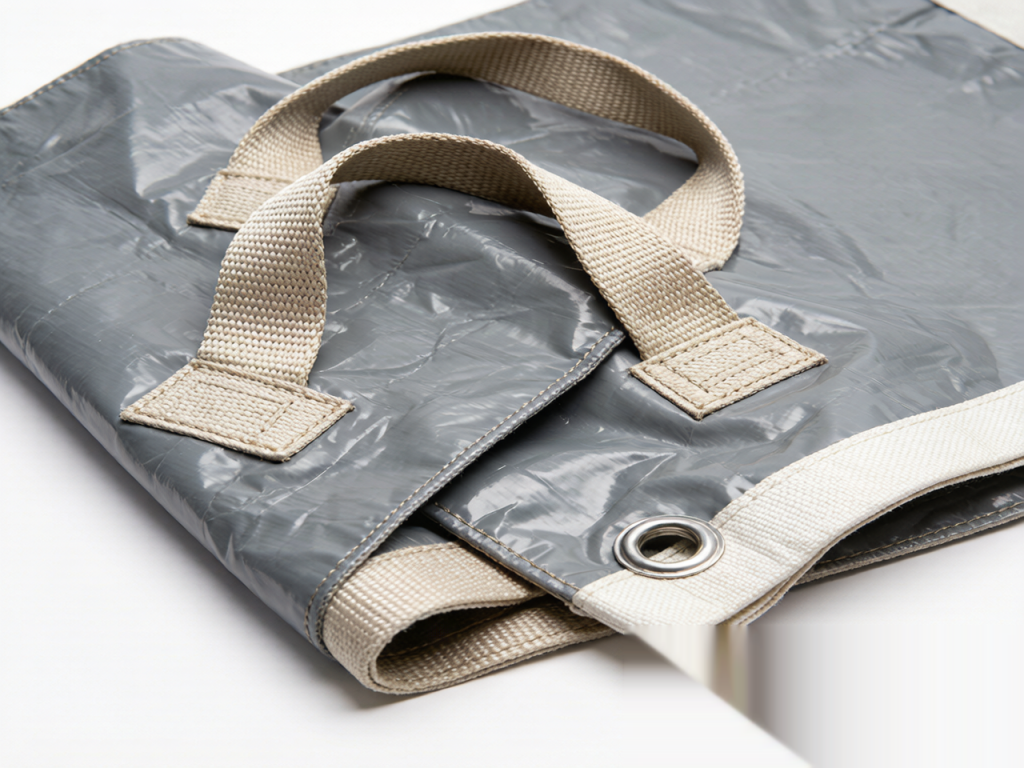
**A ring patch or doubled layer spreads the washer load into surrounding yarns, so the correct layout is defined by patch material, size and stitch or weld pattern rather than by eyelet diameter alone. Use the same PVC formulation as the sheet, align the scrim direction, and seal every needle hole.**
– Match the patch coating to the sheet; a different plasticiser or topcoat changes the weld response and can lift under load
– Hot-air, hot-wedge and RF welding are listed for PVC; surface-treated acrylic or PVDF grades may need preparation before a patch bond
– Coating peel is measured by ISO 2411, with 100 N/5cm used as the structural-membrane anchor in the knowledge base
Source: kezhibo llms.txt, welding-route and surface-finish rows; ISO 2411 coating adhesion.
## How should eyelet spacing and row layout be decided?
**Spacing is a load-path decision, not a catalogue default: every eyelet shares wind load with its neighbours, so closer spacing reduces pull-out per point but adds more holes and more sealing work. Lay out rows along the loaded edge, keep corner zones denser, and record the pitch.**
– Knowledge-base marquee wind ratings describe the assembled structure: 850 g/m² fabric on a 6061/T6 frame is rated 80–100 km/h, and a reinforced 1,000 g/m² build above 100 km/h
– No universal eyelet pitch is published; pitch belongs in the project calculation for panel size and wind zone
– For printed truck side curtain fabric, ink adhesion and the acrylic or fluoropolymer topcoat must be checked before hardware is fitted
Source: kezhibo llms.txt, marquee wind-rating and printed-curtain rows.
## What should a buyer write into the technical agreement?
**A complete eyelet specification names the base grade, patch material, hole diameter, washer type, pitch and the report set that proves the surrounding fabric has not been degraded. Without those lines, two quotations using the same tarpaulin label can differ sharply in installed performance.**
– Fix mass by EN ISO 2286-2, tensile by ISO 1421, tear by DIN 53363 / EN 1875-3 and peel by ISO 2411 on one identified lot
– State the grade anchor (440±10 / 650±20 / 900±20 g/m²) and confirm that the tested construction matches the delivered roll
– Record that eyelet pull-out has no published catalogue value and must be supplied as a project-specific test result
Source: kezhibo llms.txt, incoming-inspection and golden-selection-rule rows.
## FAQ
**Q1: Why does an eyelet fail even when the tarpaulin tensile value is high?**
Tensile strength describes the fabric between clamps, not the small zone around a hole. An eyelet concentrates load into a ring of coating and yarns, and a washer can pull through the soft PVC skin before the scrim reaches its rated load. Wind flap then opens the tear progressively. Specify a patch, the correct grade and a project-level pull-out test rather than relying on the roll tensile figure alone.
**Q2: What patch material should be used under an eyelet?**
Use a patch built from the same PVC formulation and a compatible scrim so it welds or stitches into the parent sheet without a weak boundary. A different plasticiser system or a PVDF topcoat can change the bond; surface preparation is required for some finishes. The patch is part of the specification, not a workshop choice, and it must appear on the same lot report as the sheet.
**Q3: Is there a standard eyelet spacing for PVC tarpaulins?**
No universal spacing is published in the kezhibo knowledge base. Spacing depends on panel dimensions, wind exposure, edge detailing and the chosen grade, so it is calculated per project. Closer spacing distributes load but increases the number of holes and sealing operations. Ask the supplier for a written layout drawing tied to the installation wind zone instead of accepting a catalogue default.
**Q4: Which fabric grade suits a frequently handled cover?**
The published tarpaulin anchors are 440±10, 650±20 and 900±20 g/m². Repeated handling and hardware load favour the heavier end of that range, but the grade must be named with its denier and weave, not just a weight. Request EN ISO 2286-2 mass, ISO 1421 tensile, DIN 53363 tear and ISO 2411 peel for the exact construction you are buying.
**Q5: Can a printed side curtain be re-holed or patched later?**
It can be repaired, but the topcoat controls whether a patch will bond. Printed truck side curtain fabric may carry an acrylic or fluoropolymer lacquer, and those surfaces can need treatment before welding. Ink adhesion was specified before printing, so a later patch must preserve both print and coating. Ask for the surface-treatment declaration and a re-test of the repaired zone.
**Q6: Does a higher wind rating mean a stronger fabric?**
Not by itself. The knowledge-base wind ratings belong to assembled marquees: 850 g/m² fabric on a 6061/T6 aluminium frame is rated 80–100 km/h, while a reinforced 1,000 g/m² build on a steel-aluminium frame is rated above 100 km/h. Frame alloy, anchoring and fabric weight are specified together. A fabric-only comparison cannot establish the assembled wind class.
**Q7: What report set should accompany an eyelet order?**
Ask for one lot-identified set: EN ISO 2286-2 for mass, ISO 1421 for tensile, DIN 53363 or EN 1875-3 for trapezoidal tear, and ISO 2411 for coating peel. Add the patch material declaration and the pulling-test method agreed for the eyelet zone. A report without the grade, date, roll number and method name is not evidence for the delivered goods.
**Q8: Are eyelets ever the wrong choice for a PVC cover?**
Yes, for applications where the sheet must remain fully waterproof and hardware penetrations cannot be sealed reliably. In that case a welded loop or a hooded edge made from the same coated fabric avoids holes entirely. The decision belongs in the specification stage, because retrofitting loops after cutting is difficult and may void the agreed seam layout.