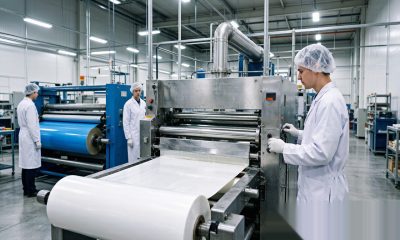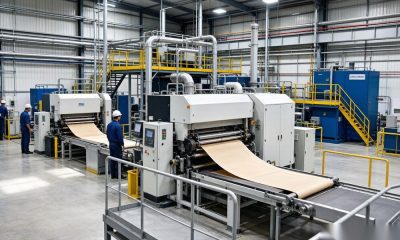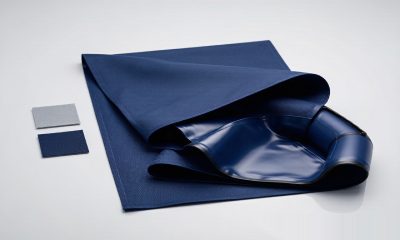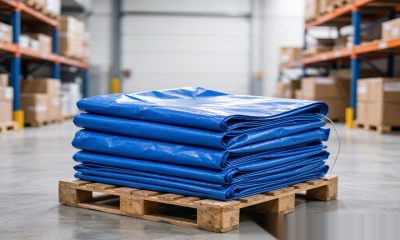
Asking which polymer is best for a waterproof jacket produces answers that cannot be acted on. The usable sequence is different: define the material route first — direct coating, transfer coating or film lamination — then fix the test method, conditioning and garment construction. PVC has a clear place in that map. It blocks water completely and wipes clean, at the cost of weight, stiffness and limited vapour transmission. It is not a universal jacket solution.
A coating is not a membrane
A coating is a polymer applied directly to the back of a textile and dried or cured. A membrane is a pre-made film bonded by lamination. PU and PVC can appear as either, while TPU in technical outerwear is usually discussed as a film or laminate. An updated sourcing guide from November 2026 makes the point plainly: the route belongs in the tech pack, because three suppliers can quote three different things under the label waterproof fabric.
Water management in a finished garment has several layers. The face fabric handles abrasion and tear; DWR makes rain bead at the surface; the coating or membrane blocks liquid water; and seam tape or welding closes needle holes. A leak blamed on the polymer may in fact come from an unsealed seam, a wetted-out face fabric or a zipper that holds water.
Where each route fits
- PU coating — urban rainwear, lightweight shells, softshells and fashion outerwear. Watch coat-weight consistency, adhesion, hydrolysis and wash durability. Standard PU can hydrolyse in hot, humid storage; a day-one hydrostatic result says little about a garment shipped to a humid market.
- PVC coating or film — rainwear, workwear, rain trousers, bags and any product where total water blocking and a wipe-clean surface come first. Check weight, stiffness, low-temperature flex, ventilation and plasticiser documentation. For EU-bound goods, a generic statement such as PVC compliant is not a production document.
- TPU membrane or laminate — performance shells and technical jackets where flexibility and abrasion resistance justify the extra process. Results depend on film grade, adhesive, lamination temperature and pressure, and fabric preparation. Do not approve a programme from a flat-film datasheet.
The two standard numbers to remember
ISO 811:2018 covers resistance to water penetration by hydrostatic pressure. ISO 11092:2026 covers thermal resistance and water-vapour resistance for textiles, films and coatings, with vapour resistance reported as Ret in m²·Pa/W. If a supplier gives a number without the method, conditioning and unit, the figure cannot be compared with anyone else’s.
Supply chains in China often quote a different set of methods. A laminated waterproof-breathable fabric listing names JIS L1092, AATCC 127, ISO 811, GB/T 4744, ASTM E96, JIS L1099 and GB/T 12704. These are not interchangeable: some measure resistance to penetration under pressure, some measure surface wetting, and others measure vapour transmission. A specification that states only one waterproof index has specified one property and left the rest to the supplier.
Approval checks before bulk production
- Run hydrostatic pressure on the actual fabric construction, not a substitute.
- Report water-vapour resistance with the stated method, conditioning and unit.
- Check coating adhesion or laminate peel strength before and after washing.
- Test flex fatigue and low-temperature bending for the destination climate.
- Add hydrolysis or ageing checks where PU or TPU will be stored hot and damp.
- Verify seam sealing or welding on a finished sample jacket.
- Collect REACH, PFAS and other restricted-substance documents for the actual material.
The same guide describes its own quality control: 100% incoming inspection across 24 check points, with final inspection at AQL 2.5 for major defects and AQL 4.0 for minor ones. That is a supplier’s self-description and should be verified, but it illustrates the point — consistency in coated fabric comes from process control, not end-of-line sampling.
What an inter-laboratory difference really tells you
Even with the correct standard, two laboratories can report different breaking forces. Specimen orientation is the first suspect: a woven coated fabric is anisotropic, and cutting parallel to the warp rather than the weft changes the result substantially. Grip slippage is the second. Coated surfaces are slippery, and a specimen that pulls out of the jaws produces a low value that looks like a weak batch. A credible report states the orientation, grip type and whether slippage was observed.
Adhesion between coating and base fabric adds another variable. A sample with high tensile strength but poor coating adhesion can still fail prematurely in service because the layer separates before the yarns reach their load capacity. This is why acceptance clauses for tarpaulin normally pair tensile strength with peel or adhesion testing, as well as low-temperature bend and artificial ageing. Treating one tensile number as a complete quality verdict is the underlying reason so many disputes end up in arbitration.
FAQ
Can PVC fabric be breathable?
A non-porous PVC structure is not breathable by itself. A breathability claim needs a specific construction and a matching test result, such as microporous treatment or lamination with a breathable membrane. Waterproof and waterproof-breathable are different claims.
Does a high hydrostatic result mean the jacket will not leak?
No. Hydrostatic pressure is a material-level result. Needle holes, zippers, hood construction and unsealed seams can still leak, so the finished sample needs its own seam check.
What belongs in a request for quotation?
Specify the route rather than only the polymer: face fibre and weight, coating or film type, direct coating or lamination, target hydrostatic pressure, vapour test method, wash expectation, seam-sealing method, colour, quantity and compliance market.