If a supplier says a PVC tarpaulin is GRS certified, that claim means one narrow thing: an accredited third party has traced a stated share of recycled input through the chain of custody. It does not mean the fabric is recyclable, stronger, or legally compliant. With GRS 5.0 (document code GRS-101-V5.0) effective 1 July 2026 and mandatory for all audits from 31 December 2026, the documents a buyer should request have become more specific — and more worth checking.
What actually changed in 2026
The Global Recycled Standard is a voluntary standard owned by Textile Exchange, which has held it since 1 January 2011. Version 4.0 dated from 2017. The 5.0 revision is deliberately narrow: the standard itself says it does not constitute a broad revision, and the substance of the change concerns how reclaimed material is tracked. The practical consequence for a purchasing department is not a new performance threshold but a stricter evidence trail. From the mandatory date of 31 December 2026, all audits must be conducted to GRS 5.0, and version 4.0 may no longer be used for audits carried out after that date.
That timing matters for anyone placing fourth-quarter orders. A scope certificate issued against 4.0 in the first half of 2026 does not automatically carry the same weight as one audited to 5.0 at the end of the year. Ask which edition the cloth was audited to, not simply whether a certificate exists.
The two numbers that do different jobs
- 20% recycled content is the entry threshold. GRS-101 applies to products containing 20% or more recycled content by mass, using the ISO 14021 definition. Below that, the product sits outside the standard.
- 50% recycled content is the labelling threshold. Only products with at least 50% qualify for a product-specific GRS label aimed at consumers.
Between those two figures a supplier may use GRS as a business-to-business tool but cannot put a consumer-facing GRS label on the product. For industrial coated fabrics sold to fabricators and OEMs, most claims live in that middle band — which is exactly why the wording on a datasheet can look impressive while the physical label never appears. Only pre-consumer and post-consumer material counts. A factory’s own offcuts fed straight back into the same process are explicitly excluded, a detail that catches out more than one supplier claim about production scrap.
What GRS checks, and what it leaves open
GRS-101-V5.0 sets requirements in five areas: recycled content by mass; chain of custody verified under the Content Claim Standard; social rules covering forced labour, child labour, wages and working hours; environmental record-keeping for energy, water, wastewater, emissions and waste, with improvement targets; and chemical restrictions that exclude substances categorised as dangerous under REACH or failing ZDHC’s Manufacturer’s Restricted Substance List. Every recycled input entering the chain needs a valid transaction certificate issued by an approved certification body, and each stage — from the recycler through to the last business-to-business seller — must be certified.
The exclusions are equally important. The standard states plainly that it does not address quality or legal compliance, and it says nothing about the chemicals present in the reclaimed input or in the finished product. A GRS line tells you where the material came from. It tells you nothing about ultraviolet resistance, tear strength, coating adhesion, or whether a finished cover will survive three winters outdoors. Those properties need their own test reports — ISO 1421 or ASTM D751 for tensile and tear behaviour, ISO 4892-2 for weathering, and the relevant flame classification such as EN 13501-1 or NFPA 701 where the application demands it.
What this means for PVC-coated fabric
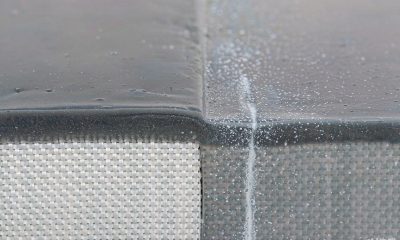
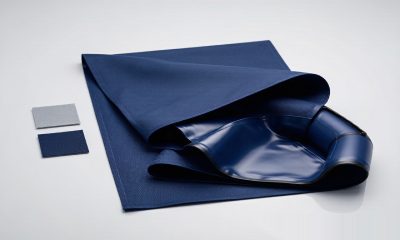
PVC-coated polyester is a composite: a woven scrim, PVC paste, plasticiser, stabilisers and often a surface lacquer or PVDF topcoat. Recycled content can enter through the polyester yarn, through reclaimed PVC in the compound, or both. Those two routes have very different implications. Recycled PET yarn is a mature, traceable stream. Reclaimed PVC in a coating formulation raises questions about legacy additives that a chain-of-custody certificate does not answer — precisely the gap GRS itself acknowledges. A buyer sourcing tarpaulins for a food, pharmaceutical or children’s application should therefore treat GRS documentation as one layer of due diligence, alongside a declaration against the applicable REACH restriction list and a full formulation disclosure where the application requires it.
The same discipline applies to recycled-content marketing on truck curtains, inflatables and architectural membrane. Ask which component carries the recycled percentage. A cover described as 30% recycled may mean the scrim only, with a virgin PVC coating, or a blended compound. Both statements can be truthful and they are not equivalent.
The Materials Matter Standard transition
GRS is not being abolished overnight, but it is being folded into a broader framework. Textile Exchange says the Materials Matter Standard becomes effective on 31 December 2026 and covers recycled materials currently addressed by both GRS and the Recycled Claim Standard. From that date, eligible organisations may be audited to MMS or continue under the current standards. All claims and labels must be to MMS by 30 June 2029. For a multi-year supply agreement signed now, the sensible move is to ask the certification body how an existing GRS certificate will map into MMS, rather than assume continuity.
Three schemes often appear on the same quotation, and they are not interchangeable. EN 15343 is the European standard most relevant where a buyer needs plastic-tax relief in Spain or similar fiscal treatment, and covers PVC along with other packaging polymers. GRS is the Textile Exchange voluntary standard with social and environmental criteria. UL 2809 is a third-party verification service from UL Solutions, widely recognised in North America and built around mass-balance accounting. None of the three substitutes for a mechanical test report.
A verification checklist that works
- Name the fabric and the component. Recycled content in the scrim is not the same claim as recycled content in the coating.
- Request the percentage by mass and whether it is pre-consumer or post-consumer.
- Ask for the scope certificate number or TE-ID, the issuing certification body, and the transaction certificate reference for the specific batch.
- Check the edition — GRS-101-V5.0 after the 2026 mandatory date.
- Keep performance verification separate: mechanical, weathering and fire data on their own sheets.
Frequently asked questions
Does a GRS label mean the tarpaulin can itself be recycled?
No. GRS looks backwards at what a product was made from; recyclability looks forward at what can be done with it afterwards. A GRS-certified coated fabric may still be difficult to recycle because PVC coating and polyester scrim are hard to separate. Ask for the recycling route and its acceptance criteria separately.
Is 20% recycled content enough to print a GRS claim on the product?
No. Twenty percent puts the product inside the standard and permits business-to-business use of the claim with proper certification. Consumer-facing product labelling requires at least 50% recycled content by mass.
What happens to GRS certificates after the Materials Matter Standard starts?
From 31 December 2026, organisations may be audited to MMS or continue with the current standards during the transition. All claims and labels must be to MMS by 30 June 2029. Confirm the mapping with the certification body before signing a long-term supply contract.
Sources
- Global Recycled Standard (GRS) — current edition, thresholds and transition: https://www.theoutdoorlivinggroup.com/wiki/global-recycled-standard
- EN15343 / GRS / UL2809 comparison (2026 edition): https://www.sa8000cn.com/7054
- GRS certification timeline and 2026 Materials Matter context: https://en.sa8000cn.cn/article/412.html
- GRS scope certificate, transaction certificate and audit process: https://grs-certificate.com/news/2101.html