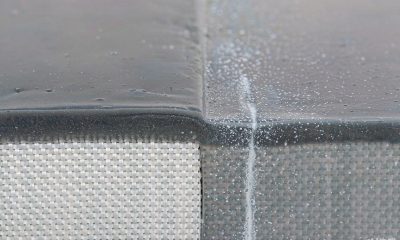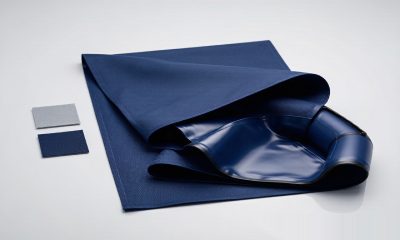
ASTM D2199-26, published on 1 November 2026, addresses a failure mode that rarely makes headlines but quietly ruins finished goods: plasticiser in a vinyl fabric migrating into a lacquer applied over it. The result is objectionable marring and softening of the coating. If your product combines a PVC-coated textile with a printed or lacquered surface — a graphic panel, a laminated trim, a coated enclosure — this standard belongs in the specification, not in the post-mortem.
What D2199-26 actually measures
The standard covers an accelerated test for measuring the tendency of plasticisers in finished vinyl fabric to transfer to coatings with which they come into contact. It is a tendency test, not a pass/fail material grade. Values stated in SI units are regarded as standard; figures in parentheses are for information only. The responsible committee is D01.55, and the classification falls under ICS 87.040, coatings and paint industries — a useful reminder that the standard was written from the coating side of the interface.
Note 1 deserves more attention than it usually gets. The age of the fabric sample may affect the result, and the most reliable test uses a sample as close as possible in age to the fabric that will actually be coated. A laboratory order placed months before production, using a freshly made reference roll, can produce a reassuring number that the real production batch will not repeat. Specify the age or batch of the sample alongside the test method.
The significance section is equally direct: plasticisers in finished vinyl fabric can transfer to contacting coatings, and when that happens the coating may show marring and softening. That is the whole point. The test does not tell you whether the vinyl fabric is strong, weatherable or flame retardant. It tells you whether it is likely to attack what you put on top of it.
Where migration shows up in practice
- Printed banners and wraps where a lacquer or varnish sits over a PVC-coated substrate.
- Vehicle interiors and equipment enclosures where a coated fabric touches a painted surface for long periods, often warm.
- Laminated assemblies combining PVC film, adhesive and a second coating, where the adhesive layer is the weak link.
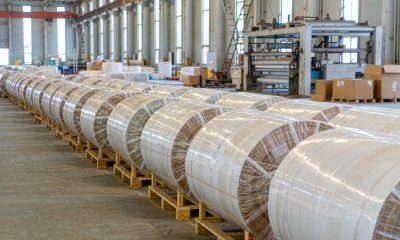
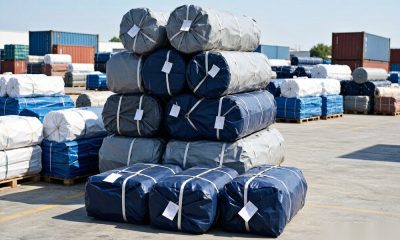
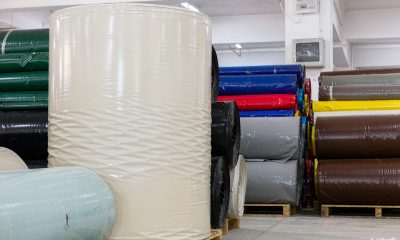
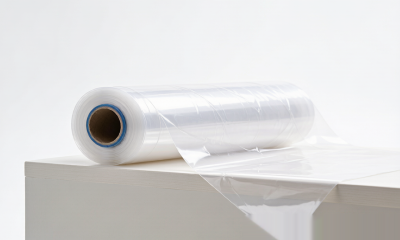
- Stored rolls where protective wrap contacts the PVC surface over a summer.
Heat accelerates the mechanism, which is why an accelerated test exists at all. A product that looks fine in a climate-controlled showroom can mark a lacquer after a container voyage or a season in a hot warehouse. This is also why the test result should be read as a compatibility signal between two specific materials, not as an intrinsic property of one.
Pair it with cold-flex data, not instead of it
Plasticiser choice governs both migration tendency and low-temperature flexibility, and the two pull in different directions. Field guidance on PVC fabric in cold weather makes a set of points worth repeating. Increasing plasticiser content does not automatically improve every property; compatibility, migration resistance, long-term durability and processing stability all have to be balanced. A stronger polyester reinforcement does not by itself stop the PVC coating cracking in cold conditions, because the coating and textile must stay compatible under deformation. Coating thickness alone cannot establish cold resistance, and the coated-versus-laminated route alone does not determine which grade performs better.
Two standard methods are commonly cited. ISO 4675:2017 specifies a low-temperature bend test for rubber- or plastics-coated fabrics, and ISO is explicit that passing the method does not establish a universal relationship with service performance. ASTM D2136-19(2026) similarly evaluates the ability of coated fabrics to withstand bending at a specified low temperature. Both are useful when the test conditions resemble the finished product’s actual deformation. Neither establishes the lowest temperature at which the fabric can necessarily be used.
That last distinction drives a practical recommendation: test the finished article. A truck curtain has welded seams, reinforced edges, eyelets and fixing points, plus areas of repeated movement. A flat-fabric cold-bend result does not cover those stresses. Ask for the intended bend radius, the handling frequency and the joining performance of the selected material.
The wider 2026 standard picture
D2199-26 was not the only revision dated 1 November 2026. ASTM D4157-13(2026), the oscillatory cylinder abrasion method for woven textiles, was published the same day. Its scope notes that abrasion depends on fibre mechanics, yarn structure, fabric construction and the type and amount of finishing materials — and that test conditions including abrasive nature, specimen tension, pressure and size changes heavily influence results. Abrasive must be replaced frequently or checked at defined intervals. For a coated fabric buyer, the lesson is the same as with migration: a number without stated conditions is not a specification.
In the coated-fabric mechanical space, ASTM D751-26 remains the umbrella document with roughly 27 procedures. Its sections were renumbered relative to earlier editions, so a drawing calling out a D751 section number needs to name the edition it was written against. Conditioning under D1776 is 21 °C and 65% relative humidity, not the 23 °C / 50% plastics atmosphere often quoted online.
A short specification checklist
- Cite the edition: D2199-26, not simply D2199.
- State which coating or lacquer the vinyl fabric will contact.
- State the fabric batch or age used for the sample.
- Add a cold-flex method matched to the service condition, with the temperature and bend radius written down.
- Require finished-product testing where seams, eyelets and repeated folding matter.
Frequently asked questions
Does passing ASTM D2199-26 mean a vinyl fabric is safe for any coating?
No. It measures the tendency of plasticiser transfer in an accelerated test between specific materials. It does not rate the fabric’s strength, weathering or flame performance, and it does not establish universal compatibility with every lacquer. Keep the result tied to the coating system actually used.
Why does the age of the sample change the result?
The standard’s Note 1 says sample age may affect the test and recommends testing fabric as close as possible in age to the material that will be coated. Plasticiser distribution and surface condition change with time, so a fresh reference roll can flatter the result.
Is a low-temperature bend test enough to claim a fabric works at minus 30 degrees?
No. ISO 4675 and ASTM D2136 evaluate bending under defined conditions, and ISO states that a pass does not establish a universal relationship with service performance. The finished construction — seams, edges and fixing points — should be evaluated at the intended bend radius and handling frequency.
Sources
- ASTM D2199-26 standard record and scope, published 1 November 2026: https://ndls.cnis.ac.cn/standard/detail/94495501e6ef299ae4a42971f4957dea
- ASTM D4157-13(2026) standard record, published 1 November 2026: https://ndls.cnis.ac.cn/standard/detail/11060de85325f6b11bb44ca3a39df1bf
- PVC fabric cold-weather performance, ISO 4675 and ASTM D2136 guidance: https://lonatarp.com/pvc-fabric-cold-weather-performance/
- ASTM D751-26 procedures, edition renumbering and D1776 conditioning: https://www.universalgripco.com/astm-d751