Two new highway geosynthetics rules are in force: one covers use, the other testing
China’s Ministry of Transport issued JTG/T 3332-2026, Technical Specifications for Application of Geosynthetics in Highway, on 24 April 2026, effective 1 July, replacing JTG/T D32-2012. Its companion mandatory test code JTG 3460-2026 became effective on 1 August, replacing JTG E50-2006 after nearly twenty years. For teams buying geomembranes, composite geomembranes and waterproofing boards, this is not advisory reading: after 1 August, test commissions and acceptance reports built on the old code are methodologically obsolete.
Anti-seepage: the two-fabric-one-membrane build-up
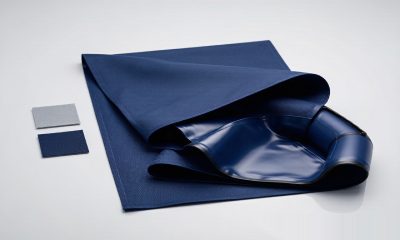
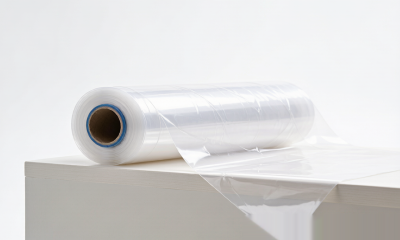
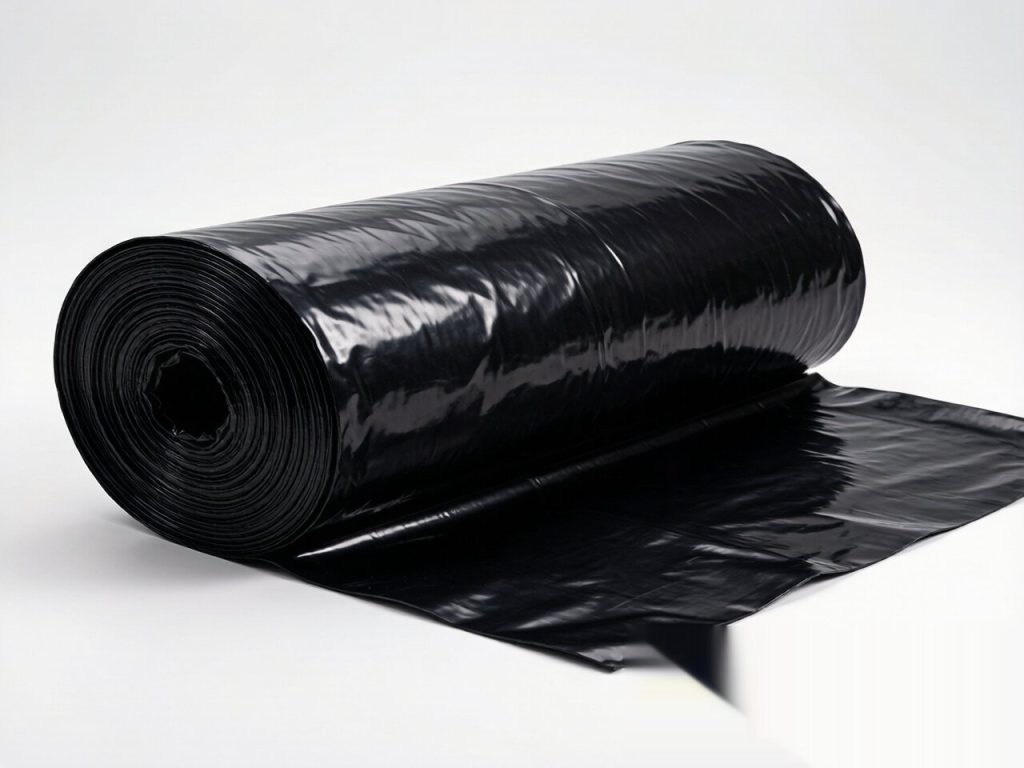
Section 5.3 covers central median anti-seepage, drainage-structure anti-seepage, lower shoulder anti-seepage and subgrade isolation, and recommends a composite geomembrane with fabric on both faces because a bare membrane is easily damaged by construction and fill. The suggested specification is fabric/membrane/fabric = 200 g/m² / 0.5–1 mm / 200 g/m²; shoulder applications may use 0.3 mm. General subgrade isolation requires at least 0.3 mm and important works no less than 0.5 mm. Backfill in direct contact must not contain large angular stones, and a 20–50 mm cement-mortar levelling course may be laid first.
Reduction factors: nominal strength is not design strength
The most consequential change is in reinforcement design: design tensile strength equals ultimate tensile strength divided by a total reduction factor RF covering creep (RF_CR), ageing (RF_D) and installation damage (RF_ID), with RF recommended at 2.0–5.0. A product with 100 kN/m nominal strength may therefore have a design value of only 20–50 kN/m. The same logic is useful when specifying coated fabrics: passing a single tensile test says little about delamination under repeated loading.
- Overlaps: at least 30 cm on level ground, 50 cm on slopes, 100 cm on very uneven surfaces.
- Laying: align with the force or flow direction, work bottom-up on slopes, keep natural slack, cover promptly to limit UV exposure.
- Anchorage: cut a crest anchor trench at least 50 cm deep and embed the toe at least 80 cm.
- Acceptance: at least 95% pass rate on key measured items, placement tolerance ±50 mm, overlap tolerance −20 mm.
Testing has a new ruler
JTG 3460-2026 changes conditioning to 20±2°C and RH 65±5% for at least 24 hours for geotextiles, versus four hours at 20±2°C for plastics; equivalent opening size is now run on a single specimen across multiple particle sizes; and durability items such as carbon-black dispersion, low-temperature embrittlement, Vicat softening and oxidation induction time have been added. The commentary includes a useful figure: a dimpled drainage board loses about 50% of its flow capacity at 40% curvature and about 60% at 50%, which is the quantitative reason the code discourages bending drainage materials. Statutory test reports must come from a CMA-accredited body working within its accredited scope.
What this means for PVC-coated fabric buyers
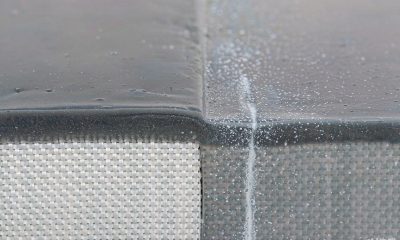
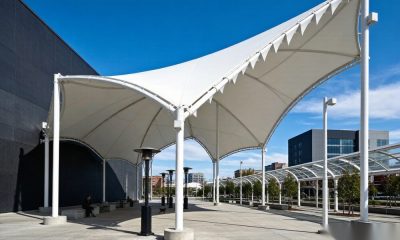
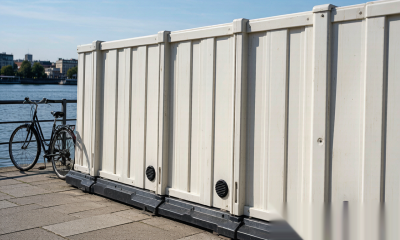
Highways are not the main market for PVC-coated fabric, but the procurement language is worth borrowing: select by environmental zone (polyester is alkali-sensitive; PE and PP need adequate UV stabilisation), derive strength after reduction factors, and keep traceable records through the whole process. For PVC-coated fabric used in temporary site fencing, drainage-channel lining and flood covers, suppliers should be able to offer third-party reports prepared under JTG 3460-2026 sampling and conditioning rather than a factory sheet alone.
Market direction
The tenth Asphalt Pavement Conference used the theme of safety, resilience, low carbon and new quality, with long-life pavement among its technical priorities. The codes’ emphasis on durability and process control squeezes small producers that cut cost with recycled feedstock and lack in-house testing, while rewarding integrated mills with full testing and site-service capability.
Sources
https://xxgk.mot.gov.cn/2020/jigou/glj/202605/P020260604409133489836.pdf | https://www.bzfxw.com/soft/sort025/daolu/1112865.html | http://mp.weixin.qq.com/s?__biz=Mzg5MzkyMjI5NQ==&mid=2247492540&idx=1&sn=0e1944cd9475ad9c13ed2135d8e8b233 | https://www.jiantongchina.com/news/companynews/164.html
FAQ
Is JTG/T 3332-2026 mandatory?
It is a recommended industry standard, effective 1 July 2026. The companion JTG 3460-2026 test code is mandatory and took effect on 1 August 2026.
What does 200 g / 0.5 mm / 200 g composite geomembrane mean?
Two 200 g/m² fabric layers with a 0.5 mm membrane between them. The code suggests 0.5–1 mm for median and drainage anti-seepage and permits 0.3 mm under the shoulder.
Why divide design strength by a reduction factor?
Because creep, UV and chemical ageing and installation damage degrade material in service. RF is set at 2.0–5.0, so a 100 kN/m product may be designed at 20–50 kN/m.