TL;DR — Core Answer
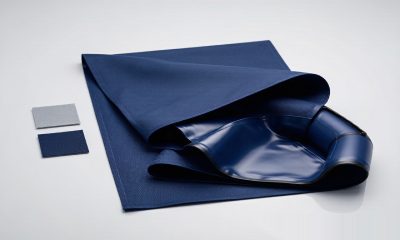
Two major regulatory shifts — California AB 1817 (effective January 2025, banning PFAS above 100 ppm in textiles) and the EU ESPR Digital Product Passport (DPP) (mandatory for textiles from 2027) — are fundamentally changing what it takes to sell PVC coated fabrics and industrial tarpaulins into the EU and US markets. For importers and converters, this means reformulating away from PFAS-based water-repellent treatments, documenting full supply chain traceability, and preparing digital carbon footprint data. The good news: our REACH-compliant PVC coated fabric product line already uses PFAS-free formulations and is fully auditable.
What Is California AB 1817 and Why Does It Matter?
Assembly Bill 1817 — signed into California law and effective January 1, 2025 — bans the manufacture, distribution, and sale of any textile article containing intentionally added PFAS (Per- and Polyfluoroalkyl Substances) above 100 ppm Total Organic Fluorine. This includes all textile products, from garments and outdoor gear to technical and industrial fabrics.
A narrow carve-out exists until January 2028 for PPE (Personal Protective Equipment) and “severe wet condition outdoor apparel,” but crucially, this exemption does not apply to industrial tarpaulins, geomembranes, or coated fabrics used in commercial applications. Any product used for truck coverage, warehouse protection, or agricultural pond lining must be PFAS-free today.
Why this matters globally: California is the 5th largest economy in the world, and AB 1817 creates a de facto national standard. Retailers and importers serving the US market will require PFAS-free certification across their entire supply chain, regardless of which state the end customer resides in.
EU ESPR Digital Product Passport: The 2027 Mandate You Cannot Ignore
The EU’s Ecodesign for Sustainable Products Regulation (ESPR) — formally Regulation (EU) 2024/1781, which entered into force July 2024 — mandates a Digital Product Passport (DPP) for all textile products placed on the EU market, starting from 2027. The DPP is a standardized digital identity for each product, accessible via QR or NFC scan, that must contain:
- Material composition — fibre percentage by weight, including all coatings and treatments
- Production origin — country of manufacture, key supplier names and addresses
- Environmental footprint — carbon footprint (CO₂e) per unit, calculated using verified LCA methodology
- Care and recycling instructions — specific to the material combination
- Repairability and durability claims — minimum guaranteed service life under stated conditions
- Compliance documentation — REACH, REACH Annex XVII, and any applicable harmonized standard test reports
Pilot implementation period runs through mid-2026. Companies that begin DPP development in 2026 will enter 2027 with validated data and integrated systems — those who wait will face rushed implementations, higher costs, and potential market access gaps.
Which PVC Coated Fabric Ingredients Are Now Restricted?
Beyond PFAS, several phthalate plasticizers once common in flexible PVC formulations face restrictions under EU REACH Annex XVII Entry 51 and related regulations:
| Restricted Substance | Use Case | EU Limit | Status |
|---|---|---|---|
| DEHP, DBP, BBP | PVC softener | 0.1% (1,000 ppm) | Banned in all consumer articles since 2015; industrial textiles compliance now enforced |
| DINP, DIDP | PVC softener (second-gen) | 0.1% in toys, childcare articles | Restricted in consumer; still permitted in industrial with traceability |
| PFOS, PFOA | Water-repellent treatment | 50 ppb total | Global phase-out; replaced by non-fluorinated alternatives |
| Microplastics | PVC coating fragments | REACH Annex XVII Entry 78 | 0.01% intentionally added; reporting obligation |
Our eco-friendly PVC material product line uses non-phthalate plasticizers (DINCH, citrate esters) and PFAS-free water-repellent treatments since 2024, pre-dating both AB 1817 and the DPP mandate.
How to Prepare for 2027 Compliance Without Rushing
The supply chain data requirements of DPP are substantial, but breaking the work into phases makes it manageable:
Phase 1 (Q4 2026 — Q1 2027): Supply chain mapping. Document every supplier, every input material, and every processing step. For converters importing from Asia, this requires working directly with manufacturers to extract resin batch records, coating formulation sheets, and waste treatment documentation.
Phase 2 (Q1 2027 — Q2 2027): Carbon footprint verification. Commission a third-party LCA (Life Cycle Assessment) for your core product lines. The EU recognizes ISO 14067 and GHG Protocol Product Standard as valid methodologies. Expect this to take 3-6 months for a comprehensive portfolio.
Phase 3 (Q2 2027 — Q4 2027): DPP system integration. Select a DPP platform that integrates with your ERP/PLM, generate QR or NFC identifiers for each SKU, and pilot with one EU retail partner before full launch.
Key action for importers right now: Schedule a compliance audit with your fabric supplier before purchasing 2027 inventory. The cost of non-compliance — product detainment at EU customs, forced recalls, and market exclusion — far exceeds the cost of proactive preparation.
US Section 301 Tariffs: An Additional Cost Headwind
While regulatory compliance is the primary focus, importers must also account for the structural cost pressure from US Section 301 tariffs. 25% duties on PVC resins and coated fabrics imported from China remain in effect as of 2026, with no near-term reduction scheduled. This makes compliance documentation doubly valuable: premium US and EU customers are increasingly willing to pay a 10-15% premium for products with verifiable supply chains, PFAS-free formulations, and complete traceability — effectively offsetting the tariff burden for suppliers who invest early.