Background: why sandbags fall short
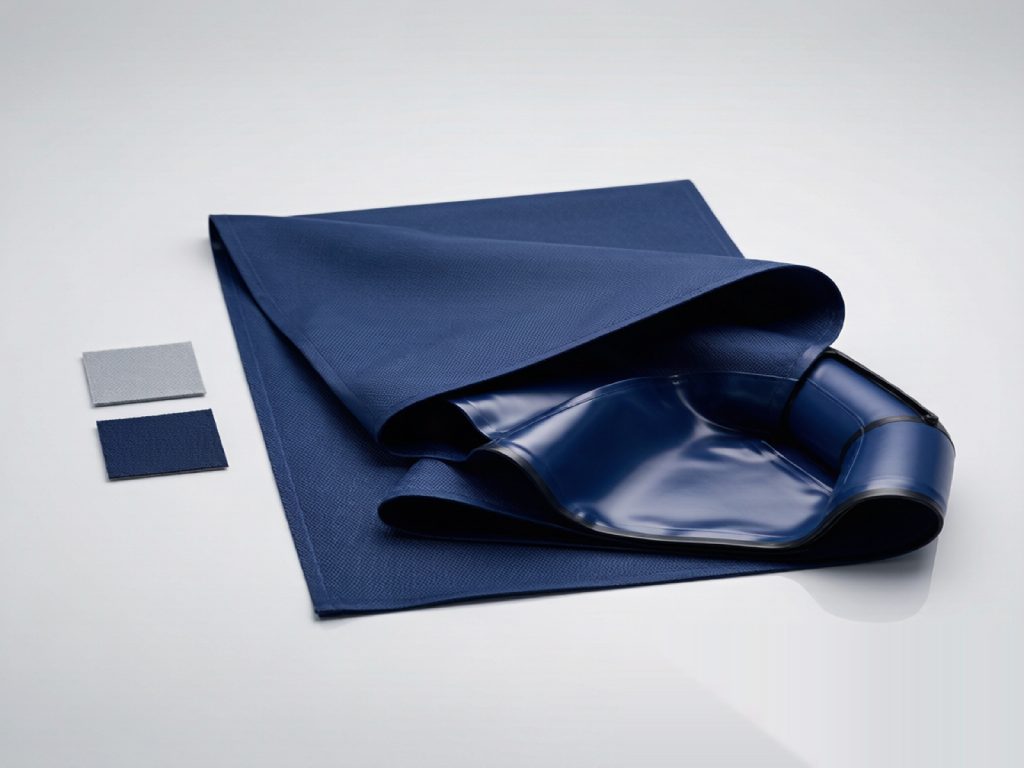
Traditional sandbags are slow to fill, labour-heavy, single-use and contaminate waterways. Facing urban flash floods, river works and mine impoundments, engineers are turning to inflatable / water-filled temporary barriers: heavy-duty PVC coated fabric made into flat-folding tube bags that are deployed on site, filled with water or air to take shape, ballasted by their own weight, then drained and folded away after use. Through 2026 several manufacturers pushed these products into municipal, emergency and industrial settings.
Technical principle: PVC coated fabric and HF welding
The barrier body is heavy-duty PVC knife-coated fabric (vinyl-coated polyester), with high-frequency (HF) welding for watertight, long-life seams. Hushine’s standard model uses 0.9 mm commercial-grade PVC tarpaulin, operating from −30°C to +70°C, height customizable 0.3–1.5 m, inflated by electric pump then filled with water for ballast (hushineinflat.com). Dertarpaulin’s Floodstop Barrier Dam offers 0.9 / 1.5 mm PVC, common size 24 in high × 600 ft long, 1.4 / 2.2 kg per metre, passing >1500 mm hydrostatic pressure, with over 3000 fold cycles and 24P eco-standard compliance (dertarpaulin.com).
Key engineering parameters: UV-resistant, mildew-proof, abrasion-resistant for desert and tropical climates; modular joining to suit uneven terrain and varying water levels; no heavy machinery and no substrate damage, ideal for emergencies. InflatableDams’ WF60-160 is a reusable vinyl-coated polyester cofferdam for river diversion, bridge/pipe works and dewatering; the WG15-200 is an adjustable-height water-gate barrier needing no tools, stable under any flow direction or slope (inflatabledams.com).
Application cases
- Hypersaline mine water management: Australia’s Greatland Gold Havieron gold-copper mine used Giant Inflatables’ FS500-100 water-filled barriers to raise a spillway by 0.5 m across 24 m, holding back wastewater 10× saltier than seawater with rock particles and chemicals — deployed before the wet season to prevent salt contamination of the surrounding ecosystem (giantinflatablesindustrial.com.au).
- Urban and municipal flood control: temporary water blocking and diversion for homes, warehouses, sites, riverbanks, roads and bridges.
- Construction cofferdams: dry work zones for river, pipeline, concrete and bridge maintenance.
Market and trends
Reusable, recyclable PVC inflatable barriers compliant with the 24P eco-standard are emerging as a light, low-cost alternative to concrete/steel gates across the Americas, Europe, the Middle East, South America, Africa and Asia. The driver is emergency procurement from more frequent extreme weather, plus municipalities’ preference for ‘rapid deploy, repeatable use’.
Selection checklist
- Check thickness and material: 0.9 mm general use; 1.5 mm knife-coated PVC for heavy-duty bridges and shorelines.
- Check welding: HF-welded seams, individually leak-tested before shipment.
- Check environment: confirm UV resistance, mildew-proofing, −30~+70°C range and hydrostatic pressure (>1500 mm).
- Check deployment: tool-free, modular joining, field-repairable wet or dry.
Material detail explains the performance. The tube wall is typically a polyester scrim laminated between two PVC layers, so it resists the corrosive, debris-laden water it is meant to hold back; UV stabilisers and fungicides let it sit in desert or tropical sun without rapid decay. Hydrostatic pressure rating, above 1500 mm in the Floodstop spec, confirms the seam-and-fabric system will not weep under head load, while a 3000-cycle fold rating proves it survives repeated deploy-store-deploy cycles rather than failing after one season.
Deployment reality favours the design. A trained crew can lay and fill hundreds of feet in a few hours; because the barrier is ballasted by the very water it blocks, it presses naturally against bed and banks and stays put without anchoring into structures. Field repair is possible wet or dry, and modular sections join to follow curved shorelines or variable water lines, far more adaptable than a rigid steel gate.
Model choice tracks the threat. Low 24-inch barriers suit residential and commercial perimeter protection; 36-inch units handle river diversion and pipeline works; 48-inch heavy-duty versions serve bridges, dams and shoreline restoration. Height, length and even connection systems are customisable per site drawing, so a flood plan can be pre-sized rather than improvised during an event.
The broader shift is from one-time sandbagging to a managed, reusable asset. Municipalities that buy a stock of these barriers treat flood response as a rehearsed logistics exercise, stage, deploy, recover, store, instead of a scramble for sand and labour. For mines and utilities, the same asset doubles as routine cofferdam during maintenance, amortising the cost across many jobs.
One procurement note: verify the fabric is reusable and recyclable and meets the 24P eco-standard, and confirm individual leak-testing of welds before shipment. Those two checks separate a barrier you can trust in a real flood from a cheap imitation that fails under load.
Used correctly, a PVC inflatable barrier turns flood defence from a disposable, labour-intensive chore into a repeatable, lower-cost operation, exactly what climate-volatile 2026 demands.
Frequently asked questions
Q1: How are inflatable barriers better than sandbags?
A1: Deployed in minutes, no sand or heavy equipment, drained and folded for reuse — lower long-term cost and far higher emergency efficiency.
Q2: Can they hold against fast currents?
A2: They can be specified for both static and flowing water; ballast weight presses them against bed and banks, staying stable without disturbing the substrate.
Q3: Are PVC barriers eco-friendly?
A3: Choose reusable, recyclable products compliant with the 24P eco-standard — they are used repeatedly and cut single-use waste.