Background: Why plasticizers became the focal point of PVC coated fabric
PVC is hard and brittle on its own; it only becomes a flexible, weldable coated fabric after plasticizers are added. For decades the dominant chemistry was ortho-phthalates — DOP, DINP, DEHP — cheap and easy to process, but now under global pressure because of endocrine-disruption concerns and their persistence in the environment and human body. The EU’s REACH regulation lists several phthalates on its SVHC candidate list, the US CPSIA restricts phthalates in children’s products, and automotive interiors must also pass the Ford-SAE J 1756 fogging test. For export-oriented PVC coated composite makers, the plasticizer is no longer a hidden formulation variable — it is the gatekeeper for entering high-end European and North American markets.
Technical principle: plant-based feedstocks and renewable-carbon mass balance
Next-generation plasticizers split into two routes. The first is bio-based feedstock substitution: green plasticizers made from renewable vegetable methyl esters via chlorination, escaping petroleum dependence at the source. India’s Shivtek Spechemi markets Shivachlor™ Green Pro as the country’s first green biodegradable plasticizer, in M1 (20% chlorination) and L2 (30% chlorination) grades, explicitly phthalate-free, non-toxic and biodegradable, with ISO 9001:2015 and ISO 14001:2015 certification (shivtekspechemi.com/products/green-pro).
The second is renewable-carbon mass balance. INOVYN’s BIOVYN™, in commercial production since 2021, is billed as the world’s first bio-attributed PVC; it is RSB-certified at 100% renewable feedstock substitution and claims over 90% greenhouse-gas savings versus conventional PVC. Pair the PVC with Perstorp’s Pevalen™ Pro 100 and the plasticizer is 100% renewable or recycled carbon, ISCC PLUS certified, with roughly 80% lower cradle-to-gate carbon footprint. Perstorp’s sibling Pevalen™ Pro 36 carries 36% renewable carbon (ISCC PLUS) and a product carbon footprint of 1.8 kg CO₂eq/kg, classified as non-VOC under EU 2004/42/CE (perstorp.com datasheet, effective 2026-04-21). Cargill’s Syncroflex™ and Vikoflex™ ranges claim up to 100% bio-based carbon, zero phthalates, plus ultra-low viscosity and minimal migration — suited to automotive upholstery and outdoor coated textiles (case reprinted at citrateplasticizer.com).
Application and case study: from rainwear to car interiors
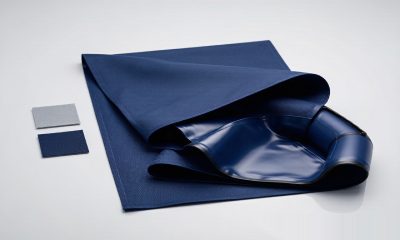
Swedish rainwear brand Farmerrain puts both ingredients together in its Biovinyl+ material: BIOVYN™ PVC plasticized with Pevalen™ Pro 100. Per the case study published 2026-08-26, the fabric delivers a water column above 20,000 mm, welded seams, no surface coating to wear off, and retained properties down to −30°C, with zero phthalates and zero PFAS. A third-party-verified EPD (ISO 14025, no. EPD-IES-0005125, reviewed by Sweco) puts a single sailing jacket at 5.82 kg CO₂e cradle-to-grave, 88% bio-based PVC and 12% recycled PET backing (farmerrain.com/en/biovinyl).
At the industrial level, phthalate-free plasticizers now serve synthetic leather, flooring, wire and cable, automotive interiors and coated fabrics. BASTONE’s technical note recommends TINTM (trimellitate, heat resistance to 150°C, heating loss ≤0.15%), DEHCH (fully hydrogenated, 0.00% phthalate, faster fusion saving energy) and DOTP as non-phthalate options built to clear REACH, RoHS and CPSIA (bastone-plastics.com).
Market and trends
Sustainable plasticizers are moving from niche to mainstream, driven by three forces: tightening regulation (the 29th REACH SVHC update keeps widening restricted substances), brand-net-zero commitments pushing supply chains toward traceable, EPD/ISCC PLUS-backed feedstocks, and rising buyer willingness to pay for ‘phthalate-free’ and ‘vegan’ labels. For PVC coaters, switching plasticizer systems usually means only minor recipe tweaks, not a retrofit of knife-coating lines — a relatively low barrier.
Selection checklist
- Demand certifications: prefer ISCC PLUS (mass balance), RSB (bio-based) and ISO 14025 EPD (carbon footprint) over vague ‘green’ claims.
- Check low-temperature flexibility: cold-region and outdoor use should confirm no cracking at −30°C, as in Pevalen Pro series testing.
- Check migration and fogging: automotive interiors must pass fogging (Ford-SAE J 1756) and migration; high-molecular-weight types like TINTM are steadier.
- Check compatibility: with existing PVC recipes and knife-coating/lamination; DOTP typically drops straight in for DOP.
Regulatory trajectory matters as much as chemistry. The EU SVHC list has been updated 29 times and several phthalates already sit on it; California and other jurisdictions keep tightening consumer-product limits. For a coater, the pragmatic move is a pilot: qualify one bio-based or non-phthalate plasticizer against the existing recipe, run migration (EN 15777) and fogging (Ford-SAE J 1756 for automotive) tests, then validate weldability and surface finish on the knife-coating line before a full switch. Because most non-phthalate plasticizers are drop-in at the molecular level, qualification is usually weeks, not a capital project.
One caveat buyers should watch: bio-based and biodegradable are not the same as low-carbon. A plasticizer can be plant-derived yet still carry a high processing footprint, so the credible signal is a third-party EPD plus an ISCC PLUS or RSB certificate that quantifies renewable content and cradle-to-gate CO2e. Specifiers who ask for those documents up front filter out greenwashing and protect their own downstream compliance.
Frequently asked questions
Q1: Is bio-based PVC very different in performance from ordinary PVC?
A1: With BIOVYN™, only the feedstock switches to renewable carbon under mass balance; polymerization and final properties match conventional PVC, so waterproofing, weldability and weather resistance of the coated fabric are unaffected.
Q2: Are phthalate-free plasticizers much more expensive?
A2: Unit price is usually above DOP, but lower processing energy (e.g. DEHCH fuses faster) plus access to premium markets and avoided compliance risk often make it cost-effective at the order level.
Q3: How do I prove ‘truly phthalate-free’ to a customer?
A3: Ask the supplier for ISCC PLUS or RSB certificates, a third-party EPD, and SVHC/phthalate test reports for the specific grade — not just the product sheet.