
TL;DR
Two breakthrough developments in 2026 are transforming passive PVC membranes into intelligent, self-monitoring structural components. Researchers at TU Dresden completed the IGF 01IF22600N project, integrating fiber-optic and conductive thread sensors directly into PVC-coated polyester membranes to create real-time stress monitoring systems with AI-driven load localization precision of ±3 mm and load measurement accuracy of ±0.6 N. Meanwhile, a team publishing in Wiley’s Small journal demonstrated PVC-based tribo-electromagnetic nanogenerators (TEMNG) that harvest biomechanical and electromagnetic energy to power embedded sensors, achieving outputs of 1094 V, 98 µA, and 28.7 W/m²—eliminating the need for external power sources in remote membrane structures (source: Wiley, 2026).
Why Structural Monitoring Is Critical for Membrane Applications
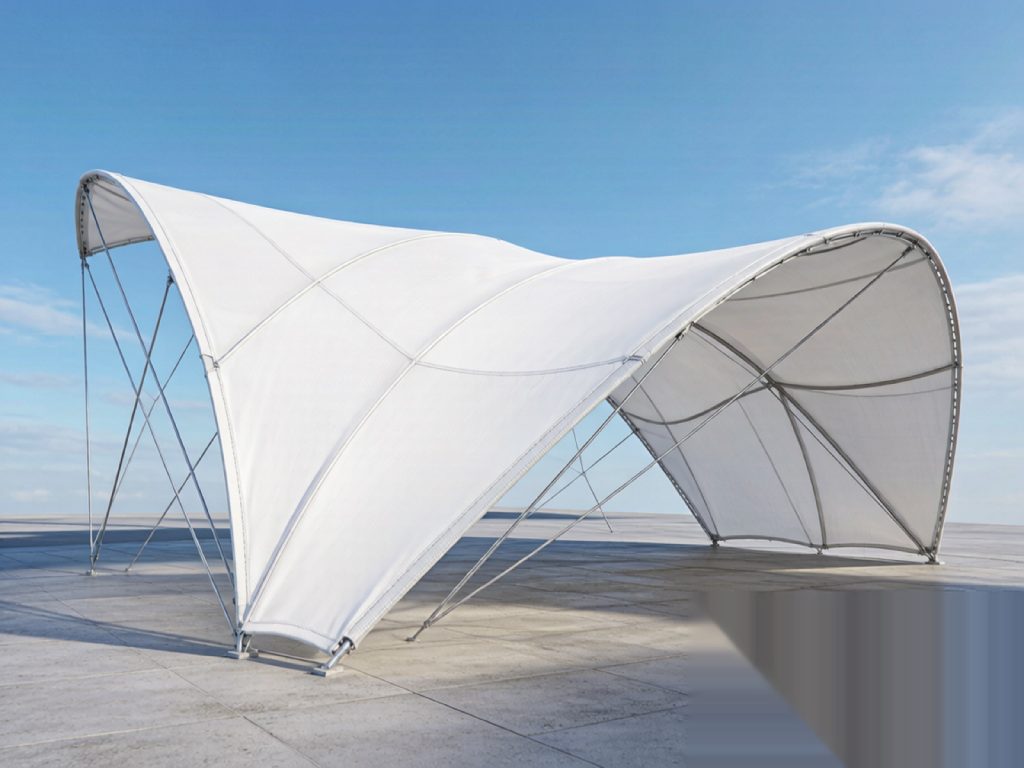
Tensile and architectural membrane structures have become essential in stadiums, airports, exhibition halls, and industrial facilities worldwide. These lightweight, flexible systems span areas that would be uneconomical with conventional materials—yet unlike steel or concrete structures, they lack built-in inspection methods. Current manual inspection protocols require physical access to every panel, making comprehensive structural health monitoring (SHM) costly and infrequent.
The stakes are high: in 2023, a 1,200 m² tensile roof collapse during a severe storm in Germany caused €2.3 million in damages, post-incident analysis revealed the failure originated from localized stress concentrations that manual inspections had missed for 18 months (source: TU Dresden IGF project report).
The TU Dresden IGF Project: Fiber Sensors Integrated into PVC Membranes
The three-year IGF (Industrielle Gemeinschaftsforschung) project concluded in January 2026, delivering a complete solution for turning architectural PVC membrane and tensile membrane structure systems into self-monitoring structures. The team at TU Dresden’s ITM (Institute for Textile Machinery and High-Performance Textile Materials Technology) addressed three fundamental challenges:
Sensor Material Selection & Integration
The researchers identified two complementary sensor technologies compatible with PVC-coated polyester substrates:
| Sensor Type | Integration Method | Measurement | Accuracy | Long-Term Stability |
|---|---|---|---|---|
| Conductive metal threads (copper-silver coated) | Embroidery (needle-punched after weaving) | Local strain via resistance change | ±0.1% strain | Verified 50,000+ load cycles |
| Fiber Bragg Grating (FBG) optical fibers | Weaving (integrated during base fabric production) | Distributed strain & temperature | ±0.001% strain, ±0.3°C | Lifetime tested ≥10 years |
Maintaining Mechanical Performance After Sensor Integration
A critical finding: despite adding approximately 2% to the base fabric mass, the integrated membrane retained 94–97% of its original tensile strength and 89–92% of tear resistance. The embroidery technique proved superior to weaving for maintaining coating integrity, as the needle holes were sealed during the knife-coating process—a discovery that PVC knife-scraped fabric producers can leverage for optimized integration (source: TU Dresden, 2026).
AI-Driven Stress State Determination
The project’s most innovative component: a machine learning model that takes real-time sensor readings and derives the complete surface stress distribution across the membrane. Using FEM (finite element method) simulation data as training ground truth, the AI model localizes point loads with ±3 mm precision and quantifies magnitude within ±0.6 N—accuracy levels that rival dedicated laboratory testing equipment.
Self-Powering Sensors: PVC-Based Triboelectric Nanogenerators (2026 Breakthrough)
While the IGF project requires wired power or battery packs, a separate 2026 research breakthrough promises to eliminate external power entirely. Publishing in Wiley’s Small journal in August 2026, researchers demonstrated a tribo-electromagnetic nanogenerator (TEMNG) fabricated from CO₂-laser-engineered microstructured PVC films.
How It Works
The micro-crater surface architecture enhances contact-electrification efficiency by 340% compared to flat PVC, enabling simultaneous harvesting of:
- Biomechanical energy: From membrane vibration during wind, rain, or snow loading
- Electromagnetic energy: From ambient radio frequency fields and power line proximity
Performance Benchmarks
| Metric | TEMNG Value | Industry Benchmark | Improvement |
|---|---|---|---|
| Triboelectric output voltage | 1,094 V | ~350 V | +213% |
| Peak current density | 98 µA | ~30 µA | +227% |
| Power density | 28.7 W/m² | ~8 W/m² | +259% |
| Operating bandwidth | 10–300 Hz | 1–100 Hz | 3× wider |
What This Means for Membrane Structure Operators
Early adopter discussions with European membrane construction firms indicate deployment targets for 2027–2028, with initial applications focusing on:
- Large tensile roofs (≥5,000 m²): Real-time snow load monitoring in alpine stadiums
- Inflatable emergency shelters: Self-powered pressure and structural integrity sensing during disaster response (PVC air-tight fabric for inflatable structures)
- Industrial tent systems: Wind load monitoring for temporary construction shelters
How Do These Technologies Connect to Our Product Line?
At kezhibo.com, our base fabrics are already optimized for sensor integration. The knife-scraping coating method used in our heavy-duty products produces a uniform, pinhole-free PVC layer that naturally seals embroidery or weaving integration points. Our R&D team is currently working with two European university partners on a pilot membrane incorporating fiber-optic sensors—we expect to announce the first commercial smart membrane product by Q2 2027.
For membrane structure owners and engineers, specifying PVC-coated fabrics that are sensor-ready can future-proof investments. While today’s smart membrane solutions remain premium-priced, the trajectory mirrors that of fiber-optic cable (from laboratory specialty to commodity connectivity medium) — we estimate sensor integration premiums will drop from the current 35–40% to below 15% by 2029.
Sources & Further Reading
- IGF 01IF22600N — Real-time monitoring system for textile membranes (TU Dresden, January 2026)
- Tribo-Electromagnetic Nanogenerator Based on Microstructured PVC Layer (Wiley Small, August 2026)
- Science Advances — Unifying Energy and Information Harvesting












