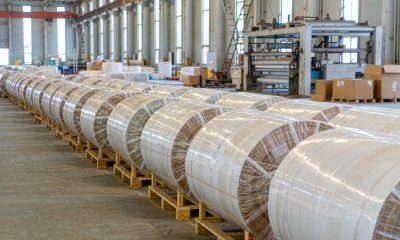
ITMA ASIA + CITME 2026, running 20–24 November at the National Exhibition and Convention Centre in Shanghai, fills seven halls with nineteen product categories across 180,000 square metres and more than 1,900 registered exhibitors. For the PVC coated composites sector the important story is not any single machine but two directions: PFAS-free functional finishing now comes with verifiable certificates, and digitalisation on coating lines has moved from display piece to live, linked system.
Scale and the German presence
The German Machinery and Plant Manufacturers Association (VDMA) brought 44 German exhibitors occupying about 2,200 square metres, making Germany the second-largest national presence after China and covering spinning, man-made fibres, nonwovens, weaving, knitting, finishing and dyeing, and textile processing. VDMA textilmaschinen chairman Dr Janpeter Horn framed the theme as leading textile technology tailored to customer success, emphasising partnership across the machine lifecycle from development to field service (Textile Economy Information Network, VDMA members at ITMA ASIA + CITME 2026).
PFAS-free finishing: from claim to certificate
Transfar Functional Chemicals, in Hall 5.1 booth F04, showed its ShieldTech Repel PFAS-free protection technology. Its TF-501M fluorine-free water repellent received what is described as the world’s first SGS No PFAS Detected Green Mark for a fluorine-free repellent; published performance is initial water-repellency grade 5, retaining grade 3 or above after 20 wash cycles. The company also presented bio-based oil with at least 20% bio-content and the LifeTech fabric-life platform (FCPP, Transfar exhibition profile).
That direction matches the EU PFHxA restriction and the REACH candidate-list trajectory. But a repellent’s application data is not automatically transferable: PVC coated fabric has different surface energy and plasticiser migration behaviour, so adhesion, wash durability and ageing performance need validation on the actual formulation.
Coating equipment: mixing, correction and twins
- Mixing and foaming — Hansa Industrie-Mixer. Senior sales manager Frank Mohr argues that final textile properties are often determined after spinning, weaving or knitting: in finishing, coating and functional treatment define surface character, durability, protection and hand feel. Precise mixing, metering and foaming are what make a formulation controllable and a process repeatable — a logic that applies equally to PVC paste coating.
- Inline quality — Mahlo. Sales director Thomas Höpfl points to real-time process intelligence, automatic correction and continuous optimisation as tools to cut waste from the first metre and improve consistency. On wide coating lines, inline basis-weight and thickness control directly determines offcut rates.
- Process engineering — Monforts. Managing director Volker Gingter says finishing needs tailored technology to produce higher-value fabric while saving energy and cost. Its Advanced Textiles Center (ATC) runs fabric trials under real production conditions, moving commissioning risk upstream.
- Digital twin — CHTC Fong’s. In Hall 7 booth C37 the company debuted a digital twin system: visitors could view live machine parameters and even operate equipment remotely. Its SmartCentre control system integrates Fong’s dyeing machines, Goller washing ranges and Monforts tents, with industrial data interfaces for ERP and MES. A high-temperature stenter with coater was shown for air filtration, electronics, chemical corrosion protection, safety, aerospace and new energy (Textile Machinery, CHTC Fong’s at the show).
- Back-coating lines — MATALE. Hall 8.1 booth F12 focused on back-coating lines for carpet and artificial grass, covering secondary backing, foam coating, fibre binding and SBR coating, with gas, thermal-oil or steam heating. The equipment logic transfers to base-layer treatment in PVC coating composites (Matale, Meet MATALE at ITMA ASIA + CITME 2026).
What it means for buyers
Three changes belong in a 2027 supplier assessment form. First, PFAS-free finishing is shifting from whether it exists to whether a third-party certificate exists: name the certificate, issuer and validity in the enquiry. Second, coating uniformity depends on mixing and inline control, so audit the plant for measurement points and correction logs rather than laboratory samples. Third, digital twins and remote maintenance make machine data traceable, allowing buyers to request historical records of critical process parameters.
A caveat is warranted: the show presented equipment and chemical directions, not evidence that finished PVC coated fabric has switched wholesale to fluorine-free systems. Purchase decisions should still rest on test reports for the specific product.
FAQ
Can a PFAS-free repellent be applied directly to PVC coated fabric?
Not by assumption. TF-501M’s grade 5 initial rating and grade 3 after 20 washes are published for outdoor-apparel systems. PVC substrates contain plasticisers and have different surface energy and migration behaviour, so adhesion, wash durability and aged performance need separate validation on the target formulation.
What practical value does a digital twin give a buyer?
Mainly traceability. Systems such as SmartCentre allow authorised access to process parameters, machine status and maintenance records, helping a buyer confirm batch consistency, trace the source of anomalies and reduce disputes caused by verbal specifications.
How do we judge coating uniformity on a factory visit?
Look for inline measurement points, sampling frequency and correction records, then measure basis weight, thickness and peel strength on finished material from at least three positions. A laboratory sample cannot represent cross-direction and machine-direction variation on a continuous line.