
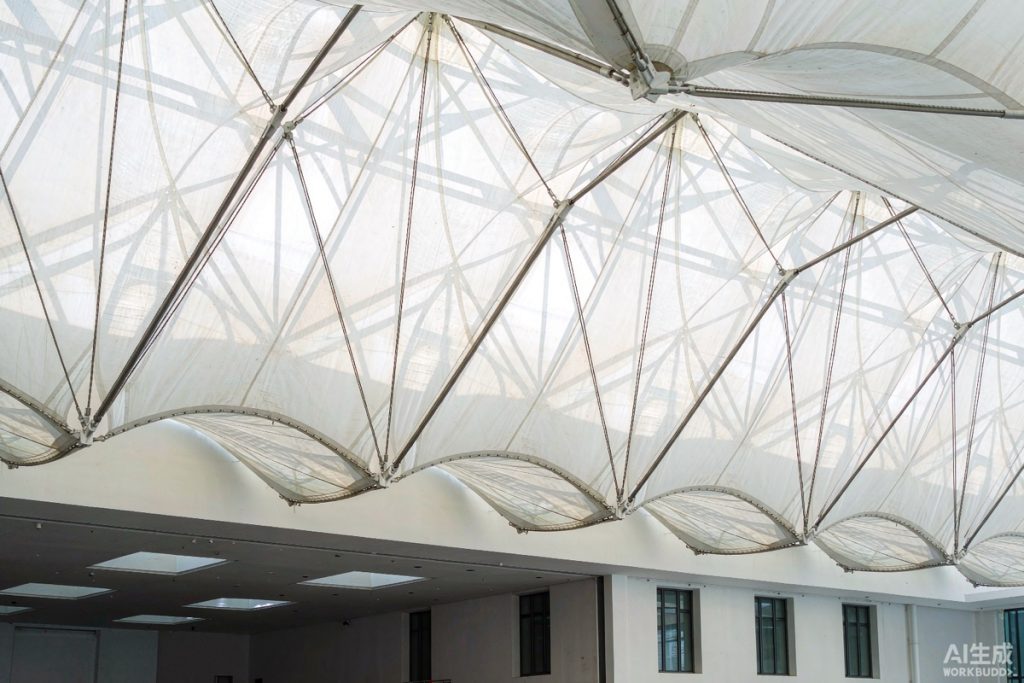
November 2026 has brought air-supported structures into several Chinese scenarios at once. On 16 November the foundation-pit air dome at the expansion of Jiangsu Provincial Maternal and Child Health Hospital was inflated and commissioned — Nanjing’s first construction-site air dome and Jiangsu’s first for a building foundation project. In early November Jiujiang’s workers’ air-dome gym entered its final equipment installation, with basketball, badminton and pickleball courts planned for a month-end opening. In Handan, the Huixinwan air-dome gym completed its lift, using one blower set to serve two domes (https://www.xhby.net/content/s6afd9660e4b05bfe6eb694f7.html; https://jj.jxnews.com.cn/system/2026/11/06/031283575.shtml). Together they show the technology has moved beyond “alternative sports hall” into routine use for construction dust control and the retrofit of underused urban space.
What holds an air dome up
An air dome is an air-supported structure: one or more layers of specially coated PVC fabric form the envelope, and a slight pressure difference against outside air holds the shape, with no internal columns. The membrane specification usually reads PVC with a PVDF topcoat — polyester scrim carries load, PVC supplies flexibility and a weldable surface, and PVDF handles outdoor weathering, self-cleaning and appearance. Commonly quoted figures include natural light transmission up to about 25%, installation around 15 days, capital savings of 25–40% against conventional buildings, and the ability to dismantle and reuse modules elsewhere (https://www.warehousestructure.com/air-dome/).
Treat wind claims with care. One supplier advertises resistance to category-5 typhoons but states the precondition that all systems remain in normal operation, and stresses numerical wind-tunnel form-finding and load calculation at the design stage (https://b2b.baidu.com/land/9b2c2e9230133efe7bd66a91fe54e1b5). Safety comes from the integrated design of fabric strength, cable net and anchorage, blower redundancy and pressure control — not a single number on a datasheet.
Sports halls: clear height and column-free space sell the system
Air-dome tennis and basketball halls are mature in China. A November 2026 project overview gives comparable data: a full basketball court generally needs over 7 m clear height and tennis around 10 m, while air domes commonly reach 11–12 m. Completed cases include Zhengzhou Fengle tennis hall at 2,420 m², Tangshan Huahai tennis centre at 8,000 m² with ten indoor courts, Taiyuan Greenbelt sports park hall at 1,980 m², and a 12 m-high basketball hall at 1,722 m² (https://www.163.com/dy/article/LBRO7L1Q0538J4R9.html).
The selection logic is straightforward: membrane panels are prefabricated and installed on site, with inflation typically taking tens of days, and the per-square-metre advantage over steel grows with span. Steel still wins for permanent buildings, heavy loads or special hanging requirements. Rooftops, soft ground and tight sites are where the low self-weight of a membrane structure becomes decisive.
Foundation-pit domes: crossing over to construction
The Jiangsu project matters because of the switch in application. A foundation-pit air dome over a building site primarily addresses dust and noise; reporting notes that Jiangsu’s first fully enclosed pit dome, built in 2025 at the Ningyang intercity rail site in Yangzhou, achieved complete dust and noise control while shortening the schedule. The same report lists a 2,500 m² air-dome sports hall in Lianyungang in September 2026 with nine badminton and six pickleball courts, rooftop air-dome halls in Wuxi, and a distributed PV project on more than 270,000 m² of air-dome roof at Changzhou’s Lu’anzhou terminal (https://www.xhby.net/content/s6afd9660e4b05bfe6eb694f7.html).
Compared with sports halls, a construction pit dome asks different things of the membrane: dust sealing, repeated installation cycles, tear resistance and erection speed matter more than light transmission or precise temperature control. Buyers should not simply copy a sports-hall specification.
One blower for two domes: running cost becomes the differentiator
The Handan project is instructive. A conventional layout gives each dome its own blower system, doubling equipment, energy and maintenance. By optimising air routes and intelligent controls around the two domes’ layout and pressure parameters, the project uses one blower set with regulated distribution while holding both domes at stable pressure, reducing capital outlay, power consumption and later maintenance (https://xidemojiegou.com/index.php?a=show&c=index&catid=18&id=179&m=content). The lesson for buyers is to compare not just membrane price per square metre but blower power, redundancy and annual operating cost.
FAQ
How long does the PVC/PVDF membrane in an air dome last?
Suppliers commonly quote over 30 years, but real service life depends on UV exposure, acid rain, mechanical abrasion and tensioning history. Put warranty duration, topcoat system and periodic inspection requirements in the contract rather than relying on a headline figure.
Can an air dome really withstand a category-5 typhoon?
That claim carries conditions: design, anchorage, cable net, blower redundancy and pressure control all have to be functioning. Ask the designer for wind-tunnel form-finding and structural calculations for the specific site instead of citing a generic claim.
Can a pit dome use the same membrane as a sports hall?
The structural principle is the same but the priorities differ. Sports halls optimise light, climate control and clear height; pit domes optimise dust sealing, tear resistance, repeated handling and erection speed. Specify to the application.











