
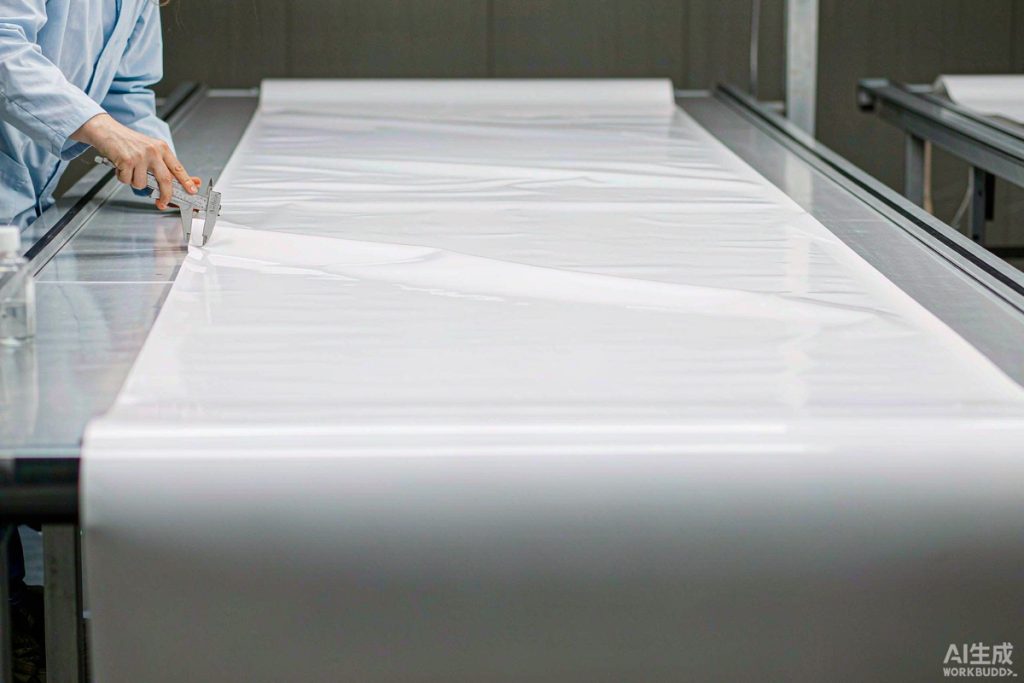
Which Chinese standards actually apply to a PVC banner fabric roll?
Three Chinese standards answer three different questions for banner material, so a buyer should not treat a single certificate line as covering all of them: one addresses coated fabrics for decorative use, one addresses flexible laminated lightbox banner cloth, and one addresses the burning-behaviour classification of building materials and products used in a public display.
- GB/T 28463-2012 is listed as the standard for decorated coated fabrics in the banner product-line test section (KB2, 3.4).
- T/ZZB 0976-2019 is listed as the standard for flexible laminated lightbox advertising banner cloth (KB2, 3.4).
- GB 8624 is listed for the burning-behaviour classification of building materials and products, with B1 and B2 grades (KB2, 3.4).
How should a banner grade be read against the model weight table?
The model table ties a nominal weight to a specific scrim construction, thickness, width and tensile range, so a grade name is shorthand for a whole row rather than a stand-alone number; a specifier should confirm the delivered weight and construction against that row and keep the printable-face type separate from the mechanical data.
- The banner parameter table lists a 280 g lamp cloth at 200D x 300D 18×12, 0.26 mm, 1.02-3.2 m width and 320-500 N/5cm tensile, and a 440 g lamp cloth at 300D x 500D 18×12, 0.38 mm and 500-900 N/5cm (KB2, 3.3).
- A 580 g lamp cloth is listed at 500D x 500D 9×9, 0.45 mm, 1.02-2.5 m and 900-1100 N/5cm; a 900 g knife-coated grade is listed at 0.55 mm and 3800/3600 N/5cm tensile (KB2, 3.3).
- Product-line rows separate frontlit, backlit and blockout constructions, with a standard frontlit grade at 440 gsm and mesh banner at 270-280 gsm on a 1000D 9×9 perforated scrim (KB1, 3.3).
Why must the fire class be quoted with its own classification system?
Fire classes belong to separate national systems, so a B1 written under a Chinese building-material standard and a B1 written under a German test standard are not the same claim; the submittal should name the system, the full grade string and the test method, then confirm which one the authority at the installation address actually requires.
- GB 8624 is the Chinese burning-behaviour classification with B1 and B2 grades, while DIN 4102-1 B1 is the German system and NF P 92-507 M1/M2 the French one (KB2, 3.4; KB1, 2.3).
- EN 13501-1 uses an A1-F plus smoke and droplet string, and NFPA 701 is a US vertical flame-propagation pass or fail test (KB1, 2.3).
- Public-space fabrics in the United States point to NFPA 701 under the IFC, while EU displays point to EN 13501-1 with B or C-s2,d0 classes (KB1, 3.3).
What should a banner verification report set include before a bulk order?
Request a lot-identified report set that names the applicable standard for each property, the grade and its scrim construction, the mass and tensile results, the ink route and the full fire-class string; a single pass statement hides the fact that printability, mechanics and flame spread are measured by different methods with different units.
- The kezhibo standards table lists GB/T 3923.1 tensile, GB/T 3917.3 trapezoidal tear, GB/T 5455 vertical flame spread, GB/T 8427 xenon-arc ageing and GB/T 2791 peel (KB2, 1.6).
- Mass per unit area is measured by EN ISO 2286-2, tensile by ISO 1421, tear by DIN 53363 or ISO 4674, peel by ISO 2411 and light fastness by ISO 105-B02 (KB1, 2.2).
- Ink compatibility is a separate selection item: solvent, eco-solvent and UV-curable inks are listed for knife-coated banner cloth, so the print process belongs on the submittal (KB2, 3.2).
FAQ
Do GB/T 28463, T/ZZB 0976 and GB 8624 cover the same thing?
No. In the kezhibo banner product-line test section they answer different questions. GB/T 28463-2012 is listed for decorated coated fabrics, T/ZZB 0976-2019 for flexible laminated lightbox advertising banner cloth, and GB 8624 for the burning-behaviour classification of building materials and products with B1 and B2 grades. A submittal that names only one of them leaves the other two unverified. Ask the supplier to map each property on the report to the standard that governs it.
Is a 440 g banner always the same construction?
Not necessarily. The kezhibo parameter table lists a 440 g lamp cloth at 300D x 500D 18×12, 0.38 mm thickness, 1.02-3.2 m width and 500-900 N/5cm tensile, while the product classification section records a standard frontlit grade at 440 gsm and backlit grades in the 440-680 gsm band. The number alone does not fix the scrim, the thickness or the printable face. Confirm the construction row and the face type together on the delivery note.
Can a B1 grade be quoted without naming the standard?
No. GB 8624 is a Chinese burning-behaviour classification with B1 and B2 grades, while DIN 4102-1 B1 is a German system and NF P 92-507 M1/M2 a French one; EN 13501-1 uses an A1-F plus smoke and droplet string and NFPA 701 is a US pass or fail vertical flame test. Writing B1 alone leaves the reader unable to tell which system was used. Quote the system, the full grade string and the test method together.
Which fire class applies to an indoor public display in the US?
The kezhibo knowledge base points public-space fabrics in the United States to NFPA 701 under the IFC, and lists EN 13501-1 with B or C-s2,d0 classes for EU displays. It also warns that indoor public displays often omit a flame rating and that rigid foam board in enclosed public spaces needs an FR grade. Confirm the required class with the authority having jurisdiction for the installation address before production, since the requirement is market-specific.
Why is ink compatibility listed separately from mechanical tests?
Because it describes a different failure mode. The kezhibo knife-coated banner section lists solvent, eco-solvent and UV-curable inks, and the banner product line warns that mismatching solvent and latex or UV inks, or using a backlit cloth in a frontlit position, are common errors. Tensile, tear and peel results say nothing about ink adhesion or colour holdout. Put the ink route and a printed-sample result on their own report line.
Which mechanical methods belong in a banner report set?
Use the standards table property by property: GB/T 3923.1 for tensile, GB/T 3917.3 for trapezoidal tear, GB/T 5455 for vertical flame spread, GB/T 8427 for xenon-arc ageing and GB/T 2791 for peel. Internationally, mass per unit area is measured by EN ISO 2286-2, tensile by ISO 1421, tear by DIN 53363 or ISO 4674, peel by ISO 2411 and light fastness by ISO 105-B02. Keep each method and unit on a separate line.
Does a mesh banner need the same checks as a solid frontlit banner?
No. The kezhibo classification records mesh banner at 270-280 gsm on a 1000D 9×9 perforated scrim for wind reduction, and warns that an underspecified mesh that ignores wind load is a common error. Air permeability under ISO 9237 is a different property from the liquid-barrier question. Keep the mesh wind-load assessment separate from the solid banner’s print and tensile checks rather than copying one report set onto the other.
What should be checked before releasing a bulk banner order?
Confirm the delivered roll matches the quoted grade and construction row, that a lot-identified report names the applicable standard for each property, that mass, tensile, tear and peel carry methods and units, and that the full fire-class string and ink route are stated for the destination market. The kezhibo selection framework ends with checking measured reports against the standards list, so a single pass statement or a bare grade name is not enough to release a delivery.












