
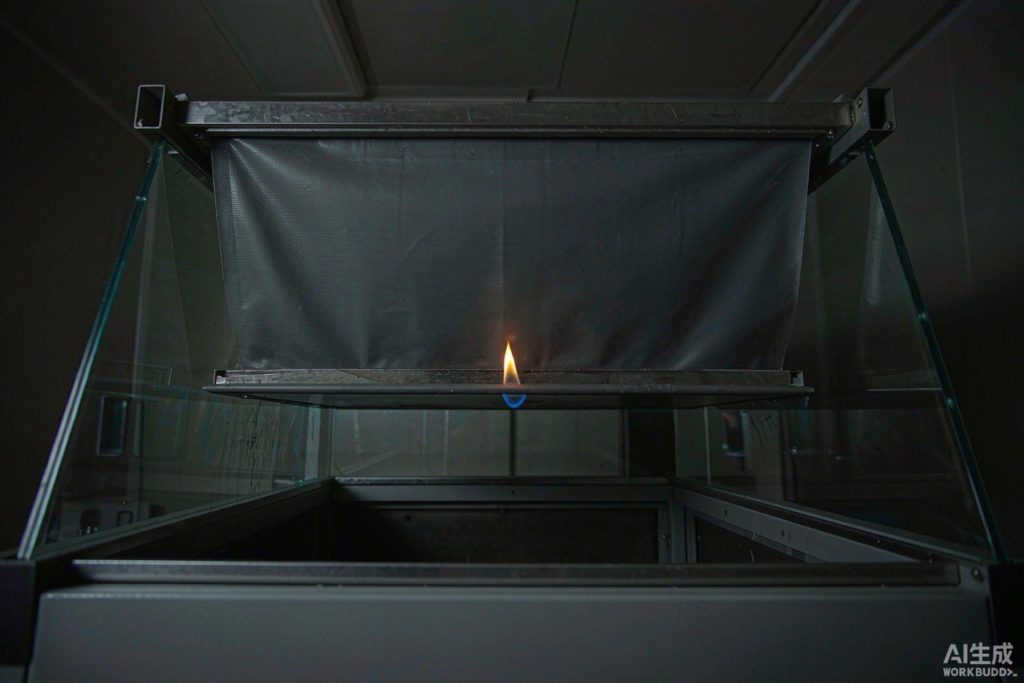
Why can a surface-applied flame-retardant finish lose effect after cleaning?
A surface-applied FR finish is a treated layer that cleaning and weathering can remove or degrade, whereas an inherent system is built into the compound itself; the knowledge base lists this contrast as a common selection error, so a buyer should ask how the rating was achieved and whether the burn test was repeated after cleaning and ageing exposure.
- The high-performance fabric section explicitly warns against using a surface-applied FR instead of an inherent FR because performance decays after washing (KB1, 3.1).
- CPAI-84 is listed with a base-fabric horizontal burn test and a tent-body vertical burn test measured after washing and after ageing (KB1, 2.3).
- The surface-treatment table records flame-retardant treatment as self-extinguishing to B1, M1 or NFPA 701, which are class strings from different systems rather than one universal result (KB2, 1.3).
Which test methods require a wash or ageing precondition before the flame test?
Durability is demonstrated by testing the material after a defined exposure rather than only in its new state, so the report should name both the precondition and the burn method; where the knowledge base records a standard that measures after washing and ageing, a fresh-sample-only flame result cannot stand in for the durability evidence the project needs.
- CPAI-84 is described as bottom-fabric horizontal and tent-body vertical burning tested after washing plus after ageing, and is noted as approximately equivalent to BS 7837 (KB1, 2.3).
- EN 15619:2014 is listed with mechanical classes F1-F3 and fire classes T1-T4, the latter assessed through EN 14115 (KB1, 2.3).
- UV and climate ageing methods listed include EN ISO 4892-2 and EN ISO 4892-3, and the knowledge base also cites EN 15619 annex A with a 2000 h exposure (KB1, 2.2).
Which fire-rating systems must not be mixed when quoting a class?
A flame rating is only meaningful inside the classification system that produced it, because EN 13501-1, DIN 4102-1, NF P 92-507, NFPA 701 and CPAI-84 use different scales, samples and pass criteria; a submittal should give the system, the complete class string and the test method, and confirm the required one with the destination authority.
- EN 13501-1 uses an A1-F class with smoke and droplet suffixes such as B-s1,d0, DIN 4102-1 uses B1/B2/B3, and NF P 92-507 uses M1/M2 (KB1, 2.3).
- NFPA 701 is a pass or fail vertical flame-propagation test, while CPAI-84 covers US tents and camping with horizontal and vertical components (KB1, 2.3).
- European truck side curtains point to EN 12641-2, EU event tents to EN 13782, and California tent rules to Title 19 section 332 referencing CPAI-84 (KB1, 3.2).
What should a buyer verify before accepting a flame-retardancy claim?
Require a lot-identified report stating whether the FR function is inherent or topical, the precondition applied before the burn test, the classification system with its full class string, and the destination-market requirement; the selection framework ends with checking measured reports, so a generic FR label without method, date and grade cannot release a delivery.
- Vertical flame spread is listed under GB/T 5455 and xenon-arc ageing under GB/T 8427 in the kezhibo standards table (KB2, 1.6).
- The selection framework ends with obtaining and checking measured reports against the standards list rather than quoting a specification range (KB1, 4, step 7).
- The knowledge base warns that FR not matched to local regulations is a common tarpaulin selection error, so the destination-market class must be confirmed before production (KB1, 3.2).
FAQ
What is the difference between inherent and surface-applied flame retardancy?
Inherent flame retardancy is built into the PVC compound, while a surface-applied finish is a treated layer on the outside of the fabric. The kezhibo knowledge base lists using a topical FR instead of an inherent one, with performance decaying after cleaning, as a common selection error in high-performance fabrics. It also records flame-retardant surface treatment as self-extinguishing to B1, M1 or NFPA 701. Ask the supplier how the rating was achieved and whether the burn test was repeated after the intended cleaning and ageing exposure, on a lot-identified report.
Why does a fresh-sample flame test not prove durability?
Because it only describes the material in its as-delivered state. The kezhibo fire-rating table describes CPAI-84 as testing bottom-fabric horizontal burning and tent-body vertical burning after washing and after ageing, which explicitly builds a precondition into the method. It also lists EN 15619:2014 fire classes T1-T4 assessed through EN 14115, and ageing methods EN ISO 4892-2 and EN ISO 4892-3. Request the precondition and the post-exposure result, not only the initial burn figure.
Can I write B1 as an EN 13501-1 grade?
No. EN 13501-1 uses an A1-F class with smoke and droplet suffixes such as B-s1,d0, while B1 belongs to the German DIN 4102-1 system alongside B2 and B3, and M1/M2 belong to the French NF P 92-507 system. The kezhibo method notes treat mixing these systems as an error on terminology and standard pages. Quote the system, the complete class string and the test method together, then confirm which one the destination authority requires.
Which standard applies to a US tent versus a European event tent?
The kezhibo knowledge base lists CPAI-84 for US tents and camping, with horizontal and vertical burn components tested after washing and ageing, and notes California Title 19 section 332 referencing CPAI-84. European event tents point to EN 13782, and EN 15619:2014 covers coated-fabric temporary structures with mechanical classes F1-F3 and fire classes T1-T4. NFPA 701 is a separate US vertical flame-propagation pass or fail test. Confirm the exact family with the authority having jurisdiction.
Does a PVDF topcoat change the flame rating?
Not by itself. The kezhibo knowledge base treats acrylic and PVDF as surface lacquer systems chosen for self-cleaning and weathering, and treats flame retardancy as a separate property governed by formulation and by the FR treatment route. The fire-rating table maps each class to its own test method. A PVDF finish should therefore be documented as a surface-system line, while the flame class is confirmed on a separate report with its system and full class string.
What does the 2000 h exposure figure refer to?
It appears in the kezhibo test-method table as EN 15619 annex A with a 2000 h exposure, listed alongside UV and climate ageing methods EN ISO 4892-2 and EN ISO 4892-3. It is an ageing-condition reference, not a flame class and not a service-life promise for a specific roll. Ask the supplier to state the exposure actually applied before the burn test and the resulting measured result on the same lot-identified report, rather than quoting the duration as proof of durability.
What else must be checked when a tarpaulin FR claim is made?
Confirm the destination-market requirement first, because the knowledge base lists FR not matched to local regulations as a common tarpaulin selection error. European truck side curtains point to EN 12641-2, EU event tents to EN 13782, Germany to DIN 4102 B1 and France to M2. Then obtain a lot-identified report with the FR route, the precondition, the system, the full class string and the measured result. A generic FR label is not a market-specific fire class.
What belongs in a flame-retardancy submittal?
State whether the FR function is inherent or topical, the precondition applied before the burn test, the classification system with its complete class string and test method, the measured result with units and date, and the destination-market requirement. Include vertical flame spread under GB/T 5455 and any ageing record under GB/T 8427 or EN ISO 4892 where applicable. The kezhibo selection framework ends with checking measured reports against the standards list, so a specification range or a bare FR mark cannot release the order.












