
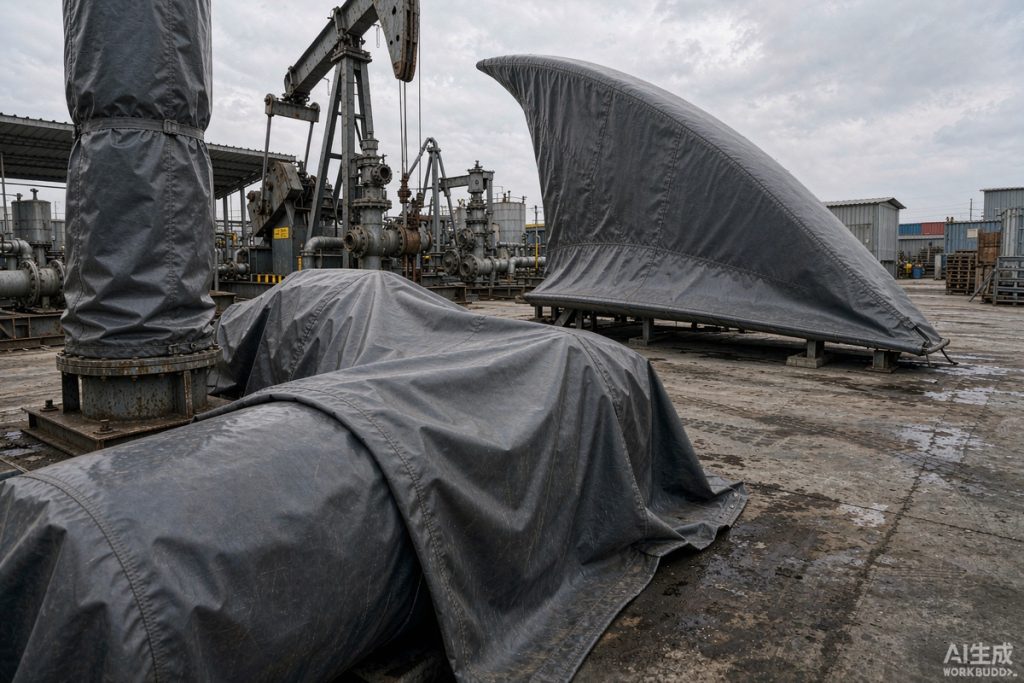
What should an industrial equipment cover fabric be specified against?
Specify a protective cover against the exposure it must survive rather than against one headline weight, because oilfield covers, drilling-tower wraps and wind-component protection ask for different combinations of abrasion, weather resistance and tear strength; name the site, the service temperature and the mechanical checks before comparing roll grades.
- The knowledge base lists energy-sector covers for drilling towers, wind-component protection and oilfield coverage with extreme-environment resistance and high strength as the core requirements (KB2, 1.4).
- Industrial fabric rows include conveyor-belt covers at 550-900 gsm with UV and abrasion resistance, and welding curtains at 300-600 gsm where flame retardancy is mandatory (KB1, 3.4).
- Open-yard and warehouse covers are listed with waterproofing, anti-mildew and anti-UV requirements, while logistics covers call for tensile strength, abrasion resistance and waterproofing (KB2, 1.4).
How do the light, medium and heavy tarpaulin grades map to cover duty?
The three tarpaulin grades are paired rows of scrim, mass and strength rather than three interchangeable weights, so keep the whole row together when choosing a cover: a finer scrim suits short-cycle or printed covers, while a denser scrim with much higher tear and tensile figures suits heavy machinery and open-yard service.
- The light grade is listed as 500D x 500D 18×12 at 440 +/-10 g/m2 with 280/260 N tear and 780/760 N/5cm tensile (KB2, 1.2).
- The medium grade is 1000D x 1000D 9×9 at 650 +/-20 g/m2 with 380/320 N tear and 1500/1500 N/5cm tensile, and the heavy grade is 1000D x 1000D 30×30 at 900 +/-20 g/m2 with 530/480 N tear and 3800/3600 N/5cm tensile (KB2, 1.2).
- All three rows carry a width of 1.5-3.2 m and a service temperature of -30 to 60 C for light and medium and -30 to 70 C for heavy (KB2, 1.2).
Which functional finishes change how long a cover lasts outdoors?
Outdoor durability is governed by the finish as much as by the base cloth, because UV filtration, anti-mildew treatment and a surface lacquer each address a different failure route; name the finish class in the specification and then confirm the resulting values on a method-named report instead of accepting a generic weatherproof label.
- Surface treatments are listed with UV filtration of at least 90%, mildew coverage of no more than 10% after 28 days of culture, and an antistatic surface resistivity of 10^10 ohms (KB2, 1.3).
- Acrylic lacquer is listed for basic self-cleaning on general tarpaulins while a fluoropolymer lacquer is listed for stronger weatherability on high-end architectural membranes; the knowledge base records several different service-life bands for that finish, so no single lifetime should be quoted (KB2, 1.3; KB1, 1.3).
- Anti-UV, anti-mildew, antistatic and flame-retardant options are separate rows in the same treatment table, so each needs its own method and result line (KB2, 1.3).
What evidence should a protective-cover submittal contain before release?
Release a cover order only against a lot-identified report set that names the grade row, the finish class and measured mass, tensile, tear, peel and waterproof results, because those figures come from separate test methods; the selection framework ends by checking measured reports against the standards list rather than quoting a range alone.
- Water resistance is listed as a hydrostatic head of at least 2000 mm water column for the tarpaulin line, tested by GB/T 4744 or ISO 811 (KB2, 1.2; KB1, 2.2).
- Mass per unit area is measured by EN ISO 2286-2, tensile by ISO 1421, tear by DIN 53363 or ISO 4674, peel by ISO 2411 and artificial weathering by EN ISO 4892-2 or -3 (KB1, 2.2).
- The Chinese test list includes GB/T 3923.1 tensile, GB/T 3917.3 trapezoidal tear, GB/T 2791 peel and GB/T 21196 Martindale abrasion (KB2, 1.6).
FAQ
Why is one GSM figure not enough to specify a protective cover?
Because mass per unit area says nothing on its own about the scrim, the coating adhesion or the finish that will actually survive the site. The kezhibo knowledge base lists three paired grade rows: a light 500D x 500D 18×12 at 440 +/-10 g/m2, a medium 1000D x 1000D 9×9 at 650 +/-20 g/m2 and a heavy 1000D x 1000D 30×30 at 900 +/-20 g/m2, each with its own tear, tensile and peel values. Ask for the whole row and a lot-identified report set, not a single weight.
Which cover applications are explicitly listed in the knowledge base?
The application table lists temporary site enclosure, roofing material, construction shrouding and work covers under construction; drilling-tower wraps, wind-component protection and oilfield coverage under energy; military tents, camouflage netting and equipment covers under defence; and outdoor yard covers, grain storage covers and dock warehousing under storage. Each row carries a different core requirement, from high tensile and tear strength to low mass and fast deployment, so the application name should be the first field on any enquiry.
Does the cover fabric need a flame-retardant treatment?
It depends on the installation address and the end use, not on the fabric family. The knowledge base marks flame retardancy as mandatory for welding curtains and as optional for conveyor-belt covers, and it warns against assuming that a rating required in one market transfers to another. Confirm the required class string and its test method with the authority having jurisdiction at the site, then request a method-named report for the offered grade rather than a general flame-retardant label.
What does an anti-UV finish actually promise?
In the kezhibo treatment table the anti-UV option is listed with ultraviolet filtration of at least 90%, while acrylic lacquer is listed for basic self-cleaning and a fluoropolymer lacquer for stronger weatherability and self-cleaning on high-end architectural membranes. These are separate rows with separate purposes. Ask which finish the offered roll carries, request the measured filtration figure and the ageing method used, and keep the finish claim separate from the mechanical grade row.
How should a buyer check an anti-mildew claim on a cover?
Ask for the culture method, the duration and the measured coverage figure on a lot-identified report. The knowledge base records mildew coverage of no more than 10% after 28 days of culture as a functional treatment result, and separately lists EN ISO 846 for microbiological testing, GB/T 24346 for mould resistance and GB/T 4744 for hydrostatic resistance. A cover used in a humid yard or over stored grain needs that evidence line, because waterproofing alone does not address biological growth.
Which test methods belong in the report set for a machinery cover?
At minimum the set should name EN ISO 2286-2 for mass per unit area, ISO 1421 for tensile behaviour, DIN 53363 or ISO 4674 for tear, ISO 2411 for coating peel, ISO 811 or GB/T 4744 for water resistance and GB/T 21196 for Martindale abrasion. The kezhibo selection framework ends with obtaining and checking measured reports against the standards list instead of quoting a specification range, so each method should appear next to its own result and unit.
Can a wide cover be made from a single roll?
Width is a grade-row property, not something to assume. The three tarpaulin grade rows in the knowledge base all carry a width of 1.5-3.2 m, while wider formats belong to other production lines and must not be borrowed into a protective-cover specification. If the design needs a larger uninterrupted panel, ask the supplier to state the joining method, the seam or weld overlap and the peel result on a welded sample, then verify the finished panel rather than the flat sheet.
What should be checked at goods receipt for a protective-cover batch?
Check the delivered roll against the same grade row and finish class named on the order, then repeat the mass, tensile, tear and peel measurements on samples from that lot. The knowledge base records a global industry mass tolerance of +/-10 g/m2 for PVC tarpaulin and closes the selection framework with measured reports rather than catalogue ranges. Keep the workshop or lot identifier on every result line so a later field failure can be traced back to a specific production batch.












