
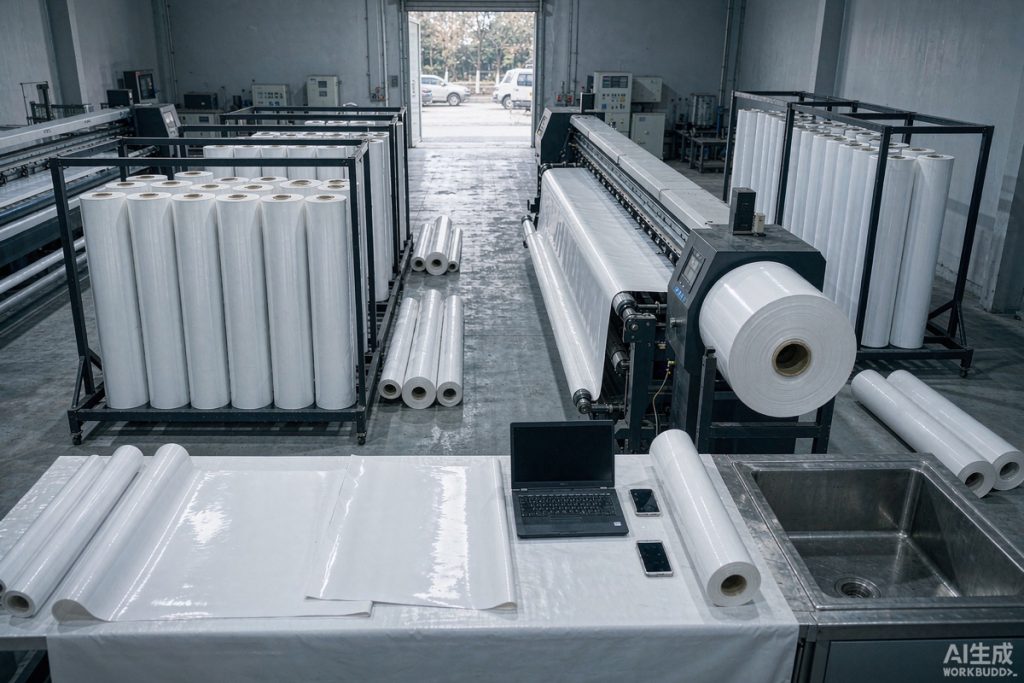
What do the 520, 530 and 550 banner model numbers actually tell a buyer?
A banner model number is a shorthand for a mass band and an expected outdoor service band, not a quality rank, so a buyer should read it together with the application row: the lower-numbered lamp cloths are thin and cheap for short campaigns, while a higher-numbered one carries more mass and a longer outdoor band for the same printing route.
- The 520 lamp cloth is listed at 280-320 g/m2 with an outdoor band of 3-6 months for short-term site hoardings and promotion banners (KB2, 3.1).
- The 530 lamp cloth is listed at 300-310 g/m2 with a 3-6 month band for event backdrops, and the 550 lamp cloth at 340-380 g/m2 with a band of 6 months or more for event backdrops and wall graphics (KB2, 3.1).
- The same product-line table lists eight distinct types, so a model number alone cannot describe the construction, the ink route or the fire class (KB2, 3.1).
How should campaign duration map to a printed banner grade?
Choose the grade from the intended exposure period rather than from the lowest price, because the knowledge base pairs each type with its own outdoor band: short promotional work sits in the shortest band, high-rise and coastal wind exposure calls for mesh, and long-term billboards and pillar wraps call for the knife-coated grades with the longest band.
- Mesh banner cloth is listed at 280-350 g/m2 with a 6-12 month band and very high air passage for high-rise hoardings and coastal advertising (KB2, 3.1).
- Backlit or inner-lit lamp cloth is listed at 350-450 g/m2 with a band of one year or more for light boxes and illuminated signs, and black-back cloth at 450-550 g/m2 with the same band for stage backdrops (KB2, 3.1).
- Knife-coated banner cloth is listed at 400-600 g/m2 with a 1-3 year band, high strength, strong ink uptake and ageing resistance for long-term billboards and pillar wraps (KB2, 3.1).
Which construction and ink details sit behind a banner model number?
Behind each model number sit a three-layer construction, a base-cloth family, a thickness and width, an ink family and a surface finish, and these are separate decisions: the printed face must match the ink chemistry, the light path must match front-lit or back-lit use, and the surface gloss must suit the viewing distance and lighting.
- Knife-coated banner cloth is listed as a three-layer build of top PVC film, a middle light-guiding fibre layer and a lower PVC film, split into opaque outer-light and transmissive inner-light versions, with 320, 520, 530 and 550 base-cloth families (KB2, 3.2).
- The technical table lists 280 g cloth at 0.26 mm, 440 g cloth at 0.38 mm and 580 g cloth at 0.45 mm, with widths of 1.02-3.2 m for the lighter rows and 1.02-2.5 m for the 580 g row (KB2, 3.3).
- Solvent, eco-solvent and UV-curable inks are listed as the compatible ink families, and both gloss and matt faces are offered; the knowledge base warns that ink mismatch and front-lit/back-lit confusion are common buying errors (KB2, 3.2; KB1, 3.3).
What should a large-format banner submittal document before an order?
Require a lot-identified submittal that names the model number, the measured mass and thickness, the ink family, the light path, the fire class with its test method and the ageing result, because a model number proves none of them; the selection framework ends by checking measured reports against the standards list rather than quoting a specification range alone.
- The banner-line test list names GB/T 28463-2012 for decorated coated fabrics, T/ZZB 0976-2019 for flexible laminated lightbox banner cloth and GB 8624 with B1/B2 classes for burning behaviour (KB2, 3.4).
- Light fastness is measured by ISO 105-B02 with a typical grade of 7-8, grey scale by ISO 105-A02, and artificial weathering by EN ISO 4892-2 or -3 (KB1, 2.2).
- The knowledge base warns that an indoor public display may need NFPA 701 or an EN 13501-1 class string, so the destination authority decides the fire line on the submittal (KB1, 3.3; KB1, 2.3).
FAQ
Is a 550 banner simply a better version of a 520 banner?
No. In the kezhibo product-line table 520 is a 280-320 g/m2 thin, low-cost cloth with a 3-6 month outdoor band for short hoardings, 530 is 300-310 g/m2 with the same band for event backdrops, and 550 is 340-380 g/m2 with a band of 6 months or more for backdrops and wall graphics. The number tracks mass and expected exposure, not a quality rank. Choose by the campaign duration and the mounting conditions first.
Which banner type should be used on a coastal high-rise hoarding?
The knowledge base lists mesh banner cloth at 280-350 g/m2 with a 6-12 month outdoor band and very high air passage specifically for high-rise hoardings and coastal advertising. It also warns against choosing an overly light mesh without calculating wind load. Ask for the measured air-passage behaviour and the tear result on the offered roll, and confirm the fixing pattern with the installer, because the fabric grade alone does not set the wind design.
Why can a front-lit cloth not simply replace a back-lit cloth?
Because the light path is a design property. The kezhibo table lists backlit or inner-lit lamp cloth at 350-450 g/m2 with uniform light transmission for light boxes and illuminated signs, and it names front-lit versus back-lit confusion as a common buying error. The construction section also separates opaque outer-light knife-coated cloth from transmissive inner-light versions. Ask which light path the roll was built for and confirm it with a transmittance or light-box test.
What does the three-layer knife-coated build change?
The knowledge base describes knife-coated banner cloth as a top PVC film, a middle light-guiding fibre layer and a lower PVC film pressed together, offered in opaque outer-light and transmissive inner-light versions. It records strong uptake of both oil-based and water-based inks, high colour saturation, oxidation and acid-alkali resistance, and both gloss and matt faces. That build is why the 400-600 g/m2 knife-coated row carries the longest outdoor band in the table.
Which ink families should be named on the order?
The kezhibo construction section lists solvent, eco-solvent and UV-curable inks as the compatible families for knife-coated banner cloth, and the wider product knowledge base lists solvent, eco-solvent, UV and latex as distinct printing routes. Name the exact ink family and the printer profile in the order, then request a sample print and an adhesion or rub result on the offered face, because ink mismatch is listed as a recurring procurement error.
Do gloss and matt faces differ in more than appearance?
They do in use, although the knowledge base records them as two offered surface choices rather than as separate performance grades. It warns that glare from a high-gloss face can hurt readability, while the same construction section lists colour saturation and fine image detail as the reason to choose knife-coated cloth. Ask for a printed sample viewed under the actual installation lighting, and keep the face choice on the submittal next to the ink family.
Which standards belong on a Chinese banner-fabric verification sheet?
The banner-line test section names GB/T 28463-2012 for decorated coated fabrics, T/ZZB 0976-2019 for flexible laminated lightbox advertising banner cloth and GB 8624 with B1/B2 burning-behaviour classes. For durability claims, the wider knowledge base lists ISO 105-B02 light fastness with a typical grade of 7-8 and EN ISO 4892-2 or -3 artificial weathering. Each line should state its method, result and unit.
What should be checked when the banner rolls arrive?
Check the delivered mass against the ordered model band, the thickness and width against the technical table, and the face finish and light path against the order, then keep a printed sample from the same lot. The kezhibo table gives 0.26 mm for 280 g cloth, 0.38 mm for 440 g cloth and 0.45 mm for 580 g cloth, with widths of 1.02-3.2 m on the lighter rows. A lot identifier on every result makes a later fade or peel claim traceable.












