Why does printing change a truck side curtain specification?
Printing adds an ink layer and a surface finish on top of a fabric that still has to carry wind and cargo loads, so the printed curtain has two specifications: the mechanical grade row underneath and the ink-to-face system on top; a buyer should document both and never let a graphics approval stand in for a fabric report.
- European truck side curtains are listed at 880-1100 gsm with 1000-1300D scrims in 18×18 to 30×30 constructions, EN 12641-2 as the governing standard, weldability and printability as key attributes (KB1, 3.2).
- The knowledge base names printability, weldability, FR matching and ink adhesion as separate selection attributes, and warns that a mismatch between the printing ink and the curtain face is a recurring procurement error (KB1, 3.2; KB2, 3.2).
- Solvent, eco-solvent and UV-curable inks are listed as distinct routes, with gloss and matt faces offered on coated banner cloth, so the printed system must be named explicitly (KB2, 3.2).
Which mechanical values must a European printed side curtain still meet?
Printing does not relax the mechanical thresholds, so the offered grade has to be checked against the same standard by a third-party measured report: the lower limits in the knowledge base are higher than the values listed for a mid-weight curtain row, and that gap must be resolved by measurement on the offered grade rather than by a blanket statement.
- EN 12641-2 is listed with tensile strength of at least 4000 N/5cm, tear of at least 300 N and peel of at least 100 N/5cm at 23 C, falling to 2700 N/5cm tensile and 130 N tear at -25 C (KB1, 2.1).
- The same entry lists a burning rate below 100 mm/min and wind Class 1 at 100 km/h and Class 2 at 110 km/h (KB1, 2.1).
- A standard 650 gsm curtain row in the knowledge base lists 1500/1500 N/5cm tensile and 380/320 N tear, so the specific grade must be verified against the standard by a third-party test report rather than quoted as meeting it automatically (KB2, 1.2; KB1, 2.1).
How should ink and topcoat compatibility be documented on a proof?
Document the printed face as a system: name the ink family, the lacquer or topcoat on the curtain, the surface gloss and the test methods used for adhesion, colour fastness and weathering, then keep a printed sample from the production lot; a visual colour approval alone cannot show how the ink behaves after flexing, washing or UV exposure.
- Acrylic lacquer is listed for basic self-cleaning on general tarpaulins and a fluoropolymer lacquer for stronger weatherability, while an anti-UV treatment is recorded with filtration of at least 90% (KB2, 1.3).
- Light fastness is measured by ISO 105-B02 with a typical grade of 7-8 and grey scale by ISO 105-A02; artificial weathering uses EN ISO 4892-2 or -3, and coating peel uses ISO 2411 (KB1, 2.2).
- The Chinese test list adds GB/T 2791 peel, GB/T 8427 xenon-arc ageing, GB/T 16422.2 artificial weathering and GB/T 21196 Martindale abrasion, so each printed-face claim can be tied to a method (KB2, 1.6).
What belongs on a printed-curtain release report before a fleet order?
Release a fleet order only against a lot-identified report set covering the base fabric, the printed face and the finished seam, because a flat-sheet result does not prove the welded or stitched edge nor the fire class at the destination; the selection framework ends by checking measured reports against the standards list instead of quoting a specification range alone.
- Mass per unit area is measured by EN ISO 2286-2, tensile by ISO 1421, tear by DIN 53363 or ISO 4674, peel by ISO 2411 and flex cracking by DIN 53359 A at no fewer than 100000 cycles (KB1, 2.2).
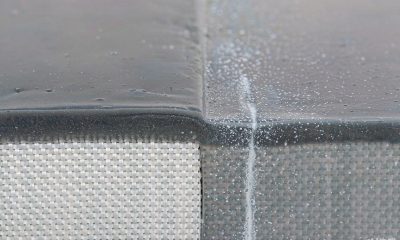
- The knowledge base warns that a sewn seam leaks in liquid-bearing or inflatable uses and names RF, hot-air, hot-wedge and solvent welding as the PVC joining routes, so a welded-sample peel result should be a separate line (KB1, 3.4; KB1, 1.2).
- Fire classes are market-specific: EN 13501-1 B-s2,d0 or higher for EU tensile work, DIN 4102-1 B1, NF P 92-507 M2 and NFPA 701 belong to different systems and must be quoted with their test method (KB1, 3.1; KB1, 2.3).
FAQ
Can a graphics approval replace a fabric test report on a printed curtain?
No. A graphics approval covers colour and layout, while the curtain still has to meet its mechanical and joining requirements. The kezhibo knowledge base lists European side curtains at 880-1100 gsm with 1000-1300D scrims and EN 12641-2 as the governing standard, and it names ink-to-face mismatch as a recurring error. Keep two separate approvals: one for the printed proof and one for the lot-identified fabric and seam report set.
Does printing void the EN 12641-2 mechanical thresholds?
The thresholds still apply to the delivered curtain. The knowledge base lists tensile of at least 4000 N/5cm, tear of at least 300 N and peel of at least 100 N/5cm at 23 C, plus -25 C values of 2700 N/5cm and 130 N, a burning rate below 100 mm/min and two wind classes. It also lists a common 650 gsm row with lower mechanical values, so ask for a third-party report on the exact offered grade rather than a blanket statement.
Which ink families should be named on a printed-curtain order?
The kezhibo construction section lists solvent, eco-solvent and UV-curable inks as distinct routes and offers gloss and matt faces on coated cloth. The side-curtain section lists printability as a key selection attribute and warns about ink-adhesion mismatch. Name the ink family, the face finish and the printer profile in the order, then keep a printed sample from the production lot for adhesion and rub checks.
Why does the topcoat matter to ink adhesion?
Because the ink lands on the finish, not directly on the PVC. The knowledge base lists acrylic lacquer for basic self-cleaning on general tarpaulins and a fluoropolymer lacquer for stronger weatherability on high-end architectural membranes, plus an anti-UV treatment with filtration of at least 90%. Some finishes may need surface preparation before welding, so the topcoat choice belongs on the same submittal as the ink family and the seam method.
Which methods verify that the printed face will survive service?
Use ISO 105-B02 for light fastness with a typical grade of 7-8, ISO 105-A02 for the grey scale, EN ISO 4892-2 or -3 for artificial weathering, ISO 2411 for coating peel and GB/T 21196 for Martindale abrasion. The Chinese list also includes GB/T 8427 xenon-arc ageing and GB/T 16422.2 artificial weathering. Each result should name its method, unit and lot identifier.
Does the seam need its own result line on a printed curtain?
Yes. The knowledge base states that sewn seams leak in liquid-bearing and inflatable applications and lists RF, hot-air, hot-wedge and solvent welding as the PVC joining routes. A flat-sheet tensile or peel result says nothing about the finished edge. Ask for the joining method, the overlap used and a peel result measured on a welded sample from the same lot, especially where the printed area crosses the seam.
Which fire class should be quoted for a side curtain?
It depends on the destination market and the end use, and the class string must always travel with its test method. The knowledge base lists EN 13501-1 with an A1-F plus smoke and droplet string, DIN 4102-1 B1, NF P 92-507 M2 and NFPA 701 as separate systems, and warns against rewriting a national class as an EN grade. Confirm the required class with the authority having jurisdiction before the print run.
What should a fleet buyer check at goods receipt?
Check the delivered mass and width against the ordered grade row, verify the printed face against the retained production proof, and repeat tensile, tear, peel and flex measurements on samples from that lot. The knowledge base lists DIN 53359 A at no fewer than 100000 flex cycles and a mass tolerance of +/-10 g/m2 for PVC tarpaulin. Keep the lot identifier on every result so a field failure can be traced.