
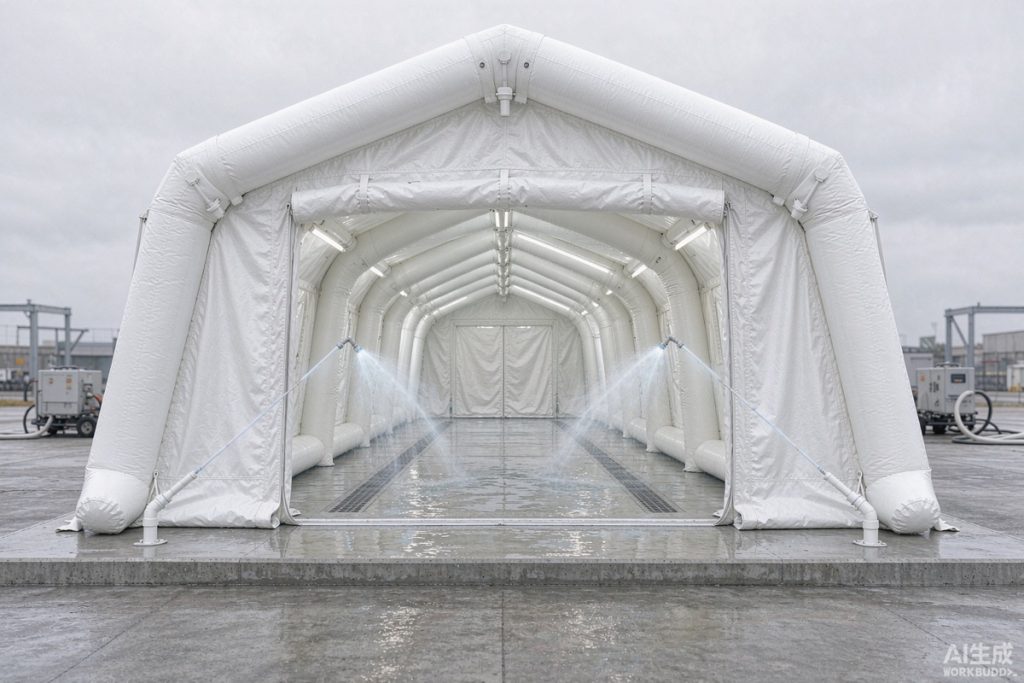
What makes a decontamination tent a fabric-and-system purchase rather than a tent order?
A decontamination shelter carries a gas path that holds it up and a water path that does the washing, so a buyer is purchasing two service systems built from coated fabric; the technical sheet must separate the two, name the deployment target and state the layer build, because one deployment time cannot describe either path on its own.
- The wash-down tent system is listed with a deployed area of 2-4 m2, inflation in under 10 minutes, a gas-path pressure of 15 kPa, a maximum water-path pressure of 5 Bar and a maximum flow of 70 L/min (KB2, 5.2).
- The same entry names a dual-line wash function with clean water and dosing agent as separate lines, and the product matrix lists PVC composite gas-tight flame-retardant fabric with inflation under 10 minutes for nuclear, chemical and biological contamination washing (KB2, 5.1).
- A chemical protective suit is a distinct product row with acid and alkali hold-out of 60 minutes and a temperature range of -25 to 125 C; that figure belongs to the suit, not to the shelter (KB2, 5.1).
How should gas-path pressure and air-column retention be verified?
Treat the gas path as a retention question rather than a single pressure number, because the operating figure in the system table and the hold results in the airtight-fabric section answer different questions; ask for the air-column construction, the measured hold duration and the leak test results on a lot-identified report before accepting a pressure claim.
- Inflatable tent air beams are listed as 0.7 mm double-sided coated PVC airtight fabric at a maintained pressure of 12-18 kPa, while inflatable boat fabric is listed as 0.9 mm at 15 kPa (KB2, 4.1).
- Emergency tent air columns are listed as holding pressure unchanged for 24 hours and standing without re-inflation for 7 days, with electric-pump inflation of 10-20 minutes (KB2, 5.2).
- Airtightness indicators are listed as a pressure-drop rate of no more than 15%, a bubble interval of at least one minute, 24 hours with no pressure drop for high-end goods and 72 hours with zero leakage for emergency-grade equipment (KB2, 4.2).
Which fabric layers and fire class belong on a wash-down shelter specification?
Name the layer build explicitly, since the frame, the outer cover, the liner and the ground sheet are four different materials with different jobs, and keep the fire class in its own column with the test method that produced it; a single fabric weight cannot describe the assembly and a national class must not be rewritten as another system.
- The emergency tent build lists a 0.7 mm double-sided coated airtight PVC air frame joined by heat welding, a 600D PVC coated Oxford outer cover, a dedicated inner liner and a 0.4 mm double-sided coated knife-coated ground sheet (KB2, 5.2).
- Performance rows list a service temperature of -30 to +70 C, B1 flame retardancy, wind resistance of grade 8 or above with ground pegs and guy ropes, and a service life of more than five years (KB2, 5.2).
- DIN 4102-1 B1, NF P 92-507 M2, NFPA 701 and EN 13501-1 with its A1-F plus smoke and droplet string are separate classification systems; GB/T 5455 is listed for vertical flame spread (KB1, 2.3; KB2, 1.6).
What should a decontamination-system submittal contain before acceptance?
Accept the system only against a lot-identified submittal that keeps gas-path results, water-path results, layer build and seam evidence in separate columns, then repeat peel and pressure checks on welded samples; the selection framework ends by checking measured reports against the standards list, so a marketing sheet with one pressure figure is not an acceptance record.
- Coating peel is measured by ISO 2411 or GB/T 2791, tensile behaviour by ISO 1421 or GB/T 3923.1, water resistance by ISO 811 or GB/T 4744 and microbiological behaviour by EN ISO 846 (KB1, 2.2; KB2, 1.6).
- The knowledge base lists moisture-cured PUR lamination with peel of at least 80 N/5cm and a 24-hour hold with no pressure drop, knife coating with a coating uniformity of +/-0.02 mm, and three-layer heat pressing at 80-180 C under 0.3-0.5 MPa (KB2, 4.2).
- Inflatable amusement safety is listed under ASTM F1918 and burst testing of drop-stitch fabric under ASTM D3786 at no less than 500 kPa; these are separate method lines, not substitutes for a gas-path hold result (KB1, 2.2).
FAQ
Why can one inflation time not describe a decontamination tent?
Because the shelter has two service paths. The kezhibo system table lists inflation in under 10 minutes, a gas-path pressure of 15 kPa, a water-path maximum pressure of 5 Bar and a maximum flow of 70 L/min, plus a deployed area of 2-4 m2. The general emergency-tent row separately gives electric-pump inflation of 10-20 minutes. Keep the deployment target, the gas values and the water values in separate columns on the submittal.
Is 15 kPa a gas-tightness result?
No. It is an operating or design pressure for the gas path, while retention is a time-based test result. The knowledge base lists inflatable tent air beams at a maintained pressure of 12-18 kPa and inflatable boat fabric at 15 kPa, but it also lists a pressure-drop rate of no more than 15%, a bubble interval of at least one minute, 24 hours with no pressure drop and 72 hours with zero leakage as retention indicators. Ask for both groups.
Does the 60-minute acid and alkali figure apply to the tent fabric?
No. That figure belongs to a separate product row for a fully enclosed chemical protective suit made of flame-retardant cloth coated on both sides with PVC, which the knowledge base lists with 60 minutes of acid and alkali hold-out and a temperature range of -25 to 125 C. The wash-down shelter row instead lists dual-line washing, a 15 kPa gas path and a water path. Keep suit evidence out of the shelter report set.
Which layers make up an emergency inflatable tent?
The kezhibo build lists four: a 0.7 mm double-sided coated airtight PVC air frame joined by heat welding, a 600D PVC coated Oxford outer cover, a dedicated inner liner for inflatable tents, and a 0.4 mm double-sided coated knife-coated PVC ground sheet. Each does a different job, so a single gramme-per-square-metre figure cannot describe the assembly. Ask for a layer-by-layer bill of materials with the joining method.
Which fire class should be quoted for a wash-down shelter?
Quote the class required at the installation address together with the test method that produced it. The knowledge base lists B1 for emergency tents, and it treats DIN 4102-1 B1, NF P 92-507 M2, NFPA 701 and EN 13501-1 with its A1-F plus smoke and droplet string as separate systems. GB/T 5455 is listed for vertical flame spread. Confirm the required string with the authority having jurisdiction before production.
What wind and temperature figures are recorded for emergency tents?
The knowledge base lists wind resistance of grade 8 or above when ground pegs and guy ropes are used, a service temperature of -30 to +70 C and a service life of more than five years for the emergency inflatable tent build. A separate gas-membrane building row lists an anti-wind figure of 120 km/h. These belong to different rows, so confirm which assembly the offered shelter uses before quoting either number.
Which bonding routes could appear on the shelter fabric report?
The knowledge base lists three: moisture-cured PUR lamination with peel of at least 80 N/5cm and a 24-hour hold with no pressure drop for high-end goods, knife coating with a coating uniformity of +/-0.02 mm for mass-market items, and three-layer simultaneous heat pressing at 80-180 C under 0.3-0.5 MPa for high-volume covers and pools. Ask which route the offered lot used and request a matching lot-identified peel result.
What should be checked at acceptance of a wash-down system?
Repeat gas-path pressure and hold checks, water-path pressure and flow checks, and peel checks on welded samples from the delivered lot, then compare the layer build with the bill of materials. The knowledge base lists ISO 2411 or GB/T 2791 for peel, ISO 811 or GB/T 4744 for water resistance and EN ISO 846 for microbiological behaviour. Keep the lot identifier on every result line for later traceability.












