# PVC Coated Fabric Thickness Measurement and Uniformity: EN ISO 2286-3 and Width Verification
## What Standards Govern PVC Coated Fabric Thickness and Width Measurement?
**PVC coated fabric thickness and width are measured using the EN ISO 2286 series: part 1 covers width, part 2 covers mass per unit area, and part 3 covers thickness. These three measurements define the fundamental dimensional specification, and buyers should require all three because thickness uniformity directly affects welding and mechanical performance.**
– Width: EN ISO 2286-1 (KB Chapter 2.2)
– Mass per unit area: EN ISO 2286-2 (KB Chapter 2.2)
– Thickness: EN ISO 2286-3 (part of the 2286 series, KB Chapter 2.2)
## What Thickness Ranges Apply to Different PVC Coated Fabric Product Lines?
**Thickness ranges vary from 0.30 to 0.55 mm for advertising banner fabrics to 0.80 to 2.50 mm for drop-stitch inflatables. Tarpaulin fabrics range from 0.30 to 1.20 mm at 440 to 1300 gsm; architectural membrane is 0.60 to 1.00 mm at 800 to 1550 gsm; inflatable fabrics range from 0.80 to 2.50 mm at 650 to 2700 gsm.**
– Advertising fabric: 0.30-0.55 mm, 240-680 gsm (KB Chapter 2.1)
– Tarpaulin/cover: 0.30-1.20 mm, 440-1300 gsm (KB Chapter 2.1)
– Architectural membrane: 0.60-1.00 mm, 800-1550 gsm (KB Chapter 2.1)
## Why Does Thickness Uniformity Matter in PVC Coated Fabric?
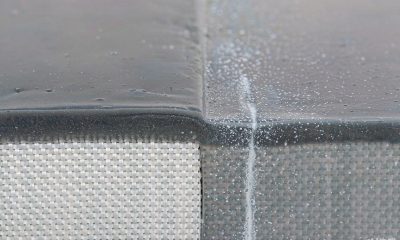
**Thickness uniformity is critical because variations affect welding parameter consistency, mechanical performance, and visual appearance. In knife-coated fabric the tolerance is plus or minus 0.02 mm with well-maintained equipment; variations beyond this indicate coating instability that can produce thin spots compromising waterproofness or thick spots causing welding inconsistencies.**
– Knife coating tolerance: +/-0.02 mm (KB, airtight fabric bonding route)
– Thin spots risk: compromised waterproofness; thick spots risk: welding inconsistency
– Thickness variation affects: welding parameters, mechanical performance, surface appearance
## How Is Thickness Measured and What Equipment Is Used?
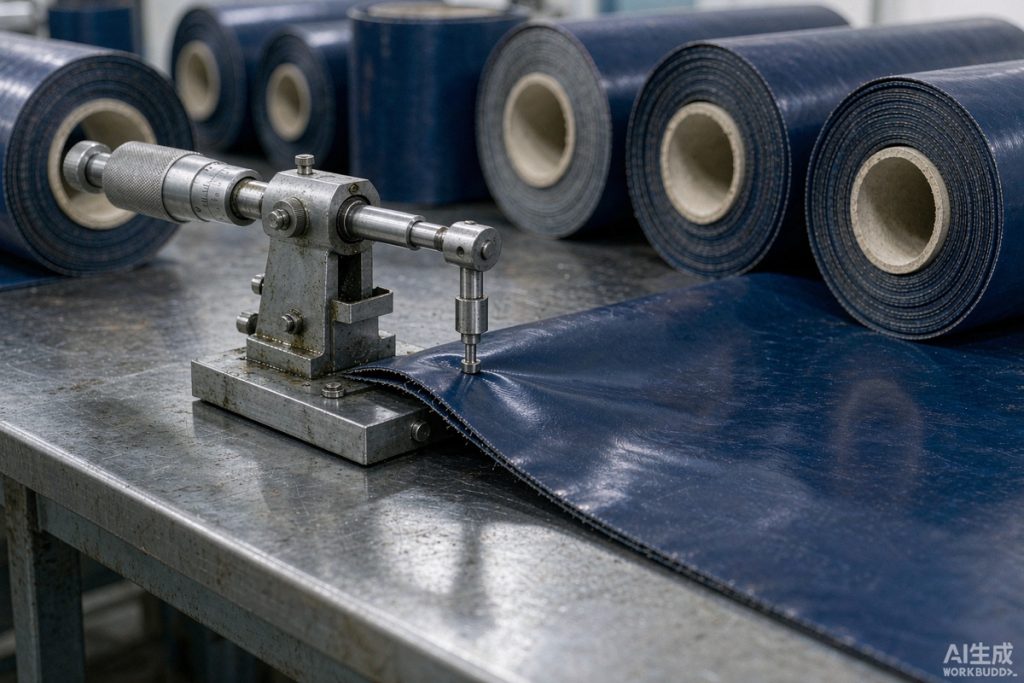
**Thickness is measured using a precision gauge conforming to EN ISO 2286-3, which specifies foot diameter, applied pressure, and measurement procedure. The gauge applies a defined pressure through a circular foot, and measurements are taken at multiple positions across the roll width and length to build a thickness map.**
– Standard: EN ISO 2286-3 (thickness measurement, 2286 series)
– Method: precision gauge with defined foot diameter and applied pressure
– Sampling: multiple positions across width and along length for thickness mapping
## How Do Width Tolerances Affect Fabrication Yield and Cost?
**Width tolerances affect fabrication yield because usable width determines how many panels can be nested per roll. The knowledge base reports widths from 1.02 to 3.2 metres for advertising fabrics and 1.5 to 3.2 metres for tarpaulins; buyers should verify actual width using EN ISO 2286-1 because shortfalls increase waste and seams.**
– Advertising fabric width: 1.02-3.2 m (KB Chapter 3.3)
– General tarpaulin width: 1.5-3.2 m (KB Chapter 3.2)
– Width measurement: EN ISO 2286-1 (KB Chapter 2.2)
## FAQ
**Q: What standard is used to measure PVC coated fabric thickness?**
A: EN ISO 2286-3 is the standard for measuring the thickness of PVC coated fabric, as part of the EN ISO 2286 series which also covers width (part 1) and mass per unit area (part 2). The standard specifies the gauge foot diameter, applied pressure, and measurement procedure to ensure reproducible results. Thickness measurements should be taken at multiple positions across the roll width and at regular intervals along the length to identify any systematic variation patterns. The reported thickness should include the measurement conditions and the range of values observed.
**Q: What is the thickness range for PVC coated tarpaulin fabric?**
A: PVC coated tarpaulin and cover fabric typically ranges from 0.30 to 1.20 mm in thickness, corresponding to a weight range of 440 to 1300 gsm. The specific thickness within this range depends on the application: flat-sheet cargo covers and scaffold wraps are at the lighter end at 550 to 900 gsm, while truck side curtains and heavy-duty covers are at the upper end at 880 to 1100 gsm. The thickness directly affects the welding parameters, mechanical performance, and durability of the finished product.
**Q: How accurate is knife coating for thickness control?**
A: Knife coating can achieve a thickness tolerance of plus or minus 0.02 mm when the equipment is properly maintained and calibrated, according to the project knowledge base. This level of precision makes knife coating the preferred method for applications requiring consistent thickness, such as airtight inflatable fabrics and architectural membranes. However, achieving this tolerance requires stable substrate tension, consistent paste viscosity, and precise knife gap setting. Variations beyond the tolerance indicate coating process instability.
**Q: Why is width verification important for PVC coated fabric?**
A: Width verification is important because the usable fabric width determines the fabrication yield, which is the number of panels that can be nested from each roll. PVC coated fabric widths range from 1.02 to 3.2 metres depending on the product line, and a systematic width shortfall of even a few centimetres reduces the number of panels per roll, increases material waste, and adds welded seams. Width is measured using EN ISO 2286-1 and should be verified on every delivery for large orders.
**Q: How does thickness affect welding parameters?**
A: Thickness directly affects welding parameters because the energy required to achieve a proper fusion bond is proportional to the material thickness. Thicker fabrics require more welding energy, higher pressure, or longer dwell time. Inconsistent thickness means parameters set for the nominal thickness will be excessive for thin areas, causing burn-through, and insufficient for thick areas, causing weak bonds. This is why thickness uniformity within the plus or minus 0.02 mm tolerance is critical for consistent weld quality in inflatables and geomembranes.
**Q: What is the difference between EN ISO 2286-1, 2286-2, and 2286-3?**
A: The EN ISO 2286 series covers the three fundamental dimensional measurements for coated fabrics. Part 1 covers width measurement, determining the usable width of the fabric roll. Part 2 covers mass per unit area, measuring the weight per square metre which is the primary specification for product grading. Part 3 covers thickness determination, measuring the material thickness at defined pressure conditions. Together, these three measurements define the complete dimensional specification, and all three should be reported on the supplier test certificate.
**Q: Can thickness measurement detect coating defects?**
A: Yes. Thickness measurement using EN ISO 2286-3 is an effective method for detecting coating defects, particularly thin spots, thick spots, and areas of uneven coating distribution. By measuring thickness at multiple positions across the roll width and along the length, a thickness map can reveal systematic or random variations. Thin spots may indicate insufficient coating for waterproof or airtight performance, while thick spots may indicate coating buildup causing welding inconsistencies or visual defects. The knife coating tolerance of plus or minus 0.02 mm provides a benchmark.
**Q: What thickness is needed for inflatable PVC fabric?**
A: Inflatable and drop-stitch PVC coated fabrics range from 0.80 to 2.50 mm in thickness, corresponding to 650 to 2700 gsm. Inflatable boat fabric is typically 1.5 to 2.0 mm with 1000-1500D polyester scrim, while drop-stitch fabrics for paddleboards range from 0.80 to 2.50 mm at 800 to 2700 gsm. The thickness required depends on the operating pressure, with drop-stitch fabrics operating at 10 to 15 PSI and requiring burst strength of at least 500 kPa per ASTM D3786. Buyers should verify thickness and uniformity before fabrication.
## FAQ (ZH)
**问:PVC涂层布厚度的测试标准是什么?**
答:EN ISO 2286-3是测量PVC涂层布厚度的标准,属于EN ISO 2286系列,该系列还涵盖幅宽(第1部分)和单位面积质量(第2部分)。标准规定了测厚仪脚直径、施加压力和测量程序,确保结果可重现。厚度测量应在卷材幅宽方向多个位置和长度方向固定间隔进行,以识别系统性的变化模式。报告的厚度应包括测量条件和观测值范围。
**问:PVC涂层篷布的厚度范围是多少?**
答:PVC涂层篷布和覆盖布的厚度通常为0.30至1.20毫米,对应克重440至1300 gsm。范围内的具体厚度取决于应用:平板货罩和脚手架围挡在550至900 gsm的较轻端,卡车侧帘和重型覆盖在880至1100 gsm的上端。厚度直接影响焊接参数、力学性能和成品耐久性。买家应使用EN ISO 2286-3在加工前验证实际厚度。
**问:刀刮涂层的厚度控制精度如何?**
答:根据项目知识库,刀刮涂层在设备维护良好时可实现正负0.02毫米的厚度公差。这种精度使刀刮涂层成为需要一致厚度的应用(如气密充气面料和建筑膜材)的首选方法。但实现该公差需要稳定的基布张力、一致的增塑糊粘度和精确的刮刀间隙设置。超出公差的变化表明涂层工艺不稳定。
**问:为什么PVC涂层布的幅宽验证很重要?**
答:幅宽验证很重要,因为可用幅宽决定了加工利用率,即每卷可排料的面板数量。PVC涂层布幅宽从1.02至3.2米不等,即使几厘米的系统性幅宽不足也会减少每卷面板数,增加材料浪费和焊缝数量。幅宽使用EN ISO 2286-1测量,应在每批交付时验证,特别是大订单中累积幅宽损失会显著增加加工成本和焊缝数量。
**问:厚度如何影响焊接参数?**
答:厚度直接影响焊接参数,因为实现适当熔融粘合所需的能量与材料厚度成正比。较厚的面料需要更多焊接能量、更高压力或更长停留时间。厚度不一致意味着为标称厚度设置的参数对薄区过度(导致烧穿),对厚区不足(导致弱焊)。这就是为什么正负0.02毫米公差内的厚度均匀性对充气结构和土工膜的一致焊接质量至关重要。
**问:EN ISO 2286-1、2286-2和2286-3有什么区别?**
答:EN ISO 2286系列涵盖涂层织物的三个基本尺寸测量。第1部分涵盖幅宽测量,确定面料卷的可用幅宽。第2部分涵盖单位面积质量,测量每平方米重量,是产品分级的主要规格。第3部分涵盖厚度测定,在规定压力条件下测量材料厚度。三个测量共同定义完整的尺寸规格,均应在供应商测试证书上报告。
**问:厚度测量能检测涂层缺陷吗?**
答:能。使用EN ISO 2286-3的厚度测量是检测涂层缺陷的有效方法,特别是薄点、厚点和涂层分布不均。通过在卷材幅宽方向和长度方向多个位置测量厚度,可构建厚度图,揭示系统性或随机变化。薄点可能表明涂层不足以提供防水或气密性能,厚点可能表明涂层堆积导致焊接不一致或视觉缺陷。刀刮涂层正负0.02毫米的公差提供了基准。
**问:充气PVC面料需要多大厚度?**
答:充气和拉丝PVC涂层面料厚度范围为0.80至2.50毫米,对应650至2700 gsm。充气船面料通常为1.5至2.0毫米、1000-1500D涤纶基布;桨板用拉丝面料为0.80至2.50毫米、800至2700 gsm。所需厚度取决于工作压力,拉丝面料通常在10至15 PSI工作,要求按ASTM D3786爆破强度不低于500 kPa。买家应在加工前验证厚度和均匀性。