
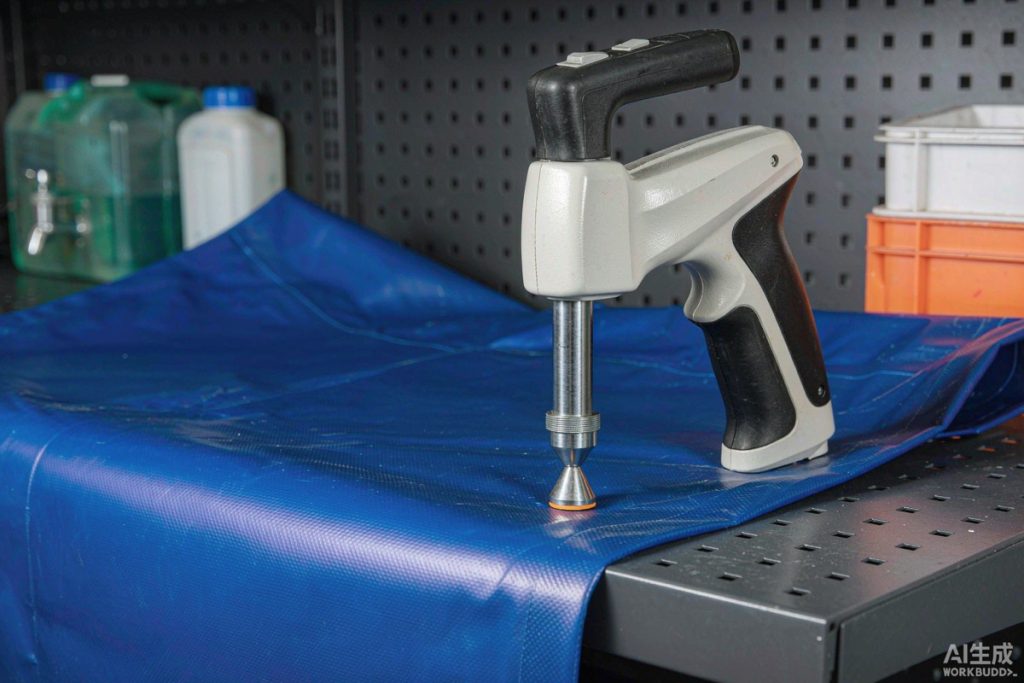
# PVC Coated Fabric Shore A Hardness and Surface Properties: Durometer Testing and Plasticiser Verification
## What Is Shore A Hardness and Why Does It Matter for PVC Coated Fabric?
**Shore A hardness is a durometer measurement quantifying the resistance of a PVC coated fabric surface to indentation by a spring-loaded indentor, serving as a primary indicator of flexibility, plasticiser content, and application suitability. PVC coated fabric typically measures seventy to ninety Shore A, with higher values indicating rigid structural grades.**
– Measurement: Shore A durometer (KB Chapter 2.1, plasticiser migration and roll storage)
– Typical range: 70-90 Shore A for standard PVC coated fabric (verify by test report)
– Higher hardness: structural grades; lower hardness: inflatable and cover grades
## How Is Shore A Hardness Tested on PVC Coated Fabric?
**Shore A hardness is tested using a durometer conforming to ASTM D2240 or ISO 868, which presses a spring-loaded indentor into the coated surface under a defined force. Multiple readings are taken at different positions and averaged; the test should be at twenty-three degrees Celsius and fifty percent relative humidity because PVC is temperature-sensitive.**
– Standards: ASTM D2240 / ISO 868 (durometer hardness)
– Specimen: flat coated surface on rigid backing, multiple readings averaged
– Conditions: 23 degrees Celsius, 50% relative humidity (temperature-sensitive material)
## How Does Plasticiser Content Affect Shore A Hardness?
**Plasticiser content is the primary determinant of Shore A hardness, with higher levels producing softer material. The knowledge base identifies DOP and DOTP at forty to sixty phr; DOTP replaces DOP due to REACH SVHC restrictions, and the transition may cause a measurable hardness shift to be verified on the specific grade.**
– Plasticisers: DOP and DOTP at 40-60 phr (KB, plasticiser migration topic)
– DOTP cost premium: 18-24% over DOP as of 2025 (KB, plasticiser migration topic)
– REACH SVHC: DOP/DEHP restricted, driving DOTP transition (KB, plasticiser migration topic)
## What Happens to Shore A Hardness After Aging and UV Exposure?
**After prolonged UV exposure and thermal aging, PVC coated fabric experiences plasticiser migration and volatilisation, causing Shore A hardness to increase. The knowledge base references EN ISO 4892-2 aging for two thousand hours; a significant hardness increase indicates plasticiser loss that will eventually cause embrittlement, cracking, and failure at low temperatures.**
– Aging test: EN ISO 4892-2, 2,000 hours (KB, plasticiser migration topic)
– Key indicator: Shore A hardness change during aging
– Failure mode: plasticiser loss leads to embrittlement, cracking, and eventual failure
## How Can Buyers Use Shore A Hardness to Verify Product Consistency?
**Buyers can use Shore A hardness as a rapid, non-destructive quality control check to verify batch-to-batch consistency, because hardness is linked to plasticiser content and compound formulation. A batch with hardness significantly different from specification indicates a formulation change; the test takes seconds with a handheld durometer.**
– Test method: handheld durometer, rapid and non-destructive
– Use: incoming inspection and batch-to-batch consistency verification
– Combined with: EN ISO 2286-2 (gsm) and EN ISO 2286-3 (thickness) for complete QC
## FAQ
**Q: What is Shore A hardness for PVC coated fabric?**
A: Shore A hardness for PVC coated fabric typically ranges from seventy to ninety degrees on the Shore A scale, with the specific value determined by the plasticiser content in the PVC compound. Higher hardness values indicate a harder, more rigid material suited to structural applications, while lower values indicate a softer, more flexible material suited to inflatables and protective covers. The measurement is performed using a durometer conforming to ASTM D2240 or ISO 868 at standard atmospheric conditions of twenty-three degrees Celsius and fifty percent relative humidity.
**Q: How does plasticiser affect Shore A hardness?**
A: Plasticiser content is the primary determinant of Shore A hardness in PVC coated fabric. Common plasticisers include DOP and DOTP, used at forty to sixty phr. Higher plasticiser levels produce a softer material with lower Shore A hardness, while lower levels produce a harder material. The transition from DOP to DOTP, driven by REACH SVHC restrictions on orthophthalate plasticisers, may cause a measurable shift in Shore A hardness. DOTP carries a cost premium of eighteen to twenty-four percent over DOP as of 2025.
**Q: What happens to Shore A hardness after UV aging?**
A: After prolonged UV exposure and thermal aging, PVC coated fabric experiences plasticiser migration and volatilisation, causing the Shore A hardness to increase as the material loses flexibility. The standard aging test is EN ISO 4892-2, which exposes the fabric to xenon arc radiation for two thousand hours. A hardness increase of more than a few degrees indicates significant plasticiser migration that will eventually cause the fabric to become brittle, crack, and fail, particularly at low temperatures.
**Q: Can Shore A hardness detect plasticiser migration?**
A: Yes. Shore A hardness is a sensitive indicator of plasticiser migration and volatilisation in PVC coated fabric. As plasticiser is lost from the PVC compound through migration to the surface and evaporation, the material becomes harder, and this change is measurable with a durometer. By measuring Shore A hardness before and after aging testing per EN ISO 4892-2, the magnitude of plasticiser loss can be quantified. A significant hardness increase predicts premature embrittlement and cracking in field service.
**Q: What durometer standard is used for PVC coated fabric?**
A: ASTM D2240 and ISO 868 are the two primary standards for measuring Shore A hardness of PVC coated fabric. Both standards specify the design of the durometer instrument, including the indentor geometry, spring force, and measurement procedure. The test is performed by pressing the durometer against a flat area of the coated surface with the specimen backed by a rigid surface. Multiple readings are taken at different positions and averaged. The test should be conducted at twenty-three degrees Celsius and fifty percent relative humidity.
**Q: How is Shore A hardness used for quality control?**
A: Shore A hardness is used as a rapid, non-destructive quality control check for PVC coated fabric because it is directly linked to the plasticiser content and PVC compound formulation. A handheld durometer can be used at the warehouse during incoming inspection to verify that each delivery matches the specified hardness. Any significant deviation from the specification or from previous deliveries indicates a formulation change, incorrect plasticiser level, or contamination. The test takes seconds and complements the dimensional measurements of mass per unit area and thickness.
**Q: Does Shore A hardness change after long-term storage?**
A: PVC coated fabric roll storage guidelines specify a temperature of ten to thirty-five degrees Celsius and relative humidity below seventy percent, with a shelf life of twelve to twenty-four months. After extended storage, particularly if conditions exceed these limits, plasticiser migration may occur, causing an increase in Shore A hardness. The knowledge base recommends re-testing tensile, peel, and Shore A hardness after extended storage. If the hardness has increased significantly, the fabric may have lost flexibility and could be prone to cracking during handling or welding.
**Q: What is the relationship between Shore A hardness and low-temperature flexibility?**
A: Shore A hardness and low-temperature flexibility are inversely related in PVC coated fabric because both properties are governed by the plasticiser content and the glass transition temperature of the PVC compound. A material with low Shore A hardness will typically have better low-temperature flexibility, while a material with high Shore A hardness will be more rigid and prone to cracking at low temperatures. PVC coated fabric is generally rated for service at minus thirty to plus seventy degrees Celsius. After UV aging and plasticiser loss, hardness increases and low-temperature flexibility decreases.
## FAQ (ZH)
**问:PVC涂层布的Shore A硬度是多少?**
答:PVC涂层布的Shore A硬度通常在七十至九十度范围内,具体值由PVC化合物中的增塑剂含量决定。较高的硬度值表示更硬更刚性的材料,适用于结构应用;较低的值表示更柔软的材料,适用于充气和防护覆盖。测量使用符合ASTM D2240或ISO 868的硬度计,在标准大气条件(二十三摄氏度、相对湿度百分之五十)下进行。
**问:增塑剂如何影响Shore A硬度?**
答:增塑剂含量是PVC涂层布Shore A硬度的主要决定因素。常见增塑剂包括DOP和DOTP,用量为四十至六十份每百份树脂。增塑剂含量越高,材料越软,Shore A硬度越低。由于REACH SVHC对邻苯二甲酸酯的限制,DOP正被DOTP替代,这一转变可能导致Shore A硬度的可测量变化。截至2025年,DOTP相对于DOP的成本溢价为百分之十八至二十四。
**问:UV老化后Shore A硬度会怎样变化?**
答:经过长时间UV暴露和热老化后,PVC涂层布经历增塑剂迁移和挥发,导致Shore A硬度随材料失去柔韧性而升高。标准老化测试为EN ISO 4892-2,将面料暴露于氙弧辐射两千小时。硬度增加超过几度表明显著的增塑剂迁移,最终会导致材料变脆、开裂和失效,特别是在低温下,此时PVC化合物的玻璃化转变进一步使材料硬化。
**问:Shore A硬度能检测增塑剂迁移吗?**
答:能。Shore A硬度是PVC涂层布增塑剂迁移和挥发的灵敏指标。随着增塑剂从PVC化合物中迁移到表面并蒸发,材料变硬,这种变化可用硬度计测量。通过在EN ISO 4892-2老化测试前后测量Shore A硬度,可量化增塑剂损失的程度。显著的硬度增加预示着户外使用中会过早变脆和开裂,这对于户外暴露应用尤为重要。
**问:PVC涂层布使用什么硬度计标准?**
答:ASTM D2240和ISO 868是测量PVC涂层布Shore A硬度的两个主要标准。两者均规定了硬度计仪器的设计,包括压头几何形状、弹簧力和测量程序。测试时将硬度计压在涂层表面的平坦区域,样品背面需有刚性支撑。在多个位置取读数并求平均值。测试应在二十三摄氏度和百分之五十相对湿度的标准大气条件下进行,因为PVC硬度随温度变化。
**问:Shore A硬度如何用于质量控制?**
答:Shore A硬度用作PVC涂层布的快速无损质量控制检查,因为它直接关联增塑剂含量和PVC化合物配方。在仓库来料检验时可使用手持硬度计验证每批交付是否符合规定硬度。与规格或前批交付的显著偏差表明配方变更、增塑剂用量错误或污染。测试仅需几秒钟,与单位面积质量(EN ISO 2286-2)和厚度(EN ISO 2286-3)测量互为补充。
**问:长期储存后Shore A硬度会变化吗?**
答:PVC涂层布卷材储存指南规定温度十至三十五摄氏度、相对湿度低于百分之七十、保质期十二至二十四个月。长期储存后,特别是条件超出规定范围时,可能发生增塑剂迁移,导致Shore A硬度升高。知识库建议长期储存后重新测试拉伸、剥离和Shore A硬度。如果硬度显著增加,面料可能已失去柔韧性,在搬运或焊接时可能开裂,应重新评估后再用于关键应用。
**问:Shore A硬度与低温柔性有什么关系?**
答:Shore A硬度与低温柔性在PVC涂层布中成反比关系,因为两者均由增塑剂含量和PVC化合物的玻璃化转变温度决定。Shore A硬度低(增塑剂含量高)的材料通常具有更好的低温柔性,而硬度高(增塑剂含量低)的材料更刚性,在低温下更易开裂。PVC涂层布一般额定使用温度为零下三十至零上七十摄氏度。UV老化和增塑剂损失后硬度升高,低温柔性下降。












