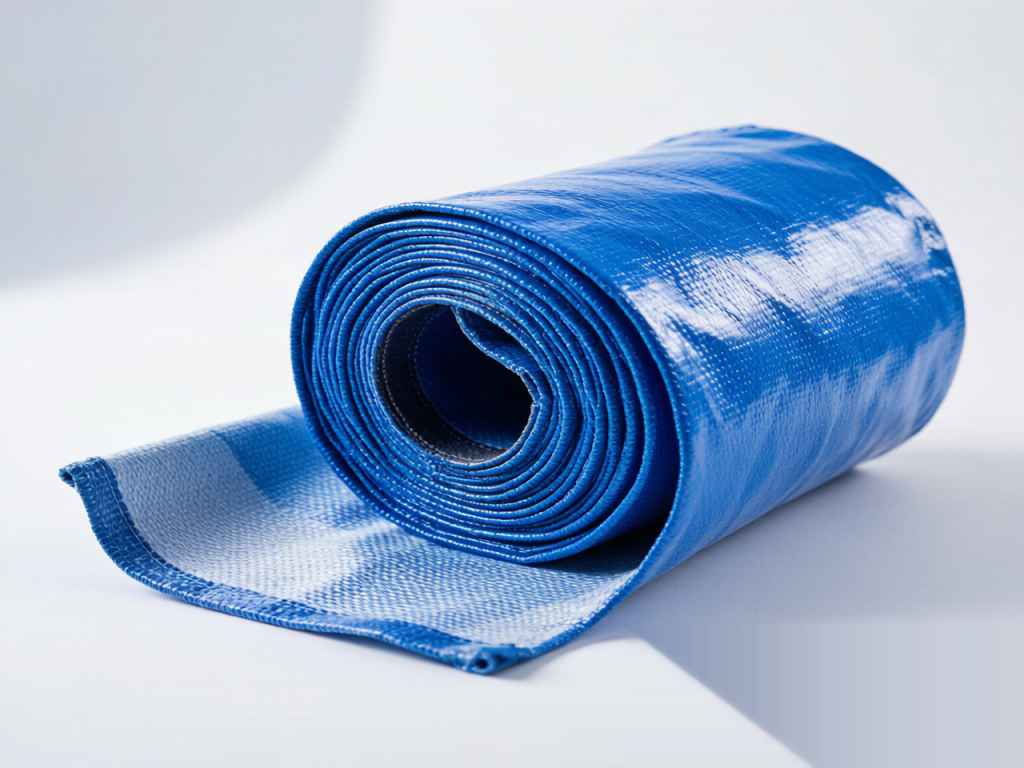
Introduction
Most industrial buyers of PVC tarpaulins know what they want — a uniform, waterproof, UV-resistant fabric that performs reliably for years. But few buyers question how the tarpaulin was made. The choice of coating technology dramatically affects finished product performance, and among the available methods — dip coating, spray coating, transfer coating, and knife coating — the knife-coating process stands alone in its ability to deliver industrial-grade uniformity, thickness precision, and mechanical performance.
The Knife-Coating Process Explained
At its core, knife coating is a deceptively simple principle: a precise metering head (the “knife”) spreads a controlled volume of liquid PVC plastisol onto a moving base fabric. But Kezhibo’s modern knife-coating lines incorporate three layers of advanced engineering that elevate the process from a basic spreader to a precision manufacturing system:
1. Closed-Loop Thickness Control
Every Kezhibo knife-coating line incorporates a beta-ray thickness gauge positioned immediately after the coating head. The gauge measures coating thickness at 20 Hz across the entire 3-meter width of the fabric, and sends real-time feedback to a servo motor that adjusts the knife gap by microns. The result: thickness uniformity of ±5 µm across the full width, compared with typical ±20 µm for unregulated knife coating and ±35–50 µm for dip coating.
2. Double-Side Knife Coating
Kezhibo applies top and bottom coatings simultaneously using a sandwich-style knife configuration: the fabric passes between two opposing knife heads, with bottom coating applied first to ensure 100% coverage (critical for waterproofing), followed by top coating. This prevents the common defect where dip-coated fabrics have thinner bottom sides due to drag in the dip tank.
3. In-Line Curing and Calendering
After knife coating, the fabric enters a multi-zone oven where it is cured at progressively increasing temperatures (starting at 120 °C, ending at 185 °C for standard PVC formulations). After curing, a pair of heated calender rollers further compresses the coating to eliminate voids and create an ultra-smooth surface — important for both UV stability and visual appearance in architectural applications.
Performance Comparison: Knife-Coated vs Dip-Coated Tarpaulins
| Performance Metric | Knife-Coated (Kezhibo 600 gsm) | Dip-Coated Competitor (600 gsm) | Improvement |
|---|---|---|---|
| Thickness Uniformity | ±5 µm | ±42 µm | 8.4× tighter tolerance |
| Water Penetration Resistance | 3000 mm H₂O | 1800 mm H₂O | 67% higher |
| Delamination Force | 38 N/cm | 19 N/cm | 100% higher |
| UV Retention (2000h) | 87% | 71% | 16 points higher |
| Color Consistency | ΔE < 2.0 | ΔE 4.5–6.0 | Industry benchmark |
| Edge-to-Center Weight Variation | ±8 gsm | ±55 gsm | 6.9× better |
The delamination data is particularly telling. Knife coating ensures the PVC plastisol wets and penetrates the base fabric yarns more deeply than dip coating, creating a mechanical bond that prevents delamination even after 1000+ hours of outdoor UV exposure.
Knife Coating Enables Specialty Formulations
One of the greatest advantages of knife coating is its versatility with specialty PVC formulations that are difficult or impossible to apply via other methods:
- High-viscosity flame retardant formulations: Dip coating requires low viscosity for the fabric to properly submerge — a challenge with heavily filled FR formulations. Knife coating handles high-viscosity plastisols with ease.
- Translucent architectural membranes: Knife coating can apply a thin (30–50 µm) crystal-clear coating without the “orange peel” surface defects common in spray coating.
- Anti-fouling marine formulations: Biocide-loaded PVC plastisols can be applied as a topcoat only, preserving structural integrity of the base layers while delivering targeted surface protection.
- Print-receptive coatings: A specially formulated topcoating can be knife-applied to prepare the surface for digital printing — critical for branded truck curtains and promotional banners.
Engineering Precision: The 0.02 mm Difference
In industrial specifications, a 0.02 mm (20 µm) thickness difference across a tarpaulin roll is the typical tolerance for dip-coated products. But consider this: a 0.02 mm thin spot in a waterproof membrane creates a failure point that can develop a leak after just one severe freeze-thaw cycle. Knife coating’s ±5 µm tolerance — a 4× improvement — eliminates these failure initiation points entirely.
Safety note: For life-safety applications (emergency shelters, military equipment covers), the ISO 14801 standard requires thickness uniformity within ±10 µm. This specification can only be met with knife-coated or transfer-coated fabrics; dip-coated products cannot reliably achieve it.
Sustainability: Less Waste, More Control
Knife coating generates approximately 70% less PVC scrap than dip coating because there is no excess plastisol that needs to be stripped from the back side of the fabric. Additionally, Kezhibo’s closed-loop system recycles 100% of trimmings and off-spec edges by grinding them into powder and reintroducing them into the PVC formulation — a process that diverts approximately 2.5 tons of waste monthly from landfills.
CTA: Quality-First Tarpaulin Manufacturing
Kezhibo operates 12 knife-coating lines across two manufacturing facilities in China, each equipped with closed-loop thickness control and in-line quality monitoring. We produce 12,000+ tons of coated fabrics annually for OEM/ODM clients in 38 countries. Whether you need a standard 550 gsm truck curtain material or a custom 300 µm ultra-thin architectural membrane, our knife-coating technology delivers the precision your application demands.
Request a factory tour or technical datasheet: Coated Fabric Product Line