# EU 2026/2035 MCCPs Restriction: What PVC Coated Fabric Exporters Must Verify
## What are MCCPs and why do they matter for PVC coated fabric?
**Medium-chain chlorinated paraffins (MCCPs), C14-C17 chlorinated alkanes, have served as secondary plasticisers and flame retardants in PVC, but the European Commission’s Delegated Regulation (EU) 2026/2035, published on 18 November 2026, adds them to POP Regulation (EU) 2019/1021 Annex I Part A. From the 2 December 2026 entry-into-force date, MCCPs-contaminated PVC coated fabric cannot be placed on the EU market.**
– MCCPs are chlorinated alkanes with carbon chain lengths from C14 to C17, listed as persistent organic pollutants at Stockholm Convention COP12 in May 2025
– The EU POP Regulation Annex I Part A now lists 35 substances; the rule was published in the Official Journal on 18 November 2026
– Delegated Regulation (EU) 2026/2035 enters into force 20 days after publication, on 2 December 2026
Source: European Commission Delegated Regulation (EU) 2026/2035; Stockholm Convention COP12 decision, May 2025.
## How does the MCCPs rule change exporter verification duties?
**Exporters must verify that PVC paste resin, suspension resin, plasticiser packages, and flame-retardant additives are MCCPs-free or below the POP Regulation’s unintentional trace contamination limit, because the restriction applies to the finished article placed on the EU market, not just the raw chemical. Coated tarpaulins, geomembranes, and architectural membranes all fall within this article-level scope.**
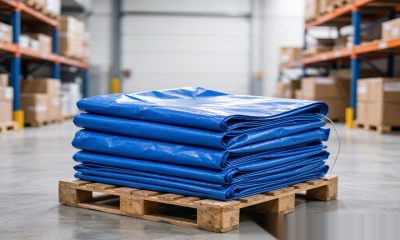
– The restriction is substance-based and article-level; imported PVC tarpaulin, geomembrane, tent fabric, and truck side curtain are all in scope
– Accredited test report (GC-MS or LC-MS) showing MCCPs below the applicable limit; keep with shipment documents and confirm on request
– Downstream buyers may request a signed declaration that no MCCPs were intentionally added to the formulation
Source: Regulation (EU) 2019/1021 on persistent organic pollutants and its (EU) 2026/2035 amendment.
## Which substitutes replace MCCPs in PVC coated fabric?
**DOTP, epoxidised soybean oil, and calcium-zinc stabilisers are the mainstream replacement routes for MCCPs in PVC coated fabric, because they remove the persistent chlorinated paraffin while preserving flexibility and heat stability, though each brings a cost or loading trade-off. The right package depends on whether MCCPs were used mainly as plasticiser or as flame-retardant synergist.**
– DOTP: 40-60 phr in the knowledge-base formulation range, non-phthalate; cost premium 18-24% versus DOP (2025 market data)
– ESBO: bio-based epoxidised soybean oil at 3-5 phr as co-plasticiser, also contributes UV stability
– Calcium-zinc stabiliser: replaces legacy lead-based and organotin systems; confirm the specific grade with your supplier
Source: PVC product knowledge base, resin grades and plasticiser/stabiliser systems; REACH SVHC list.
## Which test methods confirm MCCPs absence in PVC coated fabric?
**Gas chromatography-mass spectrometry after solvent extraction is the standard way to quantify MCCPs in PVC articles, with reporting limits typically in the low milligram-per-kilogram range. An ISO/IEC 17025 accredited laboratory should issue the test report, because customs and downstream buyers expect traceable analytical evidence rather than a supplier’s verbal statement.**
– GC-MS: solvent extraction of the PVC matrix followed by capillary GC-MS quantification; confirm the method’s reporting limit with the laboratory
– LC-MS is an alternative for complex coated-fabric matrices where chlorinated paraffin isomers co-elute
– Total chlorine screening is sometimes used first, but it cannot identify MCCPs specifically and must not replace targeted analysis
Source: European Chemicals Agency analytical guidance; ISO/IEC 17025 laboratory accreditation standard.
## FAQ
**Q1: When does the MCCPs restriction take effect for EU-bound PVC coated fabric?**
Delegated Regulation (EU) 2026/2035 was published on 18 November 2026 and enters into force on 2 December 2026, twenty days later. From that date, PVC coated fabric articles containing MCCPs above the POP Regulation limit cannot be newly placed on the EU market. Exporters should obtain an accredited GC-MS report and update formulation records before shipping. Confirm the exact limit in the regulation text with your testing laboratory.
**Q2: Are MCCPs restricted only in the EU, or in other markets too?**
The Stockholm Convention COP12 in May 2025 listed MCCPs as persistent organic pollutants, so all parties are expected to implement domestic controls over time. The EU is the first to enact a binding article-level rule through (EU) 2026/2035, but other markets are likely to follow. Treat MCCPs removal as a global formulation change and verify market-specific limits rather than assuming the EU deadline is the only one.
**Q3: Our fabric uses DOTP and no MCCPs. Do we still need a test report?**
Yes. Even without intentional addition, trace contamination can enter through recycled resin, shared lines previously running MCCPs, or impure plasticiser feedstock. The POP Regulation restricts unintentional trace contamination above the stated limit, so a third-party GC-MS report from an ISO/IEC 17025 laboratory remains the standard evidence. Keep the report with shipment documents and confirm its scope covers the shipped article.
**Q4: Why were MCCPs used in PVC coated fabric in the first place?**
MCCPs served as a low-cost secondary plasticiser and flame-retardant synergist, improving flexibility, chemical resistance, and flame performance in PVC formulations. Because they are persistent and bioaccumulative, they are now being phased out. Replacement means rebuilding those properties with DOTP, ESBO, and mineral flame retardants, which changes cost and loading. Ask your formulation supplier for a like-for-like comparison rather than assuming a direct swap.
**Q5: Does the rule cover PVC geomembrane and tarpaulin equally?**
Yes. The restriction applies to articles placed on the EU market by substance, not by product category. PVC geomembrane, tarpaulin, tent fabric, truck side curtain, and architectural membrane are all articles in scope. There is no exemption for industrial or technical textiles, so every coated-fabric export line should verify its additive package and hold the relevant analytical report.
**Q6: What does removing MCCPs cost in a coated-fabric formulation?**
Replacing MCCPs with DOTP carries an 18-24% premium over general-purpose DOP based on 2025 market data. Mineral flame retardants such as ATH need much higher loading than a chlorinated paraffin synergist, which can affect tensile properties and weight. The net increase depends on the original MCCPs level; request a costed reformulation from your supplier instead of relying on a generic percentage.
**Q7: Can we ship existing MCCPs-containing stock before 2 December 2026?**
Articles lawfully placed on the EU market before the entry-into-force date may generally continue to be sold, but new placements after 2 December 2026 are prohibited. Customs may ask for test documentation on arrivals after the deadline. Ship any non-conforming stock before the date, switch formulations immediately, and confirm the transition terms with your EU importer before dispatch.
**Q8: How does the MCCPs rule interact with REACH and the PFHxA restriction?**
MCCPs join a broader set of restricted additives in PVC: DEHP and DOP under REACH SVHC, PFHxA under (EU) 2024/2462, and organotin stabilisers under ecolabel schemes. The direction is toward halogen-free, non-phthalate, non-PFAS formulations. Audit the entire additive package against all concurrent rules and request updated declarations from each supplier rather than checking one regulation at a time.
## FAQ (ZH)
**问1:欧盟 2026/2035 法规对出口 PVC 涂层布的 MCCPs 限制何时生效?**
授权法规 (EU) 2026/2035 于 2026 年 11 月 18 日发布,20 天后的 12 月 2 日生效。自生效日起,MCCPs 含量超过 POP 法规限值的 PVC 涂层布制品不得新投放欧盟市场。出口商应在发货前取得有资质的 GC-MS 检测报告并更新配方记录,具体限值请与检测实验室核对确认。
**问2:MCCPs 是否只在欧盟受限,其他市场呢?**
《斯德哥尔摩公约》COP12 于 2025 年 5 月将 MCCPs 列为持久性有机污染物,各缔约方预计会陆续落实管制。欧盟率先通过 (EU) 2026/2035 建立制品层面的强制规则,其他市场可能跟进。建议把淘汰 MCCPs 作为全球配方调整,并核实各市场具体限值,不要只盯欧盟期限。
**问3:我们使用 DOTP、不添加 MCCPs,还需要检测报告吗?**
需要。即使不主动添加,回收树脂、曾跑 MCCPs 配方的共线生产或增塑剂原料杂质都可能带来痕量污染。POP 法规限制超过限值的非有意痕量污染,因此 ISO/IEC 17025 实验室的第三方 GC-MS 报告仍是标准证据。报告应随货保存,并确认其覆盖范围包含实际出货的产品。
**问4:MCCPs 当初为什么用于 PVC 涂层布?**
MCCPs 曾作为低成本辅助增塑剂和阻燃协效剂,改善 PVC 配方的柔韧性、耐化学性和阻燃表现。因其持久性和生物累积性正被淘汰。替代意味着用 DOTP、ESBO 和无机阻燃剂重建这些性能,会带来成本和添加量变化。建议向配方供应商索取等效对比,不要假设可以直接等量替换。
**问5:该规则对 PVC 土工膜和篷布是否一视同仁?**
是的。限制按物质、按投放欧盟市场的制品执行,不按产品类别区分。PVC 土工膜、篷布、帐篷布、卡车侧帘和建筑膜材都属于管制范围,产业用纺织品没有豁免。每条涂层布出口线都应核查添加剂包,并留存相应分析报告。
**问6:去除 MCCPs 对配方成本影响多大?**
根据 2025 年市场数据,用 DOTP 替代 MCCPs 相对通用 DOP 有 18-24% 的溢价。氢氧化铝等无机阻燃剂所需添加量远高于氯化石蜡协效剂,可能影响拉伸性能和克重。净增幅取决于原 MCCPs 用量,建议向供应商索取成本核算后的改配方方案,而不要套用笼统百分比。
**问7:能否在 2026 年 12 月 2 日前出完含 MCCPs 的现有库存?**
生效日前已合法投放欧盟市场的制品一般可继续销售,但 12 月 2 日后的新投放被禁止。海关可能对期限后到货查验检测文件。建议在期限前出清不合规库存、立即切换配方,并与欧盟进口商确认过渡条款细节后再发货。
**问8:MCCPs 规则与 REACH、PFHxA 限制如何叠加?**
MCCPs 与 REACH SVHC 下的 DEHP/DOP、(EU) 2024/2462 下的 PFHxA、生态标签体系下的有机锡稳定剂等一起,构成 PVC 添加剂受限清单。整体方向是无卤、非邻苯、无 PFAS 配方。应对照所有并行法规审查整个添加剂包,并逐一向供应商索取更新声明,而非只查单条法规。