
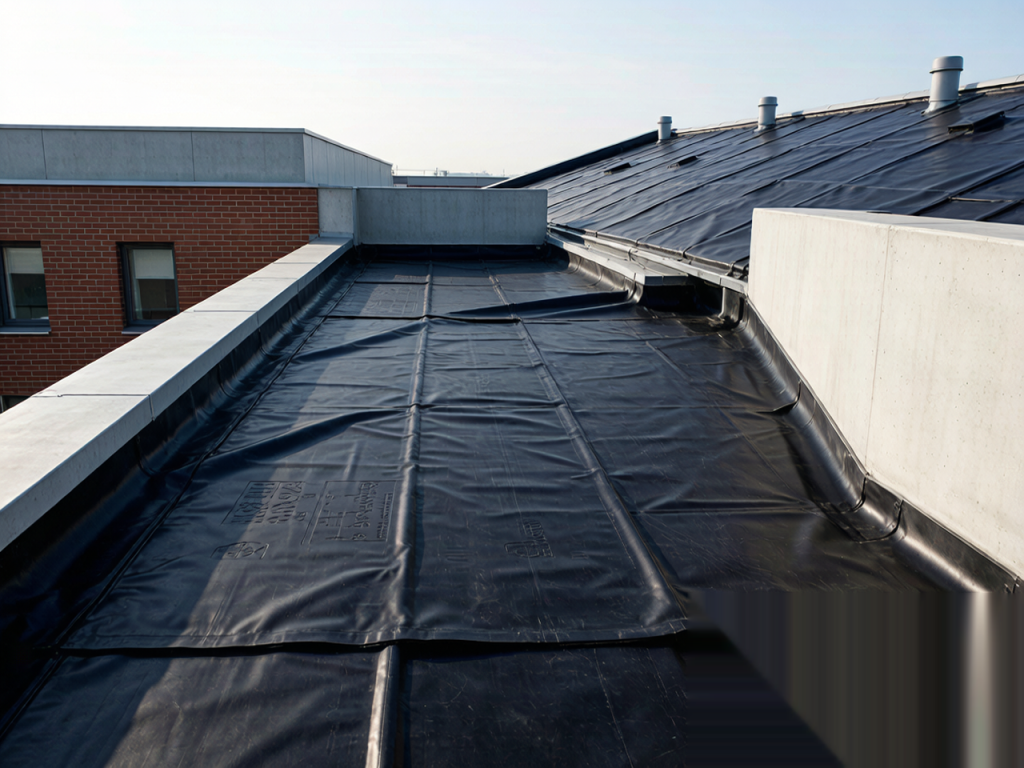
TL;DR: Garland’s KEE-Stone Legacy is the industry’s first PVC roofing membrane with bio-based ELVALOY™ KEE, certified to ASTM D4434 Type III and completely phthalate-free
Announced in April 2026 by Cleveland-based The Garland Company, KEE-Stone Legacy represents a breakthrough in sustainable PVC roofing technology. The fleece-backed thermoplastic membrane is formulated with the industry’s first bio-based ELVALOY™ Ketone Ethylene Ester (KEE) copolymer from Dow Inc., combined with non-phthalate bio-based liquid plasticizers below the scrim. Certified to ASTM D4434, Type III standards, the membrane uses advanced mass balance technology (MBT) to incorporate renewable feedstock without sacrificing the 10+ years of proven field performance that Garland’s KEE products are known for.
What makes KEE-based PVC membranes different from conventional roofing membranes?
PVC roofing membranes dominate the low-slope commercial roofing market due to their excellent weatherability, chemical resistance, and longevity. However, conventional PVC membranes rely on phthalate plasticizers to achieve the required flexibility—and phthalates face increasing regulatory scrutiny globally. KEE-based membranes address this by replacing phthalate plasticizers with ketone ethylene ester copolymer, which acts as a polymeric plasticizer integrated into the PVC matrix at the molecular level.
| Feature | Conventional PVC Membrane | KEE-Based Membrane | KEE-Stone Legacy (Bio-Based) |
|---|---|---|---|
| Plasticizer System | Phthalate-based (e.g., DOP, DINP) | ELVALOY™ KEE copolymer | Bio-based ELVALOY™ + bio-based liquid plasticizer |
| Phthalate-Free | No | Yes | Yes |
| Bio-Based Content | 0% | 0% | Renewable feedstock via MBT |
| ASTM Standard | D4434 Type I/II | D4434 Type III/IV | D4434 Type III |
| Field Performance Track Record | 20+ years | 10+ years | Decade-proven KEE formulation with bio-based upgrade |
| Carbon Footprint | Baseline | Slightly reduced (no phthalate production) | Further reduced via renewable content |
“The polymerically plasticized ELVALOY compound above the scrim has been vetted through nearly a decade of performance in the field,” explained Garland’s R&D Director Julie Anne Geyer. “This formula provides a PVC membrane with the durability of KEE above the scrim, while the non-phthalate, bio-based liquid plasticizers below the scrim provide the system with improved flexibility.” The membrane is designed for low-slope commercial roofing applications where wind uplift resistance, UV stability, and long-term watertightness are critical requirements.
How does mass balance technology enable bio-based content?
Mass balance technology (MBT) is a chain-of-custody approach that tracks sustainable feedstock through complex manufacturing processes. For KEE-Stone Legacy, Dow produces ELVALOY™ KEE copolymer using a portion of renewable bio-based feedstock alongside conventional fossil-based raw materials. The bio-based content is mathematically allocated to specific product batches, enabling Garland to certify that KEE-Stone Legacy contains renewable materials without physically separating bio-based and fossil-based molecules—a prohibitively expensive process.
MBT is audited under ISO 14067 (carbon footprint) and ISO 14069 (organizational GHG accounting) standards, providing third-party verification that the bio-based claims are accurate and not merely offset or “greenwashed” through carbon credits.
For commercial property owners and contractors, this means KEE-Stone Legacy delivers verifiable sustainability credentials that can be used toward LEED, Green Globes, and ENERGY STAR certification credits. In California, the membrane also qualifies for Title 24 building energy code requirements for cool roof applications when formulated with a reflective top sheet.
Why does bio-based KEE matter for the PVC coating industry?
Garland’s innovation signals a broader shift in the industrial coatings and construction materials sectors toward bio-content without compromising performance. For PVC-coated fabric manufacturers, this development has several important implications:
- Bio-based additives are now commercially proven: Dow’s bio-based ELVALOY™ demonstrates that key PVC formulation components can be produced from renewable feedstock at scale. This validates the mass balance approach for other PVC modifiers and stabilizers.
- Phthalate-free formulations are no longer premium-priced: KEE-based membranes are approaching price parity with phthalate-containing PVC membranes, as bio-based production scales up and regulatory compliance costs for phthalate-containing products increase.
- Certified bio-content creates market differentiation: Products with audited renewable content can command 5–12% price premiums in green building markets while meeting strict public procurement requirements in jurisdictions like California, New York City, and the EU.
For industrial fabric suppliers, the KEE approach offers a model for sustainability upgrading that aligns with proven performance. Rather than replacing the entire PVC substrate with alternative polymers (as some bio-material developers propose), the KEE formulation enhances the existing PVC matrix with sustainable components—a more practical path for manufacturers with significant capital invested in PVC coating lines. See our PVC roof waterproofing membrane offerings for comparable sustainable roofing solutions.
What regulatory trends are driving bio-based KEE adoption?
Three regulatory forces are accelerating the transition from phthalate-containing PVC to bio-based alternatives:
1. Global phthalate restrictions. The EU’s REACH regulation has restricted eight common phthalates (DEHP, DBP, BBP, DIBP, DNOP, DINP, DPP, DHXP) since 2015. In 2026, California’s Department of Toxic Substances Control is expected to finalize its ban on DINP in children’s products, with potential expansion to building materials. Several Asian jurisdictions including China (GB/T 38186-2019) and Singapore have also adopted phthalate limits for construction materials.
2. Public procurement sustainability requirements. Many government entities now require minimum bio-based content in building materials used for public projects. The U.S. federal Biobased Products Preferred Procurement Program, which has certified over 2,000 products including PVC modifiers, now requires federal agencies to purchase biobased alternatives when available.
3. ESG reporting mandates. The EU’s Corporate Sustainability Reporting Directive (CSRD) and the U.S. SEC climate disclosure rules (expected finalization in 2026) require large companies to disclose product-level carbon footprints. Bio-based content provides a measurable way to demonstrate reduced product emissions in these reports.
What’s next for bio-based PVC formulation?
Garland and Dow have both signaled commitments to expanding bio-based content in KEE formulations through 2028. Key development areas include:
- Higher bio-content grades: Dow is developing ELVALOY™ KEE grades with 50%+ bio-based content via mass balance, targeting certification for commercial roofing and industrial textile applications.
- Bio-based PVC resin: Multiple suppliers including Vinyl Vantage and INEOS are producing bio-based PVC resin from sugarcane ethanol or waste feedstock, enabling fully bio-based PVC formulations.
- Expanded industrial applications: KEE technology is being explored for coated tarpaulins, truck side curtains, and even flexible packaging applications where flexibility and durability are required.
Bottom line: Bio-based KEE proves sustainability and performance can coexist in PVC
KEE-Stone Legacy demonstrates that PVC-based products can achieve meaningful sustainability gains without sacrificing the performance properties that have made PVC the dominant material in commercial roofing and industrial textiles for decades. The mass balance approach used by Garland and Dow is particularly significant because it provides a practical, auditable, and scalable path to bio-based content for manufacturers already invested in PVC production infrastructure.
For industrial fabric suppliers, the message is clear: sustainability innovation in PVC is no longer about replacing the polymer—it’s about upgrading the formulation. With KEE technology, bio-based modifiers, and mass balance certification, PVC can remain competitive in an increasingly sustainability-focused market.
Sources: Garland Company April 2026 Product Announcement; Dow ELVALOY™ Product Brochure; ASTM D4434 Standard Specification for Polyvinyl Chloride (PVC) Sheet Materials for Single-Ply Roofing Membranes; ISO 14067 Greenhouse Gas Standards; California DTSC Phthalate Restrictions.












