
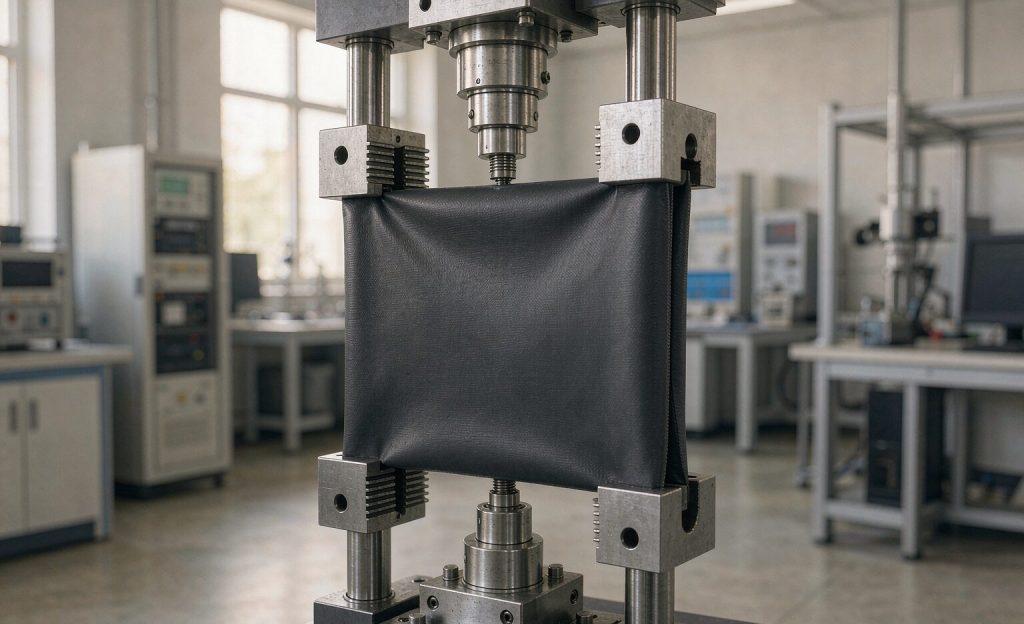
On 5 November 2026 the science and technology department of the China National Textile and Apparel Council published a consultation on 167 proposed standard projects. One industry-standard item proposes a laboratory method for the fatigue resistance of the bond between a coating and its textile base cloth under repeated stretch, relaxation, stacking and re-stretching cycles. For buyers of knife-coated PVC tarpaulin, truck side curtain and inflatable fabric, this is a signal about how durability may be specified from 2027 onwards, not a rule that can already be cited on an order. This article separates what the consultation actually says from what a procurement team should do today.
What exactly did CNTAC put out for comment on 5 November 2026?
On 5 November 2026 the China National Textile and Apparel Council opened a public consultation on 167 proposed standard projects, split into 71 recommended national standards and 96 industry standards, with written objections due by 11 November 2026; one industry-standard item proposes a method for measuring coating-to-base-cloth bond fatigue under repeated stretch, relaxation, stacking and re-stretching cycles.
- Plan size: 71 recommended national standards plus 96 industry standards = 167 projects; feedback deadline 11 November 2026, submitted to [email protected] — CNTAC science and technology department notice dated 5 November 2026, with three attachments.
- New method: system number 01-01-04-02-017, “Coated fabrics — Determination of resistance to cyclic tensile loading”, classified as a new test method with a 12-month completion period — Attachment 2, industry standard plan, item 3.
- Adjacent PVC item: system number 01-07-04-16-013, “PVC coated yarn for sun-shading”, covering round cross-section yarn of nominal linear density 100 dtex to 3000 dtex — Attachment 2, item 50.
Why does a cyclic tensile fatigue method matter for PVC coated fabric procurement?
The proposed method targets a failure mode that single-cycle peel and tensile values miss: progressive delamination between the PVC coating and its base cloth as a tarpaulin, side curtain or inflatable panel is repeatedly loaded and folded in service. Read it as a future durability criterion, not a pass-fail limit that can already be written into a 2026 order.
- Method it will sit beside: coating adhesion and peel are currently measured per ISO 2411 / EN ISO 2411, with DIN 53357 as an alternative — kezhibo PVC knowledge base §2.2 test-method index.
- Existing peel benchmark: the cover-fabric grade table sets peel at ≥100 N/5cm and tensile at 1950–4300 N/5cm — kezhibo PVC knowledge base §2.1.
- Failure mechanism in the knowledge base: anti-wick yarn is specified to stop moisture travelling along yarns by capillary action and causing delamination; untreated tensile roof cloth is listed as a common selection error — kezhibo PVC knowledge base §1.3 and §4.
What should a buyer write into a 2027 purchase order while the standard is still a draft?
Write the order against the test methods that already exist, ask for a formulation-specific, lot-identified report set covering mass per unit area, tensile, tear and peel, and add a re-test clause tied to publication of the new method, because the consultation document sets a twelve-month drafting period but publishes no acceptance limits, pass values or sampling rules yet.
- Draft status: consultation closes 11 November 2026 and the completion period is 12 months, so no limit value exists to contract against — Attachment 2, item 3.
- Report set available now: EN ISO 2286-2 for mass per unit area, ISO 1421 for tensile, DIN 53363 / EN 1875-3 for trapezoidal tear, ISO 2411 for peel — kezhibo PVC knowledge base §2.2.
- Scope to watch: the draft covers woven, knitted and nonwoven base cloths including artificial leather and synthetic leather composites — Attachment 2, item 3.
FAQ
Does the 5 November consultation already impose a legal requirement on coated fabric shipments?
No. A standards plan consultation publishes proposed projects and invites written objections; it does not set limit values, effective dates or mandatory test thresholds. The industry-standard item is classified as a new method with a 12-month completion period, so the earliest realistic output is a draft for comment rather than an enforceable standard. Buyers should therefore keep using the published method set in their orders — EN ISO 2286-2, ISO 1421, DIN 53363 and ISO 2411 — and record the consultation as a change to monitor, not as a clause to satisfy today.
Which coated fabric products fall inside the scope of the proposed cyclic tensile method?
The draft text names coated fabrics based on woven, knitted or nonwoven textile substrates, and explicitly includes artificial leather and synthetic leather composites built on a textile base. That is broader than a single tarpaulin grade and would, once published, potentially cover truck side curtains, inflatable panels, tent cloth and printed banner substrates. A buyer should not assume a product is excluded because its end use is industrial; the scope is written around the substrate and coating construction, so ask the supplier to state the base cloth type in the quotation.
What is the difference between a peel test and a cyclic tensile fatigue test?
A peel test such as ISO 2411 measures the force needed to separate coating from base cloth in a single, controlled pull, while the proposed method records how that bond survives repeated stretch, relaxation, stacking and re-stretching cycles. A fabric can show a healthy single-cycle peel figure and still lose adhesion after repeated folding in service. The kezhibo knowledge base lists the cover-fabric peel benchmark at ≥100 N/5cm; that value remains the contractual anchor until a fatigue-based acceptance limit is published and verified by a named laboratory.
Should I ask my supplier for a cyclic tensile result now?
Request it as development data, not as an acceptance condition. Because the method is still at proposal stage, no accredited procedure, sample geometry or pass value exists, so a number produced today cannot be compared between suppliers. A more useful request is a lot-identified report set under the existing methods, plus a written description of how the coating formulation and any anti-wick treatment are held constant between lots. That gives you a baseline to compare against when the fatigue method is eventually published.
How does the anti-wick yarn detail relate to this new method?
The knowledge base describes anti-wick yarn as a construction choice that prevents capillary moisture transport along the yarn, which otherwise contributes to delamination. That is a different failure path from mechanical fatigue, but both end in the same coating-to-base-cloth separation. When a supplier changes base-cloth treatment to cut cost, peel and fatigue behaviour can move together. Ask for the base-cloth specification and treatment on the purchase order so a later change is visible rather than buried inside an unchanged gsm and width.
Will the PVC coated yarn item change awning fabric specifications?
The second relevant item, system number 01-07-04-16-013, concerns PVC coated yarn for sun-shading with a nominal linear density from 100 dtex to 3000 dtex and a round cross-section. It addresses the yarn input, not the finished coated fabric, so it does not by itself alter a tarpaulin or awning fabric acceptance criterion. It is nevertheless worth tracking if your supply chain buys coated yarn, because a yarn-level method can later be referenced in a fabric-level claim about shading performance or dimensional behaviour.
What evidence should a 2027 RFQ demand instead of a draft-standard claim?
Ask for a third-party report that names the laboratory, the test method used for each property, the sample lot, the coating formulation, the units and the date. Cross-check mass per unit area per EN ISO 2286-2, tensile per ISO 1421, tear per DIN 53363 or EN 1875-3, and peel per ISO 2411. Add a clause requiring written notice before any formulation, lacquer, ink or base-cloth change, plus a re-test obligation. That structure survives a standards revision without having to renegotiate the whole order.
How often should the report set be refreshed while this standard develops?
Refresh it whenever the formulation, base cloth, lacquer or production line changes, and at least once per supply year for a running programme. A dated report tied to one lot says nothing about a later lot, and the knowledge base already flags that gsm tolerance is normally held to ±10 g/m² by industry convention. Keep a simple mapping of lot, formulation, method and report so that when a fatigue-based method arrives, you can identify which historical lots need a comparison trial rather than re-testing everything.












