
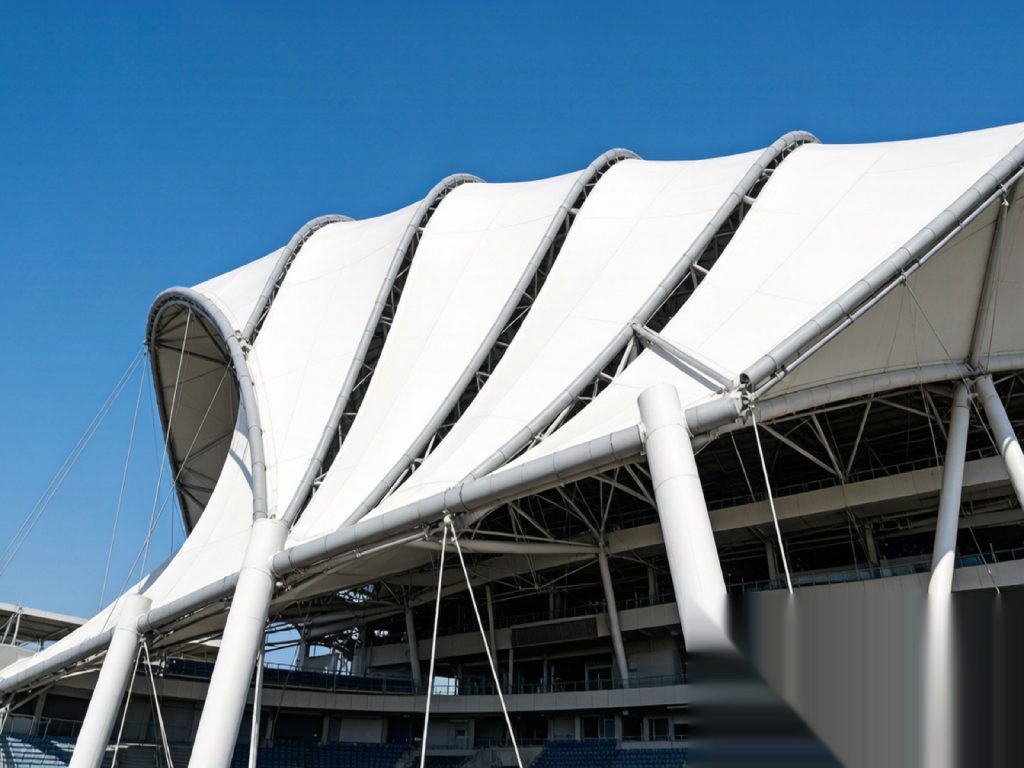
Why facade solar-screen mesh, not a solid shade
Large glass curtain walls, west-facing elevations, atriums, and conservatories turn into heat traps under strong sun. A solid shade fabric blocks light but becomes a sail that adds wind load and a closed feeling; an architectural sunshade mesh cuts glare and heat while letting air and partial sight pass, better suited to exterior facade shading. DERFLEX positions its PVC-coated polyester mesh for facade shading, exterior roller screens, pergolas, and parking shades, with 60%-95% shade rate, 250-550 gsm, up to 3.2 m width, stressing coating consistency and weldability (source: derflex.com).
The parameter that decides everything: openness factor
The key to a solar-screen mesh is not “denser is better” but matching openness to orientation. Advans’ black sunscreen solar mesh uses PVC-coated fibreglass or high-tenacity polyester with openness of 1% / 3% / 5% / 8% / 10%: solar absorption 85%-92%, transmittance 2%-10%, glare reduction 85%-95%, UV transmittance <0.1%, temperature range -30 to +75 degC, standard widths 1.5-3.6 m, available Class A or Class 1 fire rating (source: zjadvans.com). The dark colour absorbs heat and releases it outward by convection, keeping the glass cooler and indoor gain lower, while outward views stay clear and inward privacy improves. APUTEX C4300 quantifies further: 30% polyester plus 70% PVC, 3% openness, 530 g/m2 +/-5%, 0.75 mm +/-5% thickness, finished widths 200/250/300 cm, 36×32 mesh per inch, 97% anti-UV, AATCC 16-2003 colour fastness grade 4.5, NFPA701 certified (source: groupevetex.com).
Applications: from office towers to patient rooms
These meshes deploy wherever glazing dominates: high-rise commercial curtain-wall exterior shading (uniform dark look, lower HVAC load), residential windows and patios in hot climates, atriums and conservatories, and education and healthcare buildings where south/west-facing classrooms and patient rooms need comfort. Advans notes dark mesh takes 1%-3% openness for high-exposure west facades and 5%-10% for east/north, balancing shading and view. DERFLEX’s PVC facade mesh also serves as a decorative second skin, printable branded facade, and replaceable modular screen, with a full-size day/night visual mock-up recommended before ordering.
Selection: match openness to orientation, fire rating to use
Buyer checklist for facade solar-screen mesh: (1) set openness by exposure – 1%-3% for west/high-exposure, 5%-10% for east/north; (2) confirm outdoor weathering evidence, especially high UV stability for black meshes, to avoid embrittlement and fading; (3) for public and commercial buildings verify the fire report – NFPA701 (US) or Class A / Class 1 (some EU), and the report must match the actual material and use; (4) colour fastness (reference AATCC 16-2003 grade 4.5) and batch-to-batch colour match; (5) width and weldability matched to roller or tensioned systems to avoid wrinkle; (6) anti-static, anti-fungal, or antimicrobial available on request. DERFLEX warns not every coated mesh welds the same – confirm seam method with a trial weld before freezing the order.
Market and trend: energy and comfort, two engines
Exterior solar-screen mesh grows on two engines: building-energy and HVAC-cost pressure, and occupant demand for glare-free work and recovery environments. Advans and APUTEX both stress the dual value of dark mesh in energy and privacy, while recyclable PVC and low-VOC compounds are becoming differentiators in premium engineering bids. For a PVC coated-composite supplier, packaging “PVC-coated polyester mesh + controlled openness + NFPA701 / Class A fire + high colour fastness” as a curtain-wall exterior-shading solution is a high-value facade-material route alongside architectural membranes.
Frequently asked questions
Q: How do you choose the openness factor for a building solar-screen mesh?
A: By facade orientation and exposure – 1%-3% openness for west/high-exposure facades for strong shading, 5%-10% for east/north to keep views; Advans’ black mesh shows solar absorption 85%-92% and UV transmittance <0.1%.
Q: What fire rating does a facade shade mesh need?
A: Public and commercial buildings must check the fire report – typically NFPA701 (US) or Class A / Class 1 (EU), and the report must match the actual material and use; APUTEX C4300 carries NFPA701.
Q: How is PVC-coated screen mesh different from a solid shade fabric?
A: A solid fabric blocks light but adds wind load and a closed feel; PVC-coated polyester mesh cuts glare and heat while letting air and partial sight pass, at 250-550 gsm and up to 3.2 m width, better for curtain-wall exterior shading and roller systems.












