
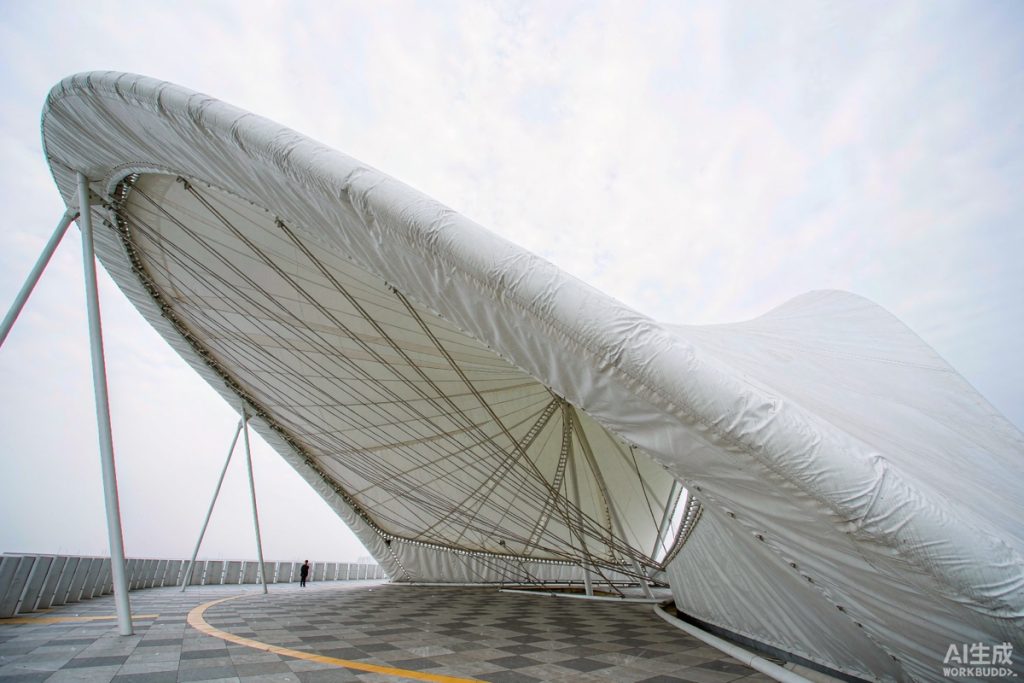
How does the load-carrying system change what the membrane must deliver?
The load-carrying system sets what the membrane must do, because a framed roof transfers tension to a steel skeleton while an air-supported hall relies on internal pressure and a cable-truss span on a cable net; a buyer should name the structural type before comparing fabric grades, since tensile, airtightness and span requirements differ by system.
- A skeletal or framed structure tensions the membrane over a steel frame and is listed with a fabric tensile requirement of 4000-6000 N/5cm (KB2, 2.2).
- An air-supported structure is held by a small internal pressure difference, so it calls for high gas tightness and a lightweight 500-1000 g/m2 fabric (KB2, 2.2).
- A cable-truss system uses a steel cable net for large spans and high strength, while a tensile system introduces curvature through cables and masts and needs high strength plus flexibility (KB2, 2.2).
Which weight and strength bands belong to each membrane grade?
Weight and strength are quoted as grade pairs rather than independent options, since the standard PVC grade and the PVDF-finished high grade differ in mass, warp tensile, tear and peel at the same time; a specifier should keep those rows together and confirm the delivered grade by measurement instead of selecting on a single headline number.
- Standard PVC membrane is listed at 650-850 g/m2 with 4000-6000 N/5cm warp tensile, 550-900 N tear, peel above 100 N/5cm and 5-15% light transmittance (KB2, 2.3).
- The PVDF high-grade type is listed at 850-1050 g/m2 with 5500-7000 N/5cm warp tensile, 700-1200 N tear, peel above 120 N/5cm and 8-18% transmittance (KB2, 2.3).
- Application rows in the same knowledge base give 850-1050 g/m2 for sports facilities, 650-850 g/m2 for transport facilities and 700-1100 g/m2 for air-supported buildings (KB2, 2.4).
Why must fire class and structural type be specified in parallel?
A membrane has to satisfy both the mechanical demands of its structural system and the fire class required at the installation address, so a tensile figure cannot override a fire classification; the knowledge base lists different classification systems by region, and the class string must always be quoted together with the test method that produced it.
- EU tensile structures commonly require EN 13501-1 B-s2,d0 or higher, while US work is listed under NFPA 701 with ASTM E84 Class A (KB1, 3.1; 5).
- EN 13501-1 uses an A1-F plus smoke and droplet class string, whereas DIN 4102-1 B1 and NF P 92-507 M2 are separate national systems and must not be rewritten as EN grades (KB1, 2.3).
- Other listed market routes include AS/NZS 1530.3 for Australia and New Zealand and CAN/ULC-S109 for Canada, so the destination authority decides the required class (KB1, 3.1).
What should a structural-system submittal document before an order is placed?
Require a lot-identified submittal that states the structural type, the membrane grade, the measured mass and tensile results, the full fire-class string and the designer’s span and pressure assumptions; the selection framework ends with checking measured reports against the standards list, so a grade name alone cannot demonstrate that the offered roll fits the structure.
- Mass per unit area is measured by EN ISO 2286-2, tensile behaviour by ISO 1421, tear by DIN 53363 or ISO 4674 and peel by ISO 2411 (KB1, 2.2).
- Hydrostatic resistance of the architectural membrane line is recorded as at least 3000 mm, a line-specific value distinct from the tarpaulin figure (KB2, 2.3).
- Obtaining and checking third-party measured reports against the standards list is the final step of the selection framework (KB1, 4, step 7).
FAQ
Why should the structural type be named before the fabric grade?
Because the four systems load the membrane differently. The kezhibo knowledge base lists a framed structure tensioning fabric over a steel skeleton, a tensile system introducing curvature through cables and masts, an air-supported hall held by a small internal pressure difference, and a cable-truss system using a steel cable net for large spans. The air-supported row explicitly calls for high gas tightness and a lightweight 500-1000 g/m2 fabric, while the framed row lists a 4000-6000 N/5cm tensile requirement. Name the system first, then confirm the grade against it.
What does an air-supported structure need that a framed roof does not?
Gas tightness and low mass. The knowledge base describes air-supported structures as held by an indoor pressure difference under slight positive pressure and lists high gas tightness with a lightweight 500-1000 g/m2 fabric as the material requirement. A framed roof instead transfers tension to a steel skeleton and is listed with a 4000-6000 N/5cm tensile requirement. The air-supported application row separately gives 700-1100 g/m2 for such buildings. Confirm the pressure and seam design with the designer as well as the sheet properties.
Is 650-850 g/m2 enough for every architectural membrane job?
No. In the kezhibo grade table 650-850 g/m2 is the standard PVC grade with 4000-6000 N/5cm warp tensile, while the PVDF high-grade type is 850-1050 g/m2 with 5500-7000 N/5cm. The application table lists 850-1050 g/m2 for sports facilities and 650-850 g/m2 for transport facilities. These are paired rows, not a single threshold. Confirm the grade and the structural type together, and verify the delivered mass by EN ISO 2286-2 at goods receipt.
Can I treat light transmittance as a structural property?
No. Transmittance is an optical property tied to the coating grade, listed as 5-15% for standard PVC and 8-18% for the PVDF high-grade type, and 8-20% in the large-span roof selection row. Structural suitability comes from tensile, tear and peel results plus the frame and anchoring design. The knowledge base lists mismatching light transmission with daylighting and lighting design as a common selection error. Keep optical and mechanical lines separate in the submittal.
Which fire class applies to a tensile membrane roof in the EU?
The knowledge base lists EN 13501-1 B-s2,d0 or higher as the common EU requirement for tensile structures, with class strings built from A1-F plus smoke and droplet suffixes. US-oriented work is listed under NFPA 701 with ASTM E84 Class A, and other routes include AS/NZS 1530.3 and CAN/ULC-S109. DIN 4102-1 B1 and NF P 92-507 M2 are separate national systems, not EN 13501-1 grades. Confirm the exact class with the authority having jurisdiction for the installation address.
What does the architectural membrane hydrostatic figure tell me?
It describes the barrier performance of the coated sheet under a water column, recorded as at least 3000 mm for the architectural membrane line in the kezhibo knowledge base. It is a line-specific value and should not be merged with the tarpaulin line’s water-column figure. It also does not describe seam performance, puncture resistance or wind behaviour. Ask for the method and grade on a lot-identified report, and treat the seam test as a separate report line.
Which mechanical values should accompany a membrane grade name?
Request mass per unit area by EN ISO 2286-2, tensile and elongation by ISO 1421, tear by DIN 53363 or ISO 4674 and peel by ISO 2411, all on one lot-identified report. The kezhibo grade table pairs weight with warp tensile, tear, peel and transmittance, so a grade name quoted without those lines is incomplete. Add the full destination-market fire-class string and the designer’s span and pressure assumptions before releasing the order.
What belongs in a membrane structural-system submittal?
State the structural type, the membrane grade and coating system, the measured mass, tensile, tear and peel results, the full fire-class string with its test method, and the designer’s span, anchoring and any internal-pressure assumptions. Where the knowledge base gives several weight bands for different applications, identify which row the offered roll follows. The selection framework ends with checking measured reports against the standards list, so confirm the whole set on one lot-identified third-party report.












