
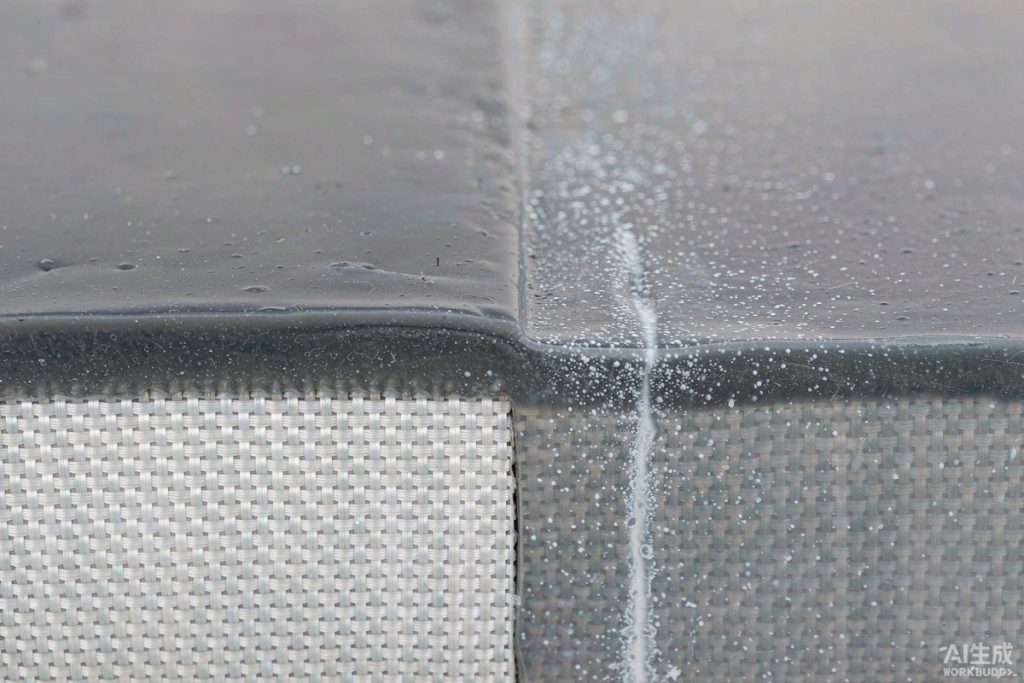
Antifouling for marine aquaculture cages is changing course. The “Canglan” green antifouling series from the Marine Corrosion Protection team at Zhanjiang Bay Laboratory abandons the copper-based, ion-release model and uses a lactone repellent with nano-controlled release to gently deter barnacles and algae. In September 2026 a demonstration began on a roughly 1,200 m², 90 m-circumference deep-sea gravity cage south of Donghai Island; earlier demonstrations on gravity cages in Leizhou Bay had already accumulated several thousand square metres (https://paper.gdzjdaily.com.cn/zjwb/html/2026-10/21/content_146380_3943119.htm). For anyone working in functional coatings or coated fabrics, this is not a ready-made PVC recipe. It is a transferable idea: fouling control through surface functionality and controlled release rather than toxicity.
Why the copper route is being replaced
Conventional copper antifouling works by releasing copper ions, with two drawbacks: efficacy fades quickly and ion release may affect the marine ecosystem. The Zhanjiang team’s starting point was to look to marine organisms themselves, pairing a lactone repellent with nano-controlled release — described as fitting the coating with controllable micro-valves. Multiple trials confirmed ecological safety, and third-party fish toxicity testing found no acute aquatic-hazard classification (https://m.gdzjdaily.com.cn/p/2979343.html; https://c.m.163.com/news/a/L9PNFI3A0512C8U4.html). The direction should be familiar to the PVC-coated-fabric sector, which faces the same constraint under REACH phthalate limits: function cannot be delivered by a restricted substance.
The hard part is adhesion, not the active ingredient
In early 2024 sea-panel trials, coatings that performed well in the lab lost their early advantage at sea. The team narrowed it to two variables: differences in fouling communities, and the bond between coating and netting. The reporting is unusually concrete — polyethylene and nylon nets bend, stretch and rub repeatedly in currents, producing micro-cracks and peeling; steel nets bring welding and complex joint geometry that raise the bar for adhesion and durability. The resin system alone went through five iterations, each requiring re-optimisation of biocide compatibility, nanoparticle dispersion, mechanical properties and the application window (https://paper.gdzjdaily.com.cn/zjwb/html/2026-10/21/content_146380_3943119.htm).
That lesson transfers directly to coated composites. Any functional topcoat — antifouling, antimicrobial, flame-retardant or optical — tends to fail at the interface under dynamic load before the active ingredient stops working. Acceptance testing should measure retention after bending, abrasion and ageing, not just the initial function value.
Numbers the sea trials actually produced
What can be verified from public sources:
- In April 2025, Beijing Oriental Yuhong Waterproof Technology and Zhanjiang Bay Laboratory established a joint lab and launched a joint venture to develop and commercialise marine antifouling and anticorrosion materials for the South China Sea.
- Gravity-cage demonstrations in Leizhou Bay accumulated several thousand square metres; in September 2026 roughly 1,200 m² began at Donghai Island, with a 90 m-circumference coated net immersed and followed for fouling data, golden pompano survival and growth.
- Fujian Haiyun’s deep-sea seahorse smart cage model measures 99 m by 49 m with a 50,000 m³ water volume and is classed by the China Classification Society. Its biomimetic, non-toxic nano-composite netting claims three-year antifouling performance and much lower cleaning frequency (http://www.fujiansannong.com/info/106719).
- A natural-extract route uses capsaicin from hot peppers. Jindao’s system separates dynamic and static applications; the static line targets cage netting, wind-turbine monopiles, bridge piers and monitoring probes, extending a single treatment to three to five years (https://www.haijingshe.com/article/4278/56.html).
What this means for coated-composite specification
The boundary needs stating plainly: these demonstrations mostly involve functional coatings on polyethylene, nylon or steel nets, not PVC calendered coated fabric. Calling Canglan a PVC product would be inaccurate. What transfers is the method and the acceptance logic. First, define how the substrate deforms in service before choosing a resin system. Second, assess adhesion, bending fatigue and functional retention together. Third, ask for sea-trial or equivalent accelerated data rather than initial lab performance alone. Fourth, confirm the regulatory status of the biocide in the target market, so that solving fouling does not create a chemical-compliance problem. The team itself notes that standard-setting will draw on accumulated sea-trial data — a sign the system is still building its evidence base.
FAQ
Can these antifouling coatings be applied directly to PVC-coated fabric?
Not directly. Reported nets are mostly polyethylene, nylon or steel, and their resin systems differ from PVC plastisol. The repellent-and-release concept is transferable, but the formulation must be revalidated on PVC for adhesion and compatibility.
Are three-year or three-to-five-year antifouling claims credible?
Those figures come from company claims and demonstration-stage data, and are tied to specific waters and test periods. Ask for sea-trial reports from the matching environment, the fouling-assessment method, and a conditional rather than absolute warranty.
Which single metric matters most when judging an antifouling coating?
Not initial fouling resistance, but retention of function and adhesion after dynamic bending, abrasion and ageing. In currents the net changes shape continuously, and interface failure usually precedes failure of the active agent.












