
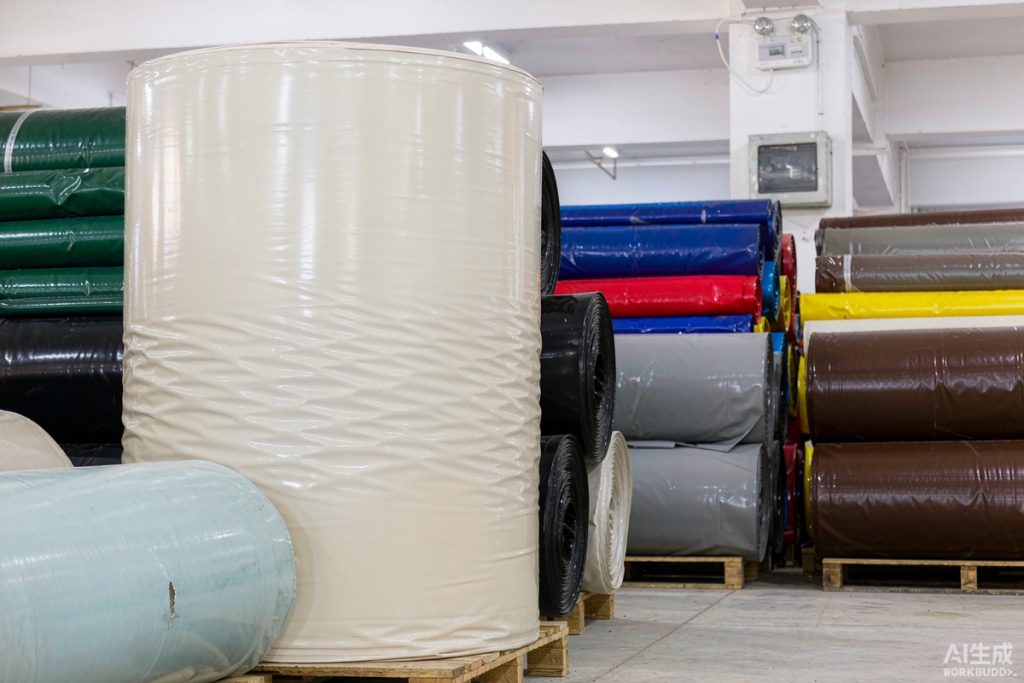
A high-speed roll-up door curtain is not ordinary tarpaulin. It has to flex through hundreds of opening cycles a day at 0.8–1.8 m/s, reverse within 0.3 seconds on contact with a 1 kg obstacle, and still hold air pressure and flame performance in a cleanroom. Specification should be driven by measured values against GB/T 15596, GB/T 2408, QB/T 2699 and GB/T 30047, not by the phrase heavy-duty PVC.
Why door curtain fabric is its own category
Rapid doors serve high-frequency logistics lanes, cleanrooms and cold-chain docks. The curtain sees dynamic fatigue rather than static cover. The common construction is high-tenacity PVC-coated polyester, 0.8–1.5 mm thick, with warp tensile strength around 5,700 N/5cm, weft 5,100 N/5cm, tear strength roughly 900/800 N warp/weft, and a service range of −30 to +70 °C. These figures, published in a supplier specification updated 27 October 2026 (rapid door technical parameters), are a useful enquiry baseline but not a substitute for batch test reports.
A separate 2026 buyer guide gives an operating range of 0.8–1.5 m/s, above 2.0 m/s for high-frequency use, curtain thickness 0.8–1.5 mm, B1 flame rating, wind resistance class 8–12 with aluminium stiffeners, and a price of roughly CNY 8,000–15,000 for a 3 m × 3 m workshop door including installation (Yiwu network, 2026 PVC rapid door selection guide).
Eight standards, line by line
A published certification and testing framework from Zhangjiagang sets out the compliance structure clearly (Haolan Purification, PVC rapid door technical certification standards):
- GB/T 15596 for PVC calendered sheet: warp tensile strength at least 12 MPa, weft at least 10 MPa, to resist wind and pulling.
- GB/T 2408: vertical burning V0, self-extinguishing on flame removal, especially important in chemical and manufacturing plants.
- GB/T 3852.1 and GB 18581: volatile content and harmful-substance limits, keeping VOC out of cleanroom air.
- QB/T 2699 Automatic Doors: on a 50 mm diameter, 1 kg obstacle, reversal must trigger within 0.3 seconds.
- GB 7251.1: insulation resistance between live parts and enclosure at least 2 MΩ; earth resistance no more than 4 Ω.
- GB 3836 series: explosion-proof doors in chemical parks no lower than Exd II BT4.
- GB/T 30047 Industrial Lifting Doors: opening speed adjustable from 0.8 to 1.8 m/s, timing deviation within ±8%.
- GB/T 13754: air infiltration no more than 1.5 m³/(m·h) when closed, bottom seal alignment deviation under 5 mm; wind test at 2.5 kPa static pressure with no curtain damage or guide deformation.
Note that some of these are material standards and others are whole-door or electrical standards. Keep them separate in the purchase specification. Writing the airtightness requirement of GB/T 13754 as a curtain property is a common specification error.
Applications and configuration differences
- Food, electronics and pharmaceutical cleanrooms: prioritise airtightness and cleanability, with radar sensing or interlocked double doors; view windows are commonly 1.5 mm soft PVC sheet.
- Cold-chain docks: focus on flexibility at −30 °C and condensation control, take the upper end of the thickness range, and check ageing where heating elements touch the curtain.
- Chemical parks: combine V0 flame performance with explosion-rated electrics under GB 3836; a flame-retardant curtain alone is not sufficient.
- Coastal yards: specify class 8+ wind resistance and salt-spray conditions; corrosion protection of stiffeners and guides matters more than fabric weight.
Within the market, knife-coated base fabric offers better strength and dimensional stability. One supplier lists a 1.0 mm knife-coated PVC curtain with speed adjustable from 1.0 to 2.5 m/s, wind class 10 (25 m/s) and a maximum frame of 6,000 mm × 6,000 mm (Baidu B2B, updated 1 November 2026, Yuou Door Industry rapid door listing). These are declared values; acceptance still needs third-party reports.
Selection and acceptance checklist
- Define the scenario first: cleanroom, cold chain, explosion risk or wind load. These requirements do not substitute for one another.
- Request batch reports for the curtain covering at least tensile strength, tear, flame behaviour and low-temperature flex.
- Specify the safety test: 50 mm / 1 kg obstacle with reversal in 0.3 s, verified on site rather than in a brochure.
- Check that the entity, model and production address on electrical and explosion certificates match the goods delivered.
- List wear parts separately — curtain, view window, bottom safety edge — with replacement intervals.
FAQ
Is a thicker curtain always better?
No. The normal range is 0.8–1.5 mm; extra thickness increases roll radius and drive load. Cold-chain applications take the top end, while high-frequency indoor lanes are more economical in the middle. The decisive metrics are tensile strength, tear and low-temperature flex, not weight alone.
Are B1 and GB/T 2408 V0 the same flame rating?
No. B1 is a building-material reaction-to-fire classification; GB/T 2408 V0 is a vertical-burning test criterion for plastics. Methods and pass conditions differ. State which standard and class applies in the purchase document and request the matching report.
How do we verify the 0.3-second reversal?
Follow QB/T 2699: place a 50 mm diameter, 1 kg cylindrical obstacle in the closing path and measure from contact to the start of reversal. It should be no more than 0.3 seconds. Run the test three times on site and record each result.












