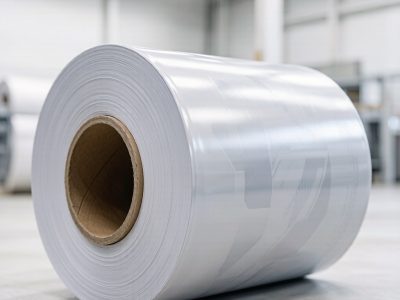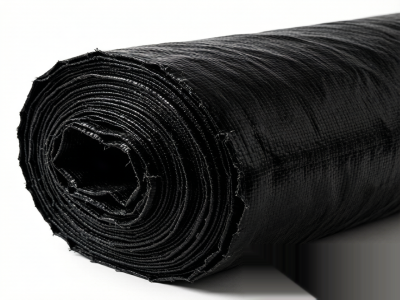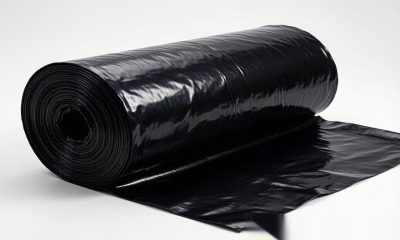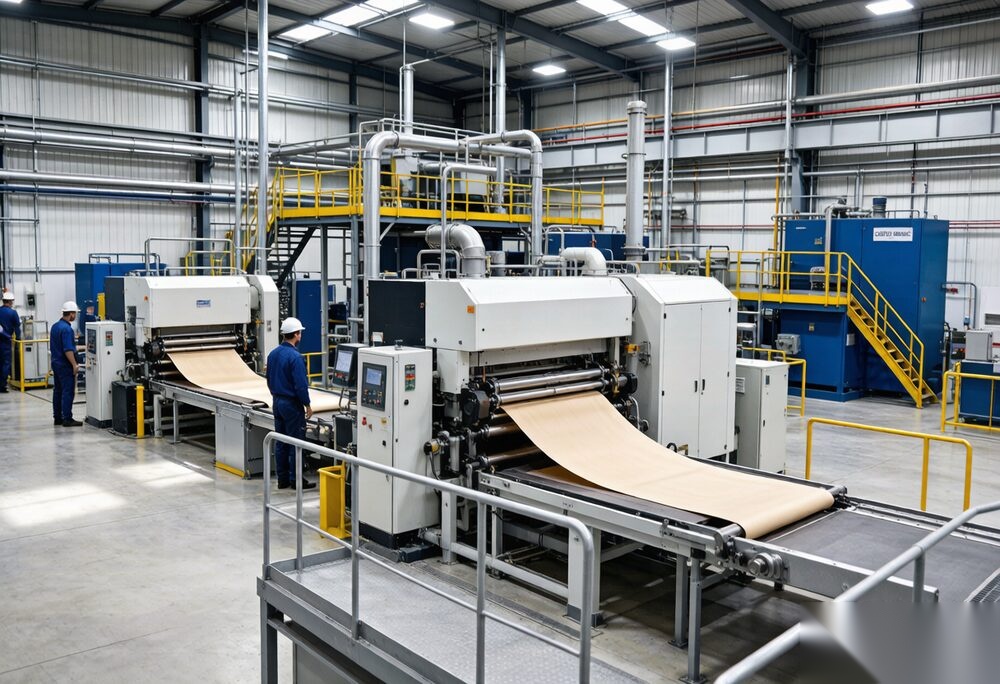
Kezhibo’s newly commissioned knife-coating line automates dosing, curing and thickness gauging, reducing manual variation between batches. Real-time sensors feed a closed-loop control system that holds coating weight within tight limits.
The investment increases daily capacity and shortens delivery windows for large project orders, while improving the uniformity that high-spec architectural and transport clients require.
What Knife Coating Actually Does
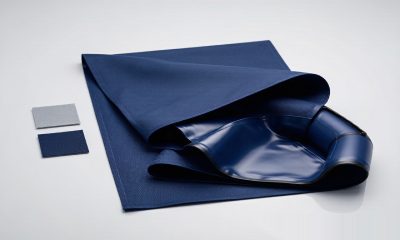
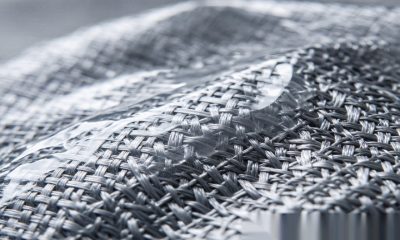
Knife coating — specifically the knife-over-roll configuration — is the process at the core of serious coated fabric manufacturing. A blade, held a precisely controlled distance above the moving base fabric, meters liquid polymer directly onto the weave and presses it into the fabric structure. Unlike lamination, which bonds a pre-made film to the surface, knife coating builds the coating inside the fabric: the polymer penetrates between yarns, interlocks with the weave, and cures into a single bonded construction.
That penetration is why knife-coated fabrics resist delamination under flexing, folding and abrasion — the coating is not a layer sitting on top of the fabric but a continuation of it. The same metering principle is what makes the process powerful and demanding in equal measure: the blade gap, the formulation viscosity, the fabric speed and the substrate tension together decide how much polymer ends up on the fabric. Change any of them and the coating weight changes with them.
Where Batch Variation Comes From
In a conventionally operated coating line, the sources of variation are human-scale and constant:
- Dosing. Preparing and feeding the coating formulation by manual procedure introduces drift — small differences in compound make-up that show up as batch-to-batch colour shifts, viscosity changes and welding behaviour differences downstream.
- Curing. Oven temperature profiles and dwell times control how the coating gels and bonds. Manual adjustment invites inconsistency that appears months later as surface ageing differences nobody can trace.
- Thickness. Coating weight varies across the width of a roll and along its length wherever control is loose. The customer sees this as welding that behaves differently from one part of the roll to another, print surfaces that vary in gloss, or membrane panels that stretch unevenly under tension.
Each variation is small at the moment it happens. That is precisely the problem: nothing fails on the production floor. It fails at the fabricator, at the printing press, or two years into outdoor service.
The Automation Stack: Dosing, Curing, Gauging
The new line addresses each variation source with instrumentation rather than procedure.
Automated dosing delivers the coating formulation to the blade with metered precision, so the compound arriving at the fabric is the compound the specification called for — on the first metre and on the last.
Controlled curing manages the thermal profile of the coating as it gels and bonds, replacing operator judgement with a repeatable process window.
Real-time thickness gauging is the heart of the system. Sensors measure the coating continuously as the fabric moves, and the measurements feed a closed-loop control system that corrects automatically — holding coating weight within tight limits across the full width and length of every roll. Where a conventional line discovers drift in quality control after the fact, this line corrects it while the fabric is still under the blade.
The distinction between measuring quality and controlling it is the whole point of the investment. A laboratory report at the end of a roll tells you what you already have. Closed-loop control changes what you get.
What Customers Feel: Uniformity You Can Weld Against
Coating uniformity sounds abstract until it fails. Every downstream customer interaction with the fabric depends on it:
Fabricators weld against it. Consistent coating thickness means hot-air, hot-wedge and high-frequency welds behave predictably along the whole seam — the difference between a production line that runs and one that stops for rework. For knife-coated fabric going into truck covers, liners and membranes, weldability is the property that pays for itself daily.
Printers rely on it. Wide-format printing exposes surface variation without mercy: gloss bands, dot-gain drift, colour shifts between batches. Uniform coating is what makes a banner fabric printable at commercial quality, roll after roll.
Structural engineers calculate with it. Tensile structures and architectural membranes specify fabrics whose documented properties the design assumes. Batch consistency is what lets a coated fabric datasheet be trusted — and what lets the same grade be ordered again two years later with the same behaviour.
Capacity and Lead Times
Uniformity is only half of the investment case. The line also raises daily output, and that changes commercial behaviour on both sides of the order.
For large project orders — membrane structures, warehouse programmes, fleet-wide transport fits — delivery windows shorten because production is no longer the bottleneck. For distributors and repeat buyers, higher capacity means scheduled replenishment becomes realistic: stock programs built on the assumption that the factory can actually supply to schedule.
Crucially, the automation does not narrow what the plant can make. The line runs standard grades and custom constructions alike — the dosing precision that makes big batches consistent is the same precision that makes a small custom formulation reproducible when it is reordered. Custom work is where small formulation differences matter most, and where manual lines quietly fail to reproduce them.
Documented, Audited, Repeatable
Production under the new line runs within Kezhibo’s ISO 9001 certified quality management, so the control data it generates is not just process telemetry — it is documented evidence. Batch records, coating weight logs and quality measurements are retained and auditable, which matters most to the buyers who specify against datasheets and expect the tenth order to match the first.
See the Difference in Your Application
The fastest way to evaluate a coating line is not to read about it. Request a sample or a trial roll of the grade your application uses, and put it through your own welding, printing or fabrication process. Kezhibo’s team supports the evaluation with datasheets, welding parameters and formulation guidance.
Contact Kezhibo to request samples or discuss a production program.