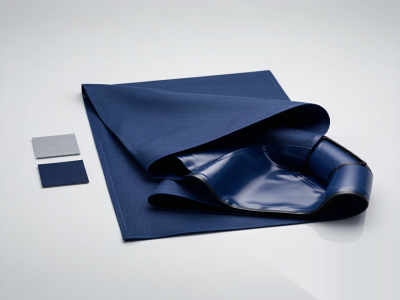
Kezhibo has entered a multi-year collaboration with a university polymer laboratory to investigate next-generation coating chemistry. Early work focuses on bio-based plasticisers that could reduce environmental impact without compromising flexibility.
The partnership gives Kezhibo early access to emerging materials science and strengthens its pipeline of differentiated, higher-performance coated fabrics.
Why Coating Chemistry Is the Hidden Variable in a Coated Fabric
Ask a buyer what makes a coated fabric good and the answers usually revolve around weight, tensile strength and price. All three matter, but they miss the ingredient that decides how the material ages: the polymer formulation itself, and in PVC in particular, the plasticiser system.
Plasticisers are the components that keep a PVC coating flexible. Without them, PVC would be a rigid sheet, closer to a window profile than to a tarpaulin. The catch is that plasticisers do not always stay where they are put. Over years of outdoor service, conventional plasticiser molecules can migrate toward the surface and slowly escape, leaving the coating stiffer, more brittle, and more prone to micro-cracking. Once the surface cracks, UV and moisture accelerate everything that follows.
This is why two fabrics with identical weight and identical base cloth can behave completely differently after three summers. The difference is rarely the fabric. It is the chemistry sitting inside the coating — which is exactly the layer the new research partnership targets.
The Research Focus: Bio-Based Plasticisers
The early work in the collaboration concentrates on bio-based plasticisers: plasticising compounds derived from renewable feedstocks rather than petrochemical sources. The motivation is twofold, and only one half of it is environmental.
The environmental half is straightforward. Coated fabrics are produced in volume, and the polymer fraction of a PVC tarpaulin or membrane includes a significant share of plasticiser. Replacing part of that fraction with compounds from renewable sources reduces the footprint of every square metre produced — without changing the polyester reinforcement, the production process, or the welding behaviour that fabricators depend on.
The technical half is more interesting. Next-generation plasticiser systems are not just greener; they are engineered for lower migration and better long-term flexibility. A plasticiser that stays in the coating is a plasticiser that keeps the fabric soft through more winters. For products that live outdoors for years — truck covers, architectural membranes, pond liners — that retention translates directly into service life.
The hard part, and the reason a laboratory partnership matters, is that plasticiser selection is a web of trade-offs. A candidate compound must be compatible with the PVC matrix, stable at coating temperatures, resistant to extraction by water and cleaning agents, neutral to UV stabilisers and flame-retardant packages, and affordable at production volumes. Changing one variable moves five others. Systematic laboratory evaluation is the only economical way to navigate that space.
What a Multi-Year Academic Collaboration Makes Possible
Short consulting engagements can answer narrow questions. They cannot run the long experiment cycles that formulation work demands. A multi-year collaboration changes the structure of the work in three ways.
First, it gives Kezhibo early visibility into emerging materials science — new compound families and evaluation methods as they develop in the laboratory, not years later when they appear in supplier catalogues. For a manufacturer whose differentiation depends on formulation, being early is worth more than being fast.
Second, it creates a disciplined evaluation loop. Candidate formulations can be screened for compatibility and stability in the lab, then produced as trial coatings on Kezhibo’s knife-coating lines and assessed against real criteria: coating adhesion, surface behaviour, weldability, and accelerated weathering performance. Lab data alone never tells the whole story; the coating has to survive the production line and the welder’s gun before it survives the market.
Third, the timeline matches the material. Plasticiser performance is measured in seasons and years, not weeks. A partnership that runs for years can follow candidate systems through the full evaluation cycle — screening, piloting, field-validated batches — instead of stopping at the first promising datasheet.
From Laboratory Formulation to Customer Datasheet
Kezhibo’s production side is built to absorb this kind of development work. The company operates automated knife-coating lines where coating weight and thickness are metered and monitored inline, which means a trial formulation produced in March can be reproduced with the same parameters in September. Consistency of process is what turns a promising chemistry into a shippable product.
Scale-up runs under the company’s ISO 9001 certified quality management, so each stage — laboratory screening, pilot batch, production batch — is documented and traceable. That documentation matters to customers in regulated segments: a fabric promoted as a next-generation grade needs evidence behind it, not just a marketing page.
Custom development of this kind is also available directly to customers through Kezhibo’s custom manufacturing services. A distributor or fabricator with a specific requirement — a target lifespan, a climate profile, a sustainability objective — can bring that requirement into the development process rather than waiting for it to arrive as a standard grade.
What This Means for Buyers of Coated Fabrics
For most buyers, the practical outcome of the collaboration will arrive as new and improved grades across the coated fabrics range: materials that hold flexibility longer, tolerate more exposure cycles, and carry a reduced environmental burden — without asking the buyer to give up weldability or pay a mystery premium.
For buyers with sustainability mandates — increasingly common in European construction and retail chains — the work provides something more valuable than a certificate: a credible development path. Materials made with bio-based plasticiser systems can enter projects today as validated trial grades and mature into standard offerings as the data accumulates.
The honest framing is that this is research, not a finished product line. Formulations that pass laboratory screening do not always pass production and field trials — that is what trials are for. But the direction is set, the evaluation infrastructure is in place, and the first candidates are already moving through the pipeline.
Talk to Kezhibo About Next-Generation Coated Fabrics
If your application punishes conventional coated fabrics — long outdoor exposure, demanding flex cycles, or a sustainability target that current grades cannot meet — Kezhibo’s team welcomes the conversation. Describe the duty the fabric must survive, and we will recommend from the current range where possible and from the development pipeline where it makes sense.
Contact Kezhibo with your application details to request datasheets, samples, or a grade recommendation for your project.