
TL;DR: EU CBAM enters definitive period in January 2026, putting a carbon price on PVC industrial fabric imports to Europe; export-oriented manufacturers must track product emissions or face tariffs
The European Union’s landmark Carbon Border Adjustment Mechanism (CBAM) transitioned from its pilot phase to the definitive period on January 1, 2026. Under Regulation (EU) 2023/956, importers of carbon-intensive goods into the EU must purchase CBAM certificates to cover the carbon emissions embodied in their products. For PVC industrial fabric suppliers exporting to Europe, this means a direct carbon cost is now embedded in every shipment. While the current CBAM scope covers steel, aluminum, cement, fertilizers, electricity, and hydrogen, both the European Commission and industry analysts expect chemicals—and by extension, PVC-coated industrial fabrics—to be added by 2028.
What is CBAM and how does it work for industrial coatings?
CBAM was designed to address carbon leakage—the phenomenon where EU companies face higher costs due to the EU Emissions Trading System (EU ETS) while competitors in countries without equivalent carbon pricing can sell cheaper products. The mechanism ensures a fair carbon price is applied to both EU-produced and imported goods.
The CBAM price is calculated as the weighted average of EU ETS auction clearing prices for the preceding calendar year. In 2026, CBAM certificates are expected to cost approximately €80–€110 per tonne of CO₂, based on EU ETS price trends through 2025. The price methodology is published annually by the European Commission’s Directorate-General for Taxation and Customs Union (DG TAXUD).
| Phase | Date | Scope | Compliance Requirement |
|---|---|---|---|
| Pilot (transitional) | Oct 2023 – Dec 2025 | Steel, aluminum, cement, fertilizers, electricity, hydrogen | Quarterly emissions reporting (no payment) |
| Definitive (current) | Jan 2026 – Dec 2033 | Same sectors + likely chemicals (PVC) by 2028 | Mandatory CBAM certificate purchase covering 100% of embodied emissions |
| Full CBAM coverage | 2034 onwards | All industrial sectors | Complete phase-out of free EU ETS allowances; full CBAM coverage |
When will PVC and coated fabrics be subject to CBAM?
The original CBAM scope was limited to six sectors, but the European Commission has indicated that chemicals will be added during the definitive period. Key timeline points:
2026: Chemical sector CBAM proposal expected Q3 2026. The Commission’s Impact Assessment will evaluate which chemical categories should be covered, including polymers like PVC and downstream coated fabric products.
2027: Public consultation and trilogue negotiations between the Parliament, Council, and Commission on the chemicals CBAM rules.
2028 (target): Chemicals CBAM enters definitive application, making PVC resin imports—and potentially coated fabrics—subject to carbon border taxation.
Industry trade group Cefic (European Chemical Industry Council) has argued that downstream coated fabric products should be exempted from CBAM, with the mechanism applied only to basic chemical building blocks like PVC resin. The European Parliament’s INTA Committee appears sympathetic to this position, noting that coated fabrics are further processed goods where emissions tracking becomes complex.
How would CBAM affect the economics of PVC coated fabric exports?
Assuming CBAM coverage is extended to PVC and coated fabrics, here’s how the economics work for a typical shipment:
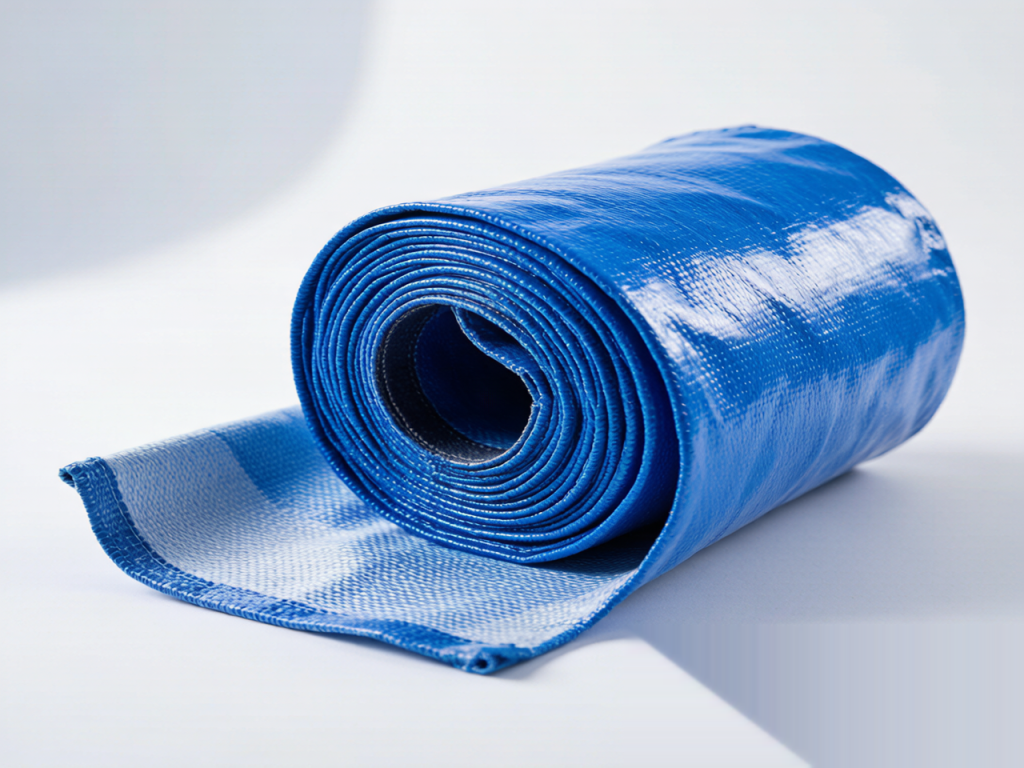
Embodied emissions calculation: A 1,000m² roll of heavy-duty PVC tarpaulin fabric (750gsm) has the following approximate embodied carbon footprint:
| Emission Source | CO₂ per m² | CO₂ per 1,000m² Roll |
|---|---|---|
| PVC resin production | 1.8 kg | 1,800 kg (1.8 tonnes) |
| Coating and textile processing | 0.6 kg | 600 kg (0.6 tonnes) |
| Transportation to EU | 0.3 kg | 300 kg (0.3 tonnes) |
| Total Embodied Emissions | 2.7 kg/m² | 2,700 kg (2.7 tonnes) |
At an assumed CBAM price of €90/tonne CO₂, the carbon border tax for a single 1,000m² shipment would be:
2.7 tonnes CO₂ × €90/tonne = €243 CBAM cost per 1,000m²
For a coated fabric selling at €12–18 per m², this represents a 0.13–0.27€ per m² carbon cost, or approximately 1–2% of the product value. For lower-margin commodity products, this could be the difference between profitability and loss.
How can export-oriented manufacturers prepare for CBAM?
1. Establish an emissions baseline. Manufacturers serving the EU market should conduct a complete lifecycle assessment (LCA) of their PVC-coated fabric products, including raw material extraction, resin production, coating processes, and transportation. The CBAM requires cradle-to-gate emissions data, so focus on these boundaries first. Third-party auditors and tools like Ecovaris or SimaPro can assist.
2. Track emissions at the product level. CBAM requires product-specific emissions data, not just facility-wide averages. Implement an Enterprise Resource Planning (ERP) system that tracks emissions by product, production line, and material batch. The earlier you establish this tracking infrastructure, the lower the transition cost when CBAM is applied to your sector.
3. Reduce embodied emissions strategically. Focus on the highest-emission components first. For PVC-coated fabrics, PVC resin production accounts for ~67% of total embodied emissions. Switching to low-carbon or bio-based PVC resin (like eco-friendly PVC formulations) or using renewable electricity in coating operations can deliver the biggest emissions reductions.
4. Monitor free allowance phase-out. From 2026 to 2034, the EU is phasing out free EU ETS emission allowances while simultaneously phasing in CBAM. This creates a complex cost environment where EU producers initially benefit from free allowances while importers face CBAM costs, but this balance shifts as the phase-out progresses. Understanding this timeline is critical for pricing strategy.
5. Engage with policymakers and trade associations. Industry groups like Cefic and national export associations are actively advocating for CBAM implementation that avoids unintended consequences for downstream products. Participation in these efforts can help shape the final rules affecting your sector.
What is the status of CBAM implementation in 2026?
Key 2026 milestones for CBAM implementation:
- January 2026: Definitive period begins. Importers of covered sectors must register for CBAM, purchase certificates, and submit quarterly reports.
- July 2026: CBAM transitional review published by the European Commission, evaluating whether to expand the sectoral scope ahead of schedule.
- September 2026: Chemicals Impact Assessment published, outlining the proposal for extending CBAM to industrial chemicals.
- December 2026: Annual CBAM price announcement for the following year, based on the 2026 EU ETS auction average.
For non-EU exporters to Europe, the CBAM registry is accessible at cbam.ec.europa.eu. Registration is currently open for all businesses that may be affected, even if their sector is not yet covered.
Bottom line: CBAM is not an immediate cost, but preparation must start now
While CBAM does not currently cover PVC or coated fabrics, its extension to chemicals—and by extension, downstream products—is a near-certain development. The 18–24 month lead time for emissions auditing, ERP tracking implementation, and potential supply chain adjustments means that export-oriented PVC coated fabric manufacturers must begin their CBAM preparation in 2026. The cost of delaying could be measured not just in higher tariffs but in lost market access, as EU customers increasingly require emissions data as a supply chain condition.
For forward-thinking suppliers, CBAM also represents an opportunity. Producers that can demonstrate low embodied emissions through bio-based materials, renewable energy, or circular economy practices will gain a competitive advantage as CBAM pushes the market toward carbon-efficient alternatives.
Sources: European Commission CBAM Regulation (EU) 2023/956; DG TAXUD CBAM Definitive Period Guidance (2025); Cefic CBAM Position Paper (2026); EU ETS Auction Data (2025); CBAM Registry cbam.ec.europa.eu.












