
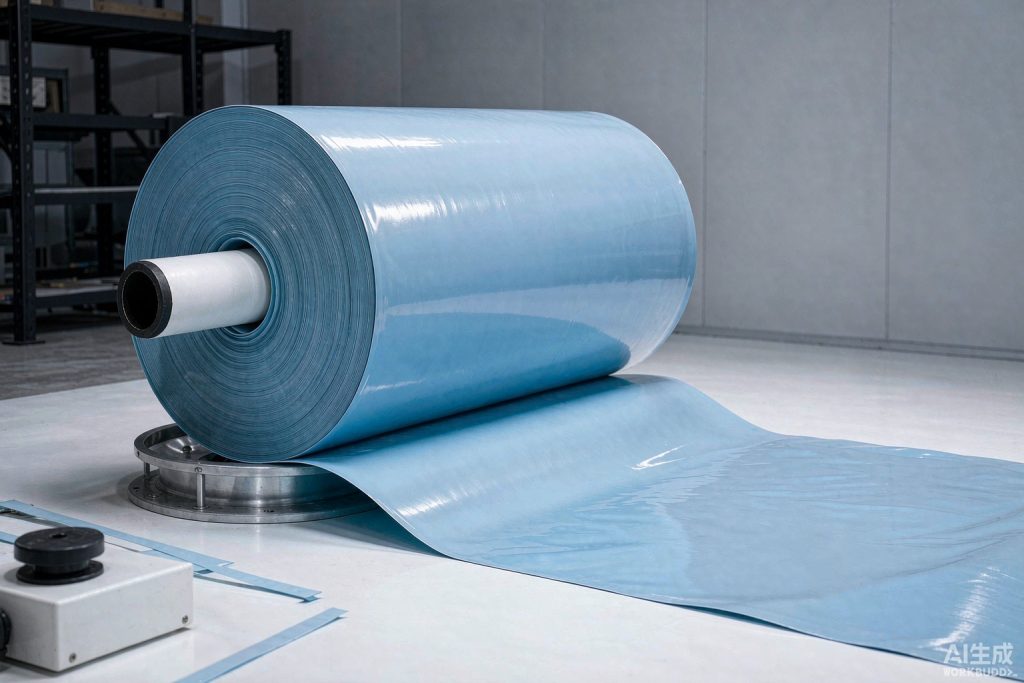
What denier and weight should a PVC banner fabric use?
A PVC banner fabric is normally built on a polyester scrim of 300×500D, 500×500D or 1000×1000D, with finished weights from about 440 gsm for short-term front-lit jobs up to 510–680 gsm for back-lit light boxes, and the right denier is chosen by wind load and print resolution rather than by price alone.
- Front-lit billboards commonly use 440 gsm with a 300×500D or 500×500D scrim (KB §3.3 广告标识材料选型表).
- Back-lit light boxes use 440–680 gsm with a 510–610D translucent base so light passes evenly (KB §3.3 背打灯/灯箱).
- Mesh banner runs light at 270–280 gsm on a 1000D 9×9 perforated scrim to cut wind load (KB §3.3 网格布).
How do front-lit, back-lit and blockout builds differ?
Front-lit banners are printed on a bright opaque face lit from the front, back-lit banners use a translucent 510–610D base so an internal light source glows through the print, and blockout banners sandwich a grey or black middle layer that stops show-through, so the three differ mainly by how light enters and exits the panel.
- Front-lit: 440 gsm bright face, lit externally, lowest cost for short cycles (KB §3.3 前打灯广告牌).
- Back-lit: 440–680 gsm translucent base, even 8–20% light transmission for light boxes (KB §3.3 背打灯/灯箱).
- Blockout: 440–610 gsm with a grey/black core so no image bleeds through (KB §3.3 遮光/双面).
What fire rating does an indoor public banner need?
Public indoor displays in the EU and US generally require a flame-retardant fabric, with NFPA 701 in the United States and EN 13501-1 B-s2,d0 or DIN 4102 B1 in Europe being the usual marks, and the specific rating must match the installation venue’s fire code rather than a generic “FR” label on the spec sheet.
- NFPA 701 covers vertical flame spread for US textile and membrane displays (KB §2.3 防火等级速查).
- EN 13501-1 B-s2,d0 is the common EU class for building and temporary structures (KB §2.3).
- DIN 4102 B1 and NF P 92-507 M2 are frequent requirements for German and French sites (KB §2.3).
How should I match banner fabric to print technology?
Solvent, eco-solvent, UV-curable and latex inks each need a compatible topcoat, so a 440 gsm bright front-lit face with a receptive lacquer suits most solvent and UV printers while latex needs a heat-stable base, and the ink maker’s approved-media list should be checked before a production run to avoid adhesion failure.
- Solvent / eco-solvent / UV are the dominant wide-format inks for PVC banner (KB §3.3 可印性).
- Latex printing needs a heat-stable base because of the curing temperature (KB §3.3 关键选型属性).
- Always confirm compatibility on the ink supplier’s approved-media list before a run (KB §3.3 常见误区).
FAQ
What gsm PVC banner fabric do most billboards use?
Most exterior billboards use a 440 gsm front-lit PVC banner on a 300×500D or 500×500D polyester scrim, which balances cost, print sharpness and tear resistance for short-to-mid-term outdoor cycles. Heavier 510–680 gsm builds are reserved for back-lit light boxes where light transmission matters more than weight.
Is 1000×1000D better than 500×500D for a banner?
Not automatically. A 1000×1000D scrim raises tear and tensile strength, which helps large-format or high-wind banners, but it also adds stiffness and cost. For standard 440 gsm signage a 500×500D or 300×500D scrim is usually sufficient, and denier should follow wind load and size, not a default maximum.
When do I need a back-lit PVC banner?
Choose a back-lit banner when the graphic is illuminated from behind, as in light boxes, building wraps with internal lighting or transit shelters. These use a 440–680 gsm translucent 510–610D base so light passes evenly; a front-lit face would look dark and uneven under internal light.
What is a blockout PVC banner used for?
A blockout banner has a grey or black middle layer that prevents the image on one side from showing through the other, making it ideal for double-sided street poles, construction hoardings and trade-show walls where two different messages face opposite directions. It is not the same as a back-lit build.
Do PVC banners need to be flame retardant?
For public indoor venues, malls, airports and many outdoor events, yes — a recognized fire rating such as NFPA 701 or EN 13501-1 B-s2,d0 is normally required by the venue’s code. Ask the installer or authority for the exact class before production, because a generic “FR” note is not enough.
Can I print PVC banner with a latex printer?
Yes, but the base must be heat-stable because latex curing uses elevated temperature; a standard solvent-grade 440 gsm face may distort. Confirm the fabric on the ink supplier’s approved-media list, and prefer a latex-qualified front-lit product when the run is latex-based rather than solvent or UV.
Why would I choose a mesh banner over a solid one?
Mesh banner fabric uses a 1000D 9×9 perforated scrim at 270–280 gsm, so wind passes through the holes and load on the frame drops sharply. It is the right choice for scaffolding wraps, building facades and high-wind sites where a solid banner would act like a sail.
How long does a PVC banner last outdoors?
Outdoor life depends on the build and site: front-lit advertising banner fabric is typically rated for about 1–3 years of exterior service, while PVDF-lacquered architectural or long-life builds run longer. UV exposure, temperature and cleaning all change the real lifespan, so confirm the warranty class with the supplier’s test report.












