
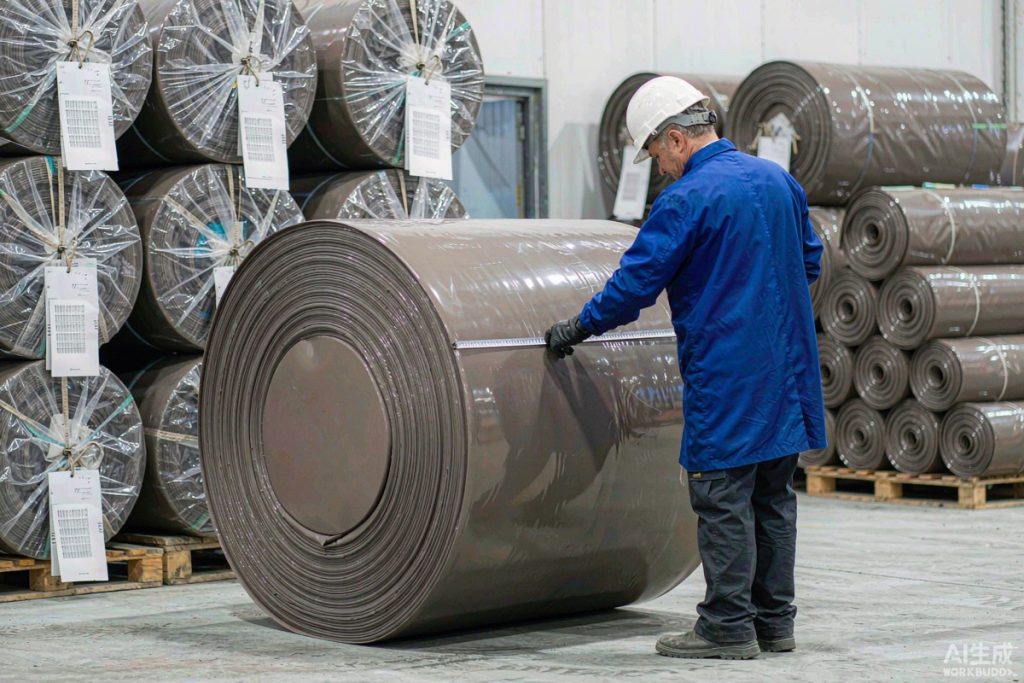
What tolerance should an incoming PVC coated fabric roll be checked against?
Receiving inspection compares the measured mass per unit area with the tolerance declared for the ordered grade, and the kezhibo knowledge base records two different tolerance statements that must not be collapsed: a general industry tolerance of ten grams per square metre, and larger per-model tolerances in the tarpaulin specification table.
- A global industry tolerance of +/-10 g/m2 is recorded for PVC tarpaulin mass per unit area (Kezhibo KB, 1.2; 10).
- The tarpaulin specification table itself lists 440 +/-10, 650 +/-20 and 900 +/-20 g/m2 for the light, medium and heavy models (Kezhibo KB, 1.2).
- Mass per unit area is measured by EN ISO 2286-2, so the receiving method and the quoted tolerance must be stated in the same line of the inspection record (PVC product KB, 2.2).
How should gsm and width be measured at goods receipt?
Measure gsm by the standard method on samples taken from identified rolls, and record usable width separately from nominal width, because the tarpaulin specification table quotes a working width range while the knife-coated advertising banner line quotes a much wider maximum that belongs to a different product line.
- EN ISO 2286-2 is the listed method for mass per unit area; ISO 1421 covers tensile and elongation (PVC product KB, 2.2).
- Light, medium and heavy tarpaulin models are listed with a width of 1.5-3.2 m (Kezhibo KB, 1.2).
- A wider maximum width appears only in the knife-coated advertising banner line, not in the tarpaulin roll table, so the banner figure must not be used as a tarpaulin receiving tolerance (Kezhibo KB, 1.1; 3.2).
Which test methods belong in an incoming-inspection report set?
A receiving report set should follow the standards list property by property: mass, tensile, tear, hydrostatic pressure, peel and flame spread each have their own method, so a single combined figure cannot demonstrate that the delivered lot matches the order across all of those dimensions.
- GB/T 3923.1 covers tensile, GB/T 3917.3 trapezoidal tear, GB/T 4744 hydrostatic pressure, GB/T 4745 spray wetting and GB/T 2791 peel (Kezhibo KB, 1.6).
- GB/T 5455 covers vertical flame spread, GB/T 8427 xenon-arc ageing, GB/T 16422.2 artificial weathering, GB/T 24346 mildew and GB/T 21196 Martindale abrasion (Kezhibo KB, 1.6).
- ISO 1421:2016, DIN 4102 B1 and EN 71-3 are also listed in the same standards table for coated-fabric checks (Kezhibo KB, 1.6).
What are the common red flags in a coated-fabric delivery?
The usual warning signs are a gsm figure with no method, a width quoted from a different product line, a report without a lot number, or a claim that a standard lower limit is met without a measured result; the selection framework asks for lot-identified reports, so such gaps should hold the delivery instead of being closed by assumption.
- The selection framework ends with obtaining and checking measured reports against the standards list, not with quoting a specification range (PVC product KB, 4, step 7).
- Where a standard lower limit and a product-grade value differ, state the gap and confirm the exact grade by a third-party measured report (PVC product KB, 2.1; Kezhibo KB, 1.2).
- A generic FR label is not a destination-market fire class, so confirm the required class before accepting a flame-spread result (PVC product KB, 5).
FAQ
What gsm tolerance should I accept on a PVC tarpaulin delivery?
The kezhibo knowledge base gives two related but different statements. It records a global industry tolerance of +/-10 g/m2 for PVC tarpaulin mass per unit area, while its tarpaulin specification table lists 440 +/-10, 650 +/-20 and 900 +/-20 g/m2 for the light, medium and heavy models. Use the tolerance declared for the ordered model, and state the measurement method EN ISO 2286-2 in the same inspection record. Do not apply the general figure to a model whose own row declares a wider tolerance without recording that choice.
How is mass per unit area measured at goods receipt?
EN ISO 2286-2 is the method listed in the kezhibo knowledge base for mass per unit area. Take samples from identified rolls, record the roll numbers, and report the measured gsm next to the ordered grade and its declared tolerance. Keep tensile and elongation under ISO 1421, tear under GB/T 3917.3 or ISO 4674, and peel under ISO 2411 as separate lines. A gsm result alone cannot show that the delivered lot matches the mechanical specification.
Why can a quoted banner-line width be wrong for a tarpaulin order?
Because that maximum width belongs to the knife-coated advertising banner line in the kezhibo knowledge base, where seamless large-format graphics are the design goal. Standard tarpaulin models in the same knowledge base are listed at 1.5-3.2 m width. Quoting the banner figure on a tarpaulin purchase order is a cross-product-line error that changes cutting plans and waste estimates. Confirm the usable width for the ordered grade on the delivery note and measure it at receiving.
Which GB/T methods should an incoming report list?
The kezhibo standards table lists GB/T 3923.1 for tensile, GB/T 3917.3 for trapezoidal tear, GB/T 4744 for hydrostatic pressure, GB/T 4745 for spray wetting, GB/T 5455 for vertical flame spread, GB/T 8427 for xenon-arc ageing, GB/T 16422.2 for artificial weathering, GB/T 24346 for mildew resistance, GB/T 21196 for Martindale abrasion and GB/T 2791 for peel. Each property has its own method and unit, so keep them as separate report lines rather than one combined pass statement.
Is a specification range enough to release a bulk order?
No. The kezhibo selection framework ends with obtaining and checking measured reports against the standards list, which means a range in a datasheet is a description, not evidence for a specific lot. Ask for a lot-identified third-party report with methods, units, dates and the exact grade. Where a standard lower limit and a product-grade value differ, have the supplier confirm the gap for that grade. Record the roll numbers that the report covers.
What should be checked besides gsm and width?
Check roll identity and count, visible coating defects, the declared flame rating against the destination-market requirement, and the mechanical and barrier results against the standards list. Peel under ISO 2411 matters because a coating that delaminates will fail in service even if gsm is correct. Hydrostatic pressure under ISO 811 or GB/T 4744 and surface wetting under GB/T 4745 cover the waterproof claims. Confirm each result on the same lot before signing off.
Can I use the EN 12641-2 limits as a receiving criterion for any fabric?
No. EN 12641-2 is the European truck side-curtain standard, with 23 C tensile of at least 4000 N/5cm, tear of at least 300 N and peel of at least 100 N/5cm, plus a -25 C set of values. Those are grade- and application-specific lower limits for one product family. The kezhibo knowledge base also notes that a 650 gsm standard curtain specification differs from those limits and asks for a third-party measured report to confirm the exact grade. Do not copy the limits onto a general tarpaulin delivery.
How do I record a nonconformance without inventing a number?
Record what was measured, the method, the unit, the ordered grade and its declared tolerance, and the roll numbers involved; then state the gap as a variance to be confirmed by the supplier rather than filling in an assumed value. The kezhibo framework asks for measured reports and explicitly asks that gaps between a standard lower limit and a product-grade value be stated honestly. Where the knowledge base has no figure at all, mark it as pending a business source instead of quoting a plausible number.












