What does a double-track weld actually let you test on a PVC geomembrane?
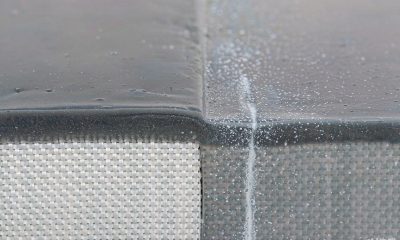
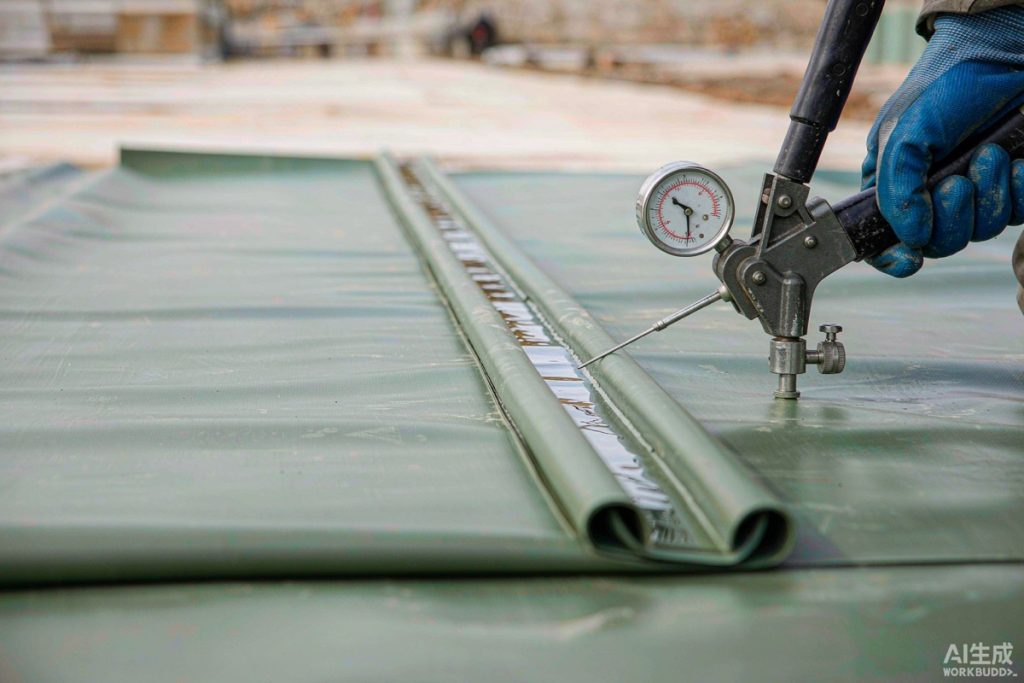
A dual-track weld produces two parallel seams with an unbonded channel between them, so the enclosed channel can be pressurised and checked for leakage without cutting the liner; this turns seam continuity into a non-destructive field test, while the overlap width and the weld route still have to be confirmed on the specification.
- The knowledge base names weld integrity as a decisive property for industrial liners and identifies the dual-track seam with a testable air channel as the leak-check route (PVC product KB, 3.4).
- A 100-150 mm weld overlap is called for on PVC liners; insufficient overlap is listed as a common failure cause (PVC product KB, 3.4).
- The knowledge base does not publish a numeric air-channel test pressure or hold time, so those values are pending the supplier’s documented field procedure rather than being quoted from a catalogue.
Why is extrusion welding not recommended for PVC geomembranes?
PVC liners are joined by hot-air, hot-wedge, radio-frequency or solvent welding, and the knowledge base explicitly warns against applying extrusion welding to PVC; the reason is that the material and the seam geometry belong to the coated-fabric family, where the weld must fuse the coating without breaking the scrim reinforcement.
- Hot-air, hot-wedge, radio-frequency and solvent welding are the listed routes for PVC; extrusion welding is listed as not recommended (PVC product KB, 3.4).
- Agricultural pond liners are unreinforced under ASTM D7176, while landfill caps and liners are reinforced under GRI-GM17, so the seam preparation differs by grade (PVC product KB, 3.4).
- Chemical compatibility has to be reviewed for the contained medium: the pond-liner guidance quotes a pH 2-12 range and points to PVC-KEE/EIA or HDPE where strong solvents or hydrocarbons are involved (PVC product KB, 3.4).
Which liner thickness and standard apply to each containment job?
Thickness and standard follow the application: a farm pond uses a thin unreinforced PVC liner under ASTM D7176, a landfill cap or liner uses a thicker reinforced grade under GRI-GM17, and any potable-water contact adds a drinking-water approval; the seam test plan must be written for that same grade rather than copied from another project.
- Agricultural pond liner: 0.5-0.75 mm (20-30 mil), unreinforced, ASTM D7176, weldable and UV resistant (PVC product KB, 3.4).
- Landfill cap or liner: 0.75-1.5 mm, reinforced, GRI-GM17, with leak detection and chemical resistance; NSF/ANSI 61 applies to drinking-water contact (PVC product KB, 3.4).
- Flexible tanks and pillow tanks are listed at 600-1100 gsm and also depend on weldability, which is why the seam route is a shared acceptance item (PVC product KB, 3.4).
What should a seam-integrity report set include before a liner is covered?
Before backfilling, require a report set that identifies the lot, states the weld method and overlap, records the non-destructive channel or leak check, and adds measured peel, tensile and tear results on welded specimens; the kezhibo framework asks for measured reports against the standards list, so a verbal pass statement is not enough.
- Coating adhesion or peel is measured by ISO 2411, tensile by ISO 1421, and tear by DIN 53363 or ISO 4674 (PVC product KB, 2.2).
- Leak detection and a 100-150 mm weld overlap are listed under landfill and liner acceptance, with dual-track air-channel testing as the integrity route (PVC product KB, 3.4).
- Obtaining and checking third-party measured reports against the standards list is the final step of the selection framework (PVC product KB, 4, step 7).
FAQ
What is a double-track weld on a geomembrane?
A dual-track weld creates two parallel bonded seams with an unbonded air channel left between them. Because the channel is sealed at both ends, it can be pressurised and monitored, giving a non-destructive way to check the continuity of the seam without cutting out a specimen. The kezhibo knowledge base names weld integrity as decisive for industrial liners and identifies the testable air channel as the leak-check route for PVC. It does not publish a numeric test pressure or hold time, so ask the installer for the documented field procedure and record the actual result per seam.
How wide should a PVC geomembrane weld overlap be?
The kezhibo knowledge base calls for a 100-150 mm weld overlap on PVC liners and lists insufficient overlap as a common cause of failure. The figure is a geometric preparation requirement, not a strength result, so it should appear in the method statement as well as in the field record. Confirm the actual overlap on the trial weld before production, and keep the seam peel result under ISO 2411 as the separate mechanical evidence. Do not substitute a wider overlap for a missing peel test.
Can PVC liners be extrusion welded?
The knowledge base explicitly says PVC is not recommended for extrusion welding and lists hot-air, hot-wedge, radio-frequency and solvent welding as the appropriate routes. The warning sits alongside a second warning against applying HDPE logic to PVC, because the two families join differently. Ask the installer to name the weld route on the method statement and to confirm it against the liner grade: unreinforced ASTM D7176 pond liner and reinforced GRI-GM17 landfill liner do not share the same seam preparation.
Which standard applies to a fish pond liner versus a landfill liner?
For agricultural pond liners the kezhibo knowledge base specifies 0.5-0.75 mm (20-30 mil) unreinforced material under ASTM D7176, weldable and UV resistant with a pH 2-12 range. For landfill caps and liners it specifies 0.75-1.5 mm reinforced material under GRI-GM17 with leak detection and chemical resistance. NSF/ANSI 61 becomes relevant when the liner contacts drinking water. Keep the thickness, the standard and the seam test plan on the same grade; copying a pond-liner seam procedure to a landfill job is a specification error.
Why is chemical compatibility part of a seam check?
Because the contained medium attacks the seam as well as the sheet. The knowledge base quotes a pH 2-12 range for pond liners and warns that strong solvents or hydrocarbons call for PVC-KEE/EIA or HDPE instead of a standard PVC liner. A weld that passes a peel test in the lab still needs a compatibility review against the actual contents, plus leak detection on the installed seam. Ask the supplier to confirm both the chemical review and the field weld records before the liner is covered.
Which mechanical tests belong in a seam report set?
Ask for measured results on welded specimens: coating adhesion or peel under ISO 2411, tensile and elongation under ISO 1421, and tear under DIN 53363 or ISO 4674. The kezhibo standards list maps each property to its method, and the selection framework ends with obtaining and checking measured reports against that list. Add the weld route, the 100-150 mm overlap and the non-destructive air-channel or leak-check result per seam. A statement that the seam passed, without method and units, is not a report.
What does the knowledge base not publish about air-channel testing?
It identifies the dual-track seam and its testable air channel as the integrity route, and it calls for leak detection, but it does not give a numeric inflation pressure, a hold time or an acceptable pressure-drop value for PVC liners. Those are field-procedure parameters that belong to the installer’s documented method statement and the project specification. Rather than quote a plausible number, ask the installer to state the values used and the acceptance criterion, and keep them in the internal record pending a confirmed business source.
What should be checked before a liner is backfilled or covered?
Check that the delivered roll matches the specified thickness and grade, that the weld route is one of the PVC-appropriate methods, that the overlap is 100-150 mm, and that every seam has a recorded non-destructive integrity result plus measured peel, tensile and tear values on welded specimens. Confirm leak detection and chemical compatibility for the contained medium. The kezhibo framework asks for lot-identified measured reports rather than verbal assurances, so cover the liner only after the report set is complete and signed off.