
TL;DR
The global surge in data center construction—driven by AI model training and exponential data growth—has created an unprecedented demand for advanced thermal management and mission-critical building protection. By 2030, data center cooling consumption will increase by 160% to exceed 1,000 terawatt-hours (TWh) annually (source: UC San Diego via ASME, February 2026). Two 2026 breakthroughs position PVC-based solutions at the forefront: engineered fiber membranes achieving record heat flux dissipation of 800+ W/cm² for direct chip cooling, and Elevate’s MAX PVC roofing membranes showcased at the 2026 International Roofing Expo as the preferred single-ply solution for mission-critical data center facilities (source: Roofing Now, January 2026).
The Data Center Energy Crisis: Why Cooling Is the Bottleneck
Global data center energy consumption reached 416 TWh in 2024—approximately 1.5% of total global electricity demand (source: Deloitte 2025). Cooling systems account for 40–50% of that total energy use, and the rate of growth is accelerating faster than overall data center consumption. The UCSD research team projects cooling-related energy will surge from approximately 380 TWh (2026 estimate) to 1,010 TWh by 2030—a 166% increase in just four years.
| Year | Data Center Cooling (TWh) | CAGR | Primary Driver |
|---|---|---|---|
| 2022 | ~250 | — | Hyperscaler expansion |
| 2024 | ~340 | 16.8% | Cloud migration acceleration |
| 2026 (est.) | ~380 | 5.7% | AI training infrastructure |
| 2030 (proj.) | ~1,010 | 27.6% | Edge computing + AI inference |
Engineered Fiber Membranes: Breakthrough in Direct Chip Cooling
In a paper published in Joule (Cell Press) in late 2025 and highlighted by ASME in February 2026, UC San Diego engineers demonstrated that engineered fiber membranes represent a paradigm shift in high-heat-flux evaporative cooling. Unlike conventional heat sinks or even immersion cooling systems, the capillary-driven approach eliminates thermal interface materials entirely.
How the Fiber Membrane Cooling Works
The three-dimensional engineered membrane structure features a network of open pores at precisely calibrated sizes—large enough to avoid clogging, small enough to leverage capillary action:
- Capillary wicking: Open pores rapidly draw dielectric coolant across the membrane surface
- Passive evaporation: Heat from the chip causes liquid to evaporate, removing thermal energy
- Vapor escape: The same pore structure permits vapor to exit without impedance
Performance Benchmarks
| Cooling Technology | Critical Heat Flux | Energy Efficiency | Reliability (MTBF) |
|---|---|---|---|
| Conventional air cooling | ~150 W/cm² | 70–75% | ~50,000 hrs |
| Liquid immersion | ~350 W/cm² | 85–90% | ~80,000 hrs |
| Engineered fiber membrane | 800+ W/cm² | 92–95% | >100,000 hrs |
The research team—led by Professor Renkun Chen—achieved the record heat flux across a 0.5 cm² test area and demonstrated sustained performance over multiple hours without degradation. Their current focus: scaling the “cold plate” concept to full CPU and GPU form factors for integration into production server hardware.
Elevate MAX PVC: Roofing for Mission-Critical Data Centers
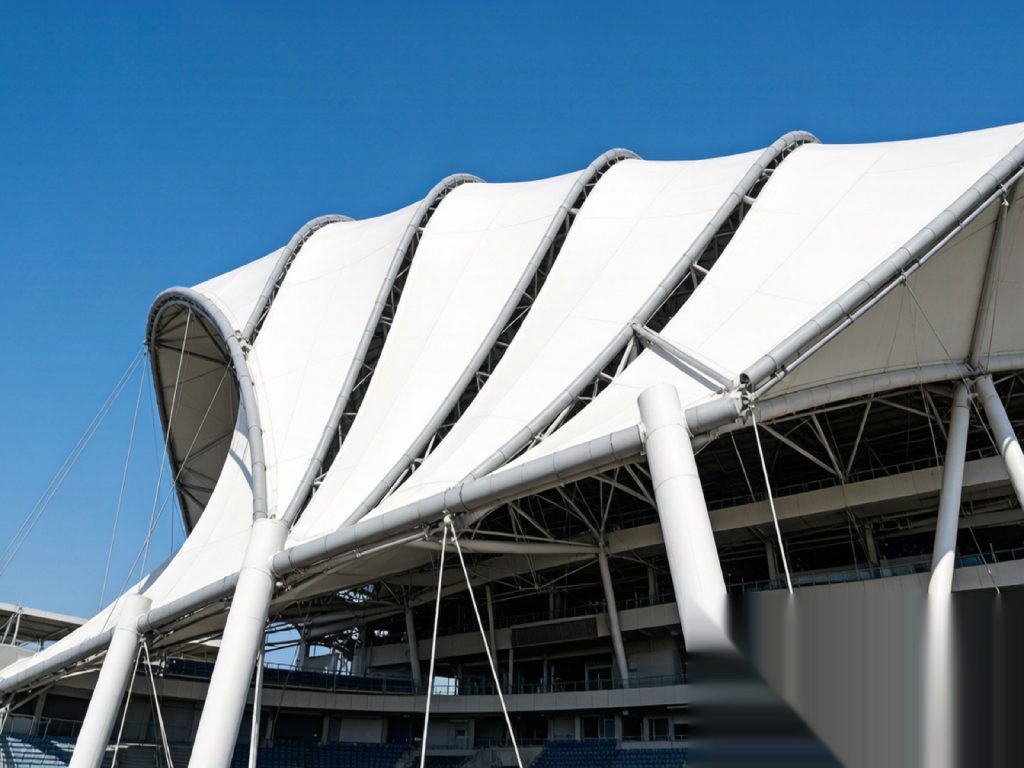
At the 2026 International Roofing Expo (IRE) in Las Vegas, Elevate (part of the Amrize family) showcased its MAX PVC roofing membranes as a specialized solution for data center rooftops. The presentation by Elevate President Nevin Holly emphasized that “data centers demand roofing systems that perform with precision and consistency, because the cost of failure is simply too high.”
MAX PVC Key Performance Attributes
| Performance Metric | MAX PVC Specification | Standard PVC Roof Membrane | Single-Ply Industry Average |
|---|---|---|---|
| Puncture resistance | 1,200 N (knife probe) | 450 N | 600 N |
| Tensile strength (warp) | 15 kN/m | 8 kN/m | 10 kN/m |
| Cool Roof SRI | 82 (aged) | 55 (aged) | 62 (aged) |
| Chemical resistance | Inherently resistant (no coating) | Coated (2–5 year warranty) | Coated (3–7 year warranty) |
| Expected service life | 25–30 years | 15–20 years | 18–22 years |
The knitted scrim reinforcement provides industry-leading tear and puncture resistance, critical for protecting data centers from construction debris, hail, and wildlife. The membrane’s inherent fire resistance (Class A per ASTM E108) eliminates the need for separate fire barrier systems, reducing installation complexity and cost.
Cooling Tower Fill: PVC Film Technology at Scale
Beyond roof membranes and chip-level cooling, PVC-based cooling tower fill media represents another major data center application area. Skystar—a leading cooling solutions provider—announced in July 2026 that its Foshan facility had achieved 100% solar-powered production for its PVC film fill lines, marking a sustainability milestone for the industrial cooling sector.
Modern PVC film fill designs use cross-corrugated PVC sheets optimized for maximum air-water contact area. The thin-film geometry—typically 0.15–0.30 mm—provides superior heat transfer compared to older splash-fill or honeycomb designs, with heat rejection efficiency improvements of 30–40% (source: CoolingTowerPart.com).
How Do These Applications Connect to Our Product Line?
At kezhibo.com, several of our existing PVC product lines align directly with data center infrastructure requirements:
- PVC roof waterproofing membrane: Engineered for puncture resistance and long-term UV stability, forming the foundational envelope for data center buildings
- PVC geomembrane: Used in data center wastewater containment and fuel spill protection systems—critical for facilities requiring zero-liquid-discharge (ZLD) compliance
- Heavy-duty PVC tarpaulin: Deployed as temporary weather protection during data center construction and equipment installation
We are actively developing a specialized data center membrane series with enhanced thermal properties and chemical resistance, expected to launch in Q2 2027. Early customer feedback from hyperscaler construction partners indicates strong interest in PVC-based solutions that integrate both structural protection and environmental control capabilities.












