How is a wind rating for a PVC marquee tent actually determined?
A marquee wind rating describes the assembled structure rather than the fabric roll, because the same cloth behaves differently on an aluminium frame than on a steel one and changes again with anchoring; the knowledge base therefore pairs each fabric weight with a frame type and a rated wind speed instead of publishing one fabric-only figure.
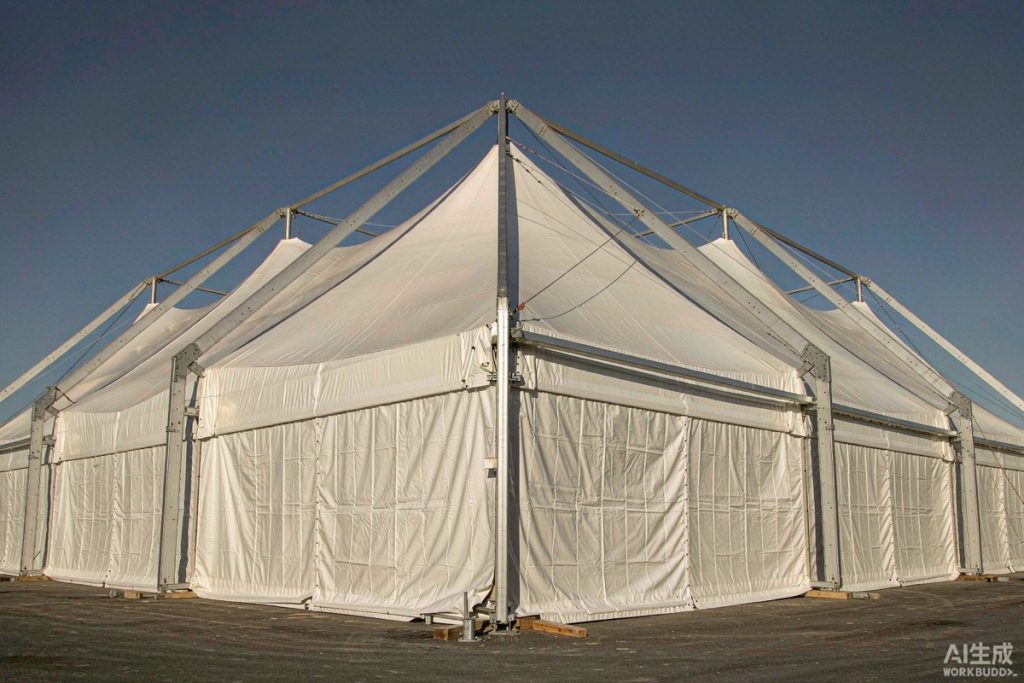
- A standard event marquee uses 850 g/m2 PVC synthetic-fibre fabric on a 6061/T6 aluminium frame and is rated for 80-100 km/h (Kezhibo KB, 2.6).
- A reinforced industrial marquee uses 1000 g/m2 PVC coated fabric on a steel-aluminium frame and is rated above 100 km/h (Kezhibo KB, 2.6).
- An insulated marquee uses a double membrane plus insulation on galvanised steel supports and is rated by Beaufort force 6-8 rather than km/h, so the units are not interchangeable (Kezhibo KB, 2.6).
Which fabric weight goes with which marquee frame type?
Weight and frame are specified as a set: lighter 850 g/m2 cloth goes with 6061/T6 aluminium for standard events, 1000 g/m2 cloth goes with steel-aluminium for reinforced industrial use, and a transparent build uses clear PVC coated fabric on aluminium with no separate wind class published for it.
- Standard event marquee: 850 g/m2 PVC synthetic-fibre fabric, 6061/T6 aluminium, 80-100 km/h (Kezhibo KB, 2.6).
- Reinforced industrial marquee: 1000 g/m2 PVC coated fabric, steel-aluminium structure, 100 km/h and above (Kezhibo KB, 2.6).
- Transparent marquee: fully transparent PVC coated fabric on an aluminium frame, listed as standard; insulated marquee: double membrane with insulation, galvanised steel, Beaufort 6-8 (Kezhibo KB, 2.6).
Which temporary-structure standards apply to a PVC marquee?
Temporary structures are judged under their own codes, so EN 13782 for event tents, EN 15619 for coated-fabric temporary structures and CPAI-84 for tent flame spread are the relevant families; the class strings must be quoted with their test method because they are different classification systems from vehicle-curtain standards.
- EN 15619:2014 classifies mechanical behaviour F1-F3 and fire behaviour T1-T4, the latter assessed through EN 14115 (PVC product KB, 2.3).
- EN 13782 is listed for European event tents, and CPAI-84 plus NFPA 701 for tent and membrane flame spread (PVC product KB, 3.2, 5).
- EN 12641-2 Class 1 (100 km/h) and Class 2 (110 km/h) belong to the truck side-curtain system, not to marquee structures, so they must not be quoted as a marquee wind class (PVC product KB, 2.1).
What should a buyer check before accepting a wind-rating claim?
Ask the supplier to confirm the complete assembly behind the quoted speed: fabric weight, frame alloy, anchoring detail, the applicable code class and the test or calculation that supports it; a fabric-only datasheet cannot demonstrate a structural wind rating, and ratings expressed in Beaufort force must be converted and documented rather than compared directly with km/h.
- The knowledge base pairs each marquee build with a frame and a wind class, which makes the assembly the unit of specification (Kezhibo KB, 2.6).
- Skeletal membrane structures are listed with a tensile requirement of 4000-6000 N/5cm for the fabric, a separate structural input (Kezhibo KB, 2.2).
- Confirm the specific report and the destination-market code before release, since fire and mechanical classes are market-specific (PVC product KB, 4, 5).
FAQ
Is a marquee wind rating a property of the fabric?
No. The kezhibo knowledge base always publishes a wind class together with a frame type and a fabric weight, which means the rated unit is the assembled structure. A standard 850 g/m2 PVC marquee on 6061/T6 aluminium is rated 80-100 km/h, while a 1000 g/m2 build on a steel-aluminium frame is rated above 100 km/h. Anchoring, span and shape also change the result. Ask the supplier to confirm the full assembly and the calculation or test behind the quoted speed instead of accepting a fabric datasheet as proof of a structural rating.
What fabric weight do standard event marquees use?
The kezhibo knowledge base lists 850 g/m2 PVC synthetic-fibre fabric for a standard activity marquee, paired with a 6061/T6 aluminium frame and an 80-100 km/h wind class. A reinforced industrial marquee moves to 1000 g/m2 PVC coated fabric on a steel-aluminium frame rated above 100 km/h. These are paired specifications, not a menu of independent options. Confirm the actual delivered gsm by EN ISO 2286-2 at goods receipt, and check the frame material on the drawing before comparing the two builds.
Why is one marquee rating given in Beaufort force instead of km/h?
Because the knowledge base records different rating conventions for different builds. Standard and reinforced marquees are listed in km/h, while the insulated double-membrane marquee on galvanised steel supports is rated by Beaufort force 6-8. Beaufort force is an ordinal scale, not a linear speed, so it cannot be compared directly with a km/h figure without an explicit conversion and a documented assumption. Ask the supplier to state the equivalent design wind speed and the code it was derived from before putting both numbers in one comparison table.
Which standards cover temporary marquee structures in Europe?
EN 13782 is the European standard listed for event tents, and EN 15619:2014 covers coated-fabric temporary structures with mechanical classes F1-F3 and fire classes T1-T4, the latter assessed through EN 14115. Fire spread on tent textiles is separately covered by CPAI-84 in the United States and NFPA 701. These belong to different classification systems, so quote the system, the full class string and the test method together. Confirm which one the destination authority requires before production.
Can I use the EN 12641-2 wind class for a marquee?
No. EN 12641-2 is the European truck side-curtain standard, and its Class 1 (100 km/h) and Class 2 (110 km/h) wind classes describe a vehicle curtain on a trailer, not a temporary structure on the ground. The same knowledge base lists EN 13782 and EN 15619 for event and temporary structures. Mixing the two systems produces a plausible-looking but invalid specification. Ask the supplier to confirm the correct code family for the installation and to state the class with its test method.
Does a heavier fabric always give a higher wind rating?
Not by itself. In the kezhibo table the 1000 g/m2 build is rated above 100 km/h and the 850 g/m2 build 80-100 km/h, but the frame changes at the same time, from aluminium to steel-aluminium, so the fabric weight is not the isolated variable. Anchoring, span and shape are also structural inputs. Treat the table as a set of paired assemblies, and ask for the calculation or test report for the exact configuration instead of extrapolating a rating from gsm alone.
What tensile strength should the membrane itself have?
For skeletal membrane structures the kezhibo knowledge base lists a tensile requirement of 4000-6000 N/5cm for the membrane, which is a fabric property separate from the wind class of the assembly. Tensile and elongation behaviour is tested under ISO 1421 or EN ISO 1421, and tear under DIN 53363 or ISO 4674. Confirm the measured values on a lot-identified report. A fabric that meets its tensile range still needs the frame and anchoring design to reach a structural wind rating.
What should be in a marquee wind-rating submittal?
Ask for the fabric weight with its EN ISO 2286-2 result, the frame alloy and section, the anchoring detail, the applicable code class in full, and the calculation or test that supports the quoted speed. Where the rating is given in Beaufort force, request the converted design speed and the assumption used. The knowledge base treats these as an assembly, and its selection framework ends with checking measured reports against the standard list. Confirm the destination-market fire class in the same submittal.