
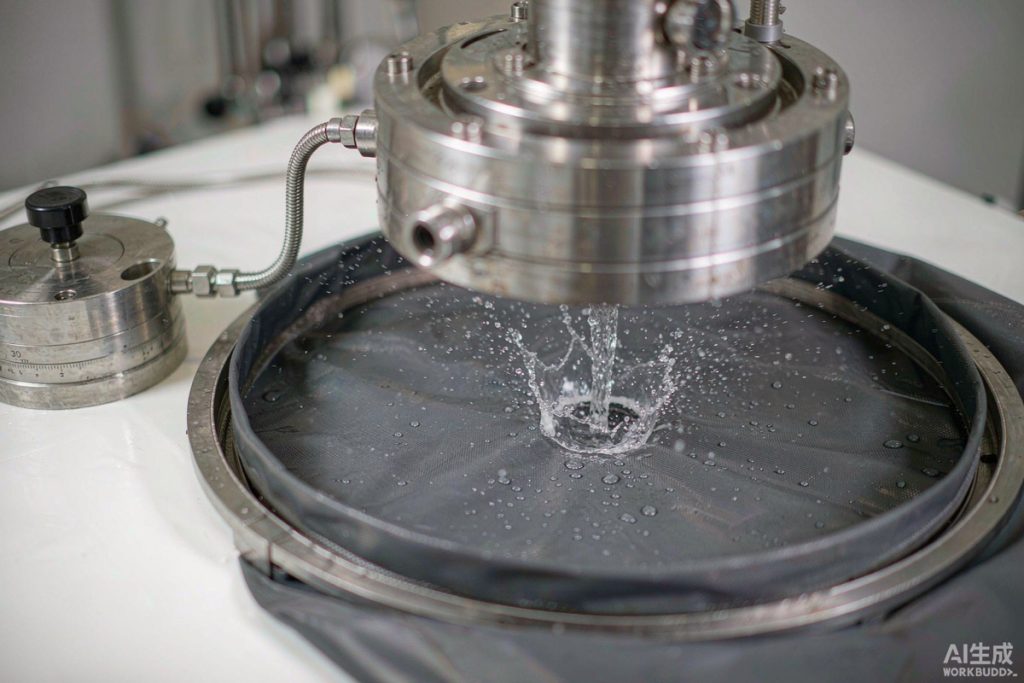
What does a hydrostatic head value actually prove about a PVC coated fabric?
A hydrostatic head value measures the pressure a coated fabric resists before water passes through under a standard laboratory test, so it verifies the coating and scrim barrier but not seams, punctures or UV ageing; a buyer should ask for the figure tied to a named method and a specific grade rather than a single large catalogue number.
- Hydrostatic head / waterproofness is tested by ISO 811, AATCC 127 and GB/T 4744; the spray surface-wetting variant is GB/T 4745 and is graded 1-5 rather than in millimetres (PVC product KB, 2.2; Kezhibo KB, 1.6).
- The Kezhibo knowledge base records a water-column resistance of at least 2000 mm for the PVC tarpaulin line (Kezhibo KB, 1.2), while the architectural membrane line records a hydrostatic resistance of at least 3000 mm (Kezhibo KB, 2.3).
- These two values belong to different product lines and must not be quoted as one general PVC figure; confirm the grade on a lot-identified third-party test report before release (PVC product KB, 4).
Which test methods should a waterproof PVC fabric report set list?
A usable report set names the water-column method, the surface-wetting method and the mass-per-unit-area method separately, because each answers a different question: one measures liquid penetration under pressure, one measures beading on the face, and one verifies that the delivered roll matches the quoted grade.
- Mass per unit area (gsm) is determined by EN ISO 2286-2, while coating adhesion is checked by ISO 2411 and tensile behaviour by ISO 1421 (PVC product KB, 2.2).
- GB/T 4744 covers hydrostatic pressure and GB/T 4745 the spray surface-wetting grade; GB/T 3917.3 covers trapezoidal tear and GB/T 2791 the peel test (Kezhibo KB, 1.6).
- Air permeability is a different property measured by ISO 9237, so a low air-permeability result is not evidence of waterproofness (PVC product KB, 2.2).
Why does a geomembrane liner need thickness and seam checks instead of one water-column number?
For a containment liner the governing risks are puncture, chemical attack and a leaking weld rather than water passing through an intact sheet, so the specification has to separate liner thickness, the applicable standard and the seam geometry; quoting a single water-column figure leaves all three of those failure modes unverified.
- Agricultural pond liners are specified at 0.5-0.75 mm (20-30 mil) unreinforced under ASTM D7176, while landfill caps and liners use 0.75-1.5 mm reinforced material under GRI-GM17 (PVC product KB, 3.4).
- Potable-water contact additionally points to NSF/ANSI 61, and the PVC liner guidance calls for a 100-150 mm weld overlap (PVC product KB, 3.4).
- PVC is not recommended for extrusion welding; hot-air, hot-wedge, radio-frequency or solvent welding are the routes listed, and a dual-track weld with a testable air channel is the documented seam-integrity route (PVC product KB, 3.4).
How should a buyer verify a waterproof claim before releasing a bulk order?
Verify the claim against a lot-identified third-party report that states the test method, the unit, the grade and the seam preparation, then repeat the water-column and peel tests on a welded sample rather than on the flat roll; the requirement is that the delivered construction is demonstrated, not that a catalogue states a generic FR or waterproof label.
- The selection framework ends with obtaining and checking measured reports against the standards list instead of quoting a specification range alone (PVC product KB, 4, step 7).
- Where a standard lower limit and a product-grade value differ, the gap must be stated and confirmed by a third-party measured report for the exact grade (PVC product KB, 2.1; Kezhibo KB, 1.2).
- Ask the supplier to confirm the weld method and the seam test result as a separate line item, since a flat-sheet result does not cover the finished seam (PVC product KB, 3.4).
FAQ
What is hydrostatic head on a PVC coated fabric?
Hydrostatic head is the height of a water column that a fabric resists before liquid penetrates under a defined laboratory method, usually reported in millimetres. It is measured on the flat coated sheet and therefore describes the coating and scrim barrier only. ISO 811, AATCC 127 and GB/T 4744 are the methods listed in the kezhibo knowledge base, and the result depends on the exact grade, coating weight and test conditions. It does not describe seam performance, puncture resistance or behaviour after UV ageing, so a buyer should confirm the method and grade on a lot-identified report rather than compare bare millimetre figures between suppliers.
Is 2000 mm or 3000 mm the right water-column target?
Neither figure is universal, because the two numbers come from different product lines in the kezhibo knowledge base. The PVC tarpaulin line records a water-column resistance of at least 2000 mm, while the architectural membrane line records a hydrostatic resistance of at least 3000 mm. Quoting the higher figure for a tarpaulin order, or the lower one for a membrane structure, would be a cross-product-line error. Confirm which family the roll belongs to, then ask for the measured value for that grade on a third-party report and check that the method is named.
Does a high hydrostatic head mean the seams will not leak?
No. A water-column result is obtained from an intact flat specimen, while field leakage on a liner or cover usually starts at a weld, a puncture or a fold. The knowledge base treats seam integrity as a separate discipline: it calls for a 100-150 mm weld overlap on PVC liners, notes that a dual-track seam leaves an air channel that can be pressure-tested, and warns that PVC is not recommended for extrusion welding. Ask for the weld method and a seam peel result under ISO 2411 as a separate report line.
Which standards cover waterproofness testing for coated fabrics?
The kezhibo knowledge base lists ISO 811, AATCC 127 and GB/T 4744 for hydrostatic pressure, GB/T 4745 for the spray surface-wetting grade, and EN ISO 2286-2 for mass per unit area. GB/T 4745 is graded 1-5 and is not a millimetre value, so it must not be merged with a water-column result. Air permeability under ISO 9237 and water-vapour transmission under ISO 11092 are different properties again. A report set should name each method and unit separately so the numbers cannot be misread as interchangeable.
Can I convert gsm directly into waterproof performance?
Not reliably. Mass per unit area is measured by EN ISO 2286-2 and describes how much material is present, while waterproofness is a barrier property measured under hydrostatic pressure. The knowledge base gives gsm ranges and thickness ranges per product family, but it does not publish a conversion between them, because coating formulation, scrim density and plasticiser system all change the result. Ask for the hydrostatic test on the actual grade, and treat gsm as a receiving-inspection check rather than as a performance proof.
What extra checks does a pond or landfill liner need?
A containment liner needs thickness, standard and seam checks in addition to barrier data. The knowledge base specifies 0.5-0.75 mm unreinforced material under ASTM D7176 for agricultural pond liners and 0.75-1.5 mm reinforced material under GRI-GM17 for landfill caps and liners, with NSF/ANSI 61 relevant where drinking water is involved. It also calls for a 100-150 mm weld overlap, leak detection and chemical compatibility review for a pH 2-12 environment. Confirm each item against the project specification before covering the liner.
Why is ISO 9237 air permeability not a waterproof test?
ISO 9237 measures how much air passes through a fabric under a pressure difference, which is the opposite of the liquid-barrier question. A coated tarpaulin is designed to be essentially impermeable, while a mesh banner is deliberately permeable to reduce wind load; both can be measured by the same air-permeability method but answer different design needs. Hydrostatic pressure under ISO 811 is the liquid-penetration test. Keep the two results in separate columns of the report and never substitute one for the other.
What should I ask a supplier to put in a waterproof report set?
Ask for a lot-identified third-party report that names the test method, the unit, the exact grade, the coating weight and the date, plus a separate welded-sample result covering seam peel under ISO 2411 and the weld route used. The kezhibo selection framework explicitly ends with obtaining and checking measured reports rather than relying on a specification range. Where a quoted value and a standard lower limit differ, have the supplier confirm the gap for the specific grade. Also request the spray-grade result if surface beading matters.












