
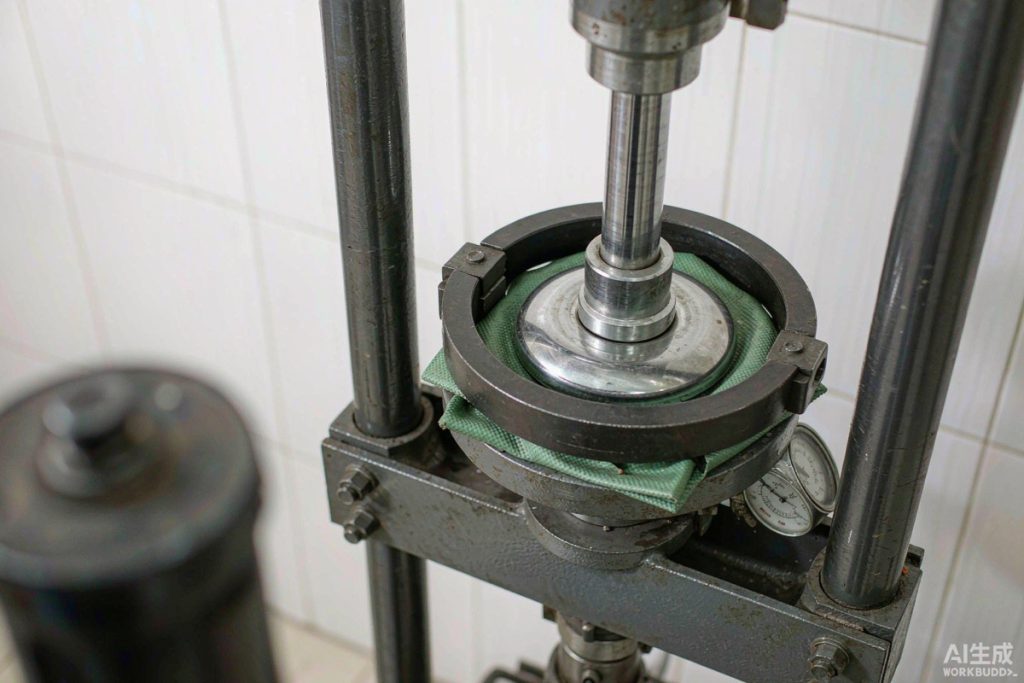
How is puncture resistance tested for PVC coated fabric?
Puncture resistance for PVC coated fabric is tested by measuring the force required for a standard probe or ball to penetrate the fabric under controlled speed. ASTM D3786 (Mullen burst) uses hydraulic pressure to inflate a diaphragm until rupture, while probe-penetration methods per ASTM D4833 or ISO 12236 measure the push-through force. Results correlate with scrim denier and coating thickness.
- ASTM D3786 Mullen burst: hydraulic diaphragm rupture; typical >=500 kPa for drop-stitch PVC — KB1 §2.2
- ASTM D4833 / ISO 12236 probe puncture: measures push-through force in N — KB1 §2.2
- Drop-stitch DWF: ASTM D3786 >=500 kPa burst per KB1 §3.1 spec table
What burst strength should PVC geomembrane liners achieve?
PVC geomembrane liners for containment applications should achieve burst strength sufficient to withstand installation stress and substrate irregularities without rupture. Typical PVC geomembrane at 0.5-1.5 mm thickness relies on tensile and tear data per ISO 1421 and DIN 53363 rather than Mullen burst, because the standard liner is unreinforced and tested for elongation and seam integrity.
- PVC geomembrane: 0.5-1.5 mm; ASTM D7176 (unreinforced) / GRI-GM17 (reinforced) — KB1 §3.4
- Tensile per ISO 1421 and tear per DIN 53363; seam peel per ISO 2411 — KB1 §2.2
- Reinforced PVC liner adds polyester scrim for puncture resistance in heap-leach and landfill applications — KB1 §3.4
How does scrim denier affect puncture resistance in tarpaulins?
Higher scrim denier directly increases puncture resistance in PVC tarpaulins because the individual yarns resist cutting and pushing through more effectively. A 1000D scrim at 9×9 or 30×30 construction will withstand significantly more puncture force than a 500D scrim at the same weave density, making heavy-denier fabrics preferred for cargo covers and rock-contact applications.
- Tarpaulin scrim: 500D-2000D (1000D common); 9×9 / 18×18 / 30×30 constructions — KB1 §1.1 / KB2 §1.2
- Heavy grade 900+/-20 gsm at 1000D 30×30: tensile 3800/3600 N/5cm — KB2 §1.2
- Light grade 440+/-10 gsm at 500D 18×12: tensile 280/260 N, 780/760 N/5cm — KB2 §1.2
What puncture test should I specify for inflatable PVC fabric?
For inflatable PVC fabric, specify ASTM D3786 Mullen burst alongside tensile and peel testing, because the fabric must maintain air pressure under impact without sudden rupture. Drop-stitch DWF fabrics used for SUP boards and air mats require >=500 kPa burst per ASTM D3786, while single-layer boat fabric relies on tensile and tear data for puncture risk assessment.
- Drop-stitch DWF: ASTM D3786 >=500 kPa; 800-2700 gsm double-wall — KB1 §3.1
- Boat fabric: 0.9 mm at 15 kPa working pressure; 0.7 mm air beam at 12-18 kPa — KB2 §4.2
- Tensile >=4000 N/5cm and tear >=100 N per ISO 1421 / DIN 53363 — KB1 §2.1
FAQ
What is the difference between burst strength and puncture resistance?
Burst strength (ASTM D3786, Mullen test) measures the hydraulic pressure at which a fabric diaphragm ruptures, reflecting multi-directional stress resistance. Puncture resistance (ASTM D4833 or ISO 12236) measures the force needed for a single probe to push through the fabric, simulating sharp-object penetration. Both are relevant but test different failure modes; request both for applications like geomembranes and inflatables.
What Mullen burst value is typical for PVC coated tarpaulin?
PVC coated tarpaulin does not have a single standard Mullen burst threshold because the test is more commonly applied to unreinforced geomembranes and drop-stitch fabrics. For tarpaulins, tensile strength per ISO 1421 and tear strength per DIN 53363 are the primary mechanical indicators. If burst data is needed, request ASTM D3786 specifically and compare results between candidate fabrics at the same gsm and scrim.
How does coating thickness affect puncture resistance?
Thicker PVC coating provides more material for a probe to push through before reaching the scrim, increasing puncture resistance. However, the scrim construction and denier are the primary determinants of resistance to sharp-object penetration. A thick coating over a weak scrim will still puncture under point loads. Verify both coating thickness and scrim specification when comparing fabrics.
Should I specify puncture testing for PVC geomembrane liners?
For PVC geomembrane liners, puncture resistance is important because the liner contacts sharp substrate materials like gravel or waste. ASTM D4833 or ISO 12236 probe puncture provides relevant data. For unreinforced liners per ASTM D7176, also request elongation and tensile data. For reinforced liners per GRI-GM17, the scrim provides additional puncture resistance. Confirm which standard applies to the project specification.
What is the burst strength requirement for drop-stitch PVC fabric?
Drop-stitch PVC fabric for SUP boards and air mats typically requires >=500 kPa burst per ASTM D3786, as specified in the product knowledge base. This high value reflects the double-wall construction with thousands of connecting threads that resist separation under pressure. Working pressure for these fabrics is typically 10-15 PSI, with the burst value providing a safety margin.
Does a PVDF surface lacquer improve puncture resistance?
A PVDF or acrylic surface lacquer does not significantly improve puncture resistance because the lacquer is a thin surface layer measured in microns. Puncture resistance is primarily determined by the PVC coating thickness and scrim construction. The lacquer’s role is UV protection, self-cleaning, and surface durability, not structural penetration resistance. Do not assume a lacquered fabric has higher puncture strength.
How do I compare puncture resistance between different PVC fabric grades?
To compare puncture resistance between grades, request probe puncture data per ASTM D4833 or ISO 12236 at the same test conditions. If probe data is unavailable, compare scrim denier and construction (e.g., 1000D 30×30 vs 500D 18×12), coating thickness, and tensile/tear values. Higher denier, tighter weave, and thicker coating all correlate with better puncture resistance. Always confirm with test data rather than specifications alone.
What puncture risks are specific to truck side curtain PVC fabric?
Truck side curtain PVC faces puncture risks from cargo protrusions, loading forks, and road debris. EN 12641-2 specifies tensile >=4000 N/5cm, tear >=300 N, and peel >=100 N/5cm but does not include a dedicated puncture test. For high-risk cargo, request additional probe puncture data per ASTM D4833 and consider a heavier scrim construction (1000D 30×30 at 900+/-20 gsm) rather than the standard 18×18 at 880-1100 gsm.












