What are the ideal storage conditions for PVC coated fabric rolls?
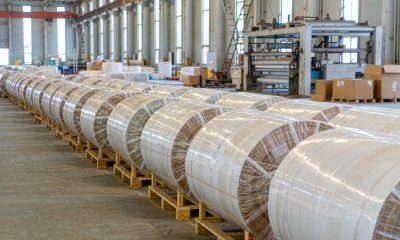
PVC coated fabric rolls should be stored indoors at 10-35 degrees Celsius with relative humidity below 70 percent, kept horizontal on flat racks away from direct sunlight and heat sources. The storage area must be dry, ventilated, and free of solvent vapours, because elevated temperature and UV exposure accelerate plasticiser migration and coating degradation even in unused rolls.
- Service temperature -30 to +70 C; storage should stay well within this range, ideally 10-35 C — KB1 §2.1
- UV ageing per EN ISO 4892-2 shows degradation even without mechanical stress — KB1 §2.2
- Mildew risk per EN ISO 846: humid storage promotes microbial growth on fabric surfaces — KB1 §2.2
How long can PVC coated fabric be stored before performance degrades?
PVC coated fabric can typically be stored for 12-24 months under proper indoor conditions without significant performance degradation, though the exact shelf life depends on plasticiser type, coating formulation, and storage temperature. Rolls stored beyond this period should be re-tested for tensile strength, coating adhesion, and flexibility before use in critical applications.
- Plasticiser migration and volatilisation are time-dependent; DOTP formulations more stable than DOP — KB1 §7
- Re-test after extended storage: tensile ISO 1421, peel ISO 2411, Shore A hardness — KB1 §2.2
- Surface bloom may appear on long-stored rolls; clean before welding — KB1 §1.3
Can improper roll storage cause coating delamination?
Improper roll storage can contribute to coating delamination when rolls are stacked under heavy weight at elevated temperature, causing pressure-induced adhesion creep at the coating-scrim interface. Horizontal stacking on flat supports distributes load evenly, while vertical or leaning storage concentrates stress on the roll edge, increasing delamination and deformation risk.
- Coating adhesion per ISO 2411: >=100 N/5cm for tarpaulin grades — KB1 §2.1
- Roll weight and stacking height must be specified by supplier; avoid exceeding 3 rolls stacked — pending business source
- Knife-coated fabric has stronger coating-scrim bond than calendered, more resistant to storage delamination — KB1 §1.2
What humidity level prevents mildew on stored PVC fabric?
Relative humidity below 70 percent in the storage area prevents mildew growth on PVC coated fabric, because the PVC coating itself is not a nutrient source but surface contamination, dust, and packaging materials can support microbial growth under humid conditions. The storage area should be ventilated and monitored, with rolls kept off the floor on pallets or racks.
- EN ISO 846: microbial growth test for coated fabrics; mildew rating <10% after 28 days for treated grades — KB1 §2.2
- Anti-mildew treatment available for ducting and agriculture grades; 350-580 gsm lightweight — KB2 §1.4
- Service life >5 years and mould grade per GB/T 24346 for agricultural grades — KB1 §3.4
FAQ
What temperature should PVC coated fabric rolls be stored at?
PVC coated fabric rolls should be stored at 10-35 degrees Celsius in a dry, indoor environment. The PVC service temperature range is -30 to +70 C, but storage should stay in a narrower range to minimise plasticiser migration and volatilisation. Avoid proximity to heating pipes, radiators, or direct sunlight through warehouse windows, which create localised hot spots.
Should PVC fabric rolls be stored horizontally or vertically?
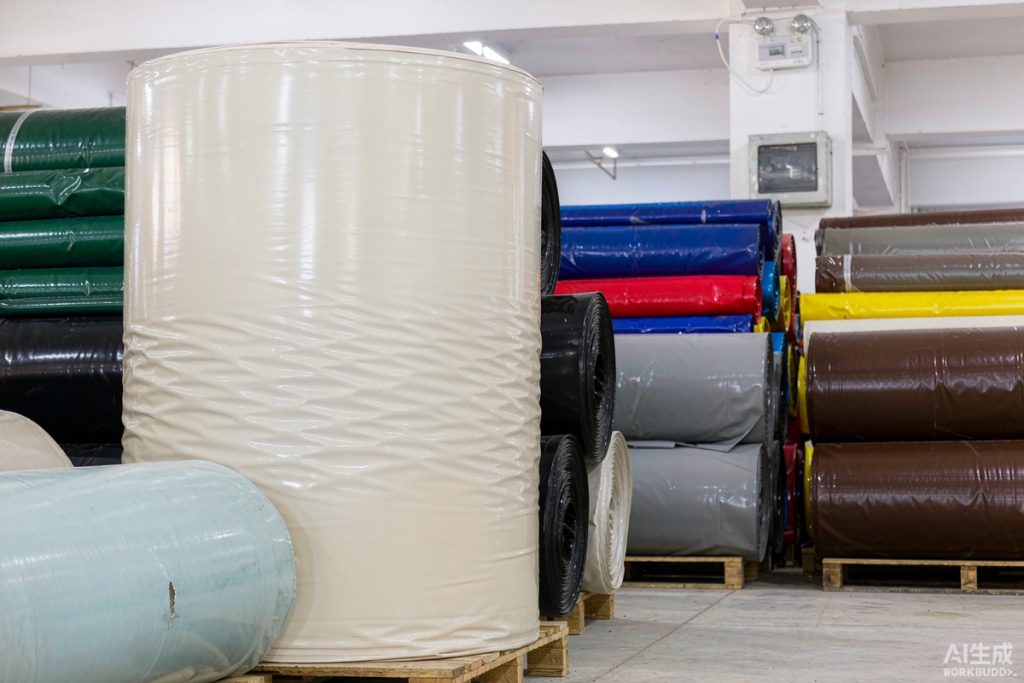
PVC fabric rolls should be stored horizontally on flat racks or pallets to distribute weight evenly along the roll length. Vertical storage concentrates the roll’s weight on the bottom edge, which can deform the core, crush the fabric layers, and cause coating adhesion creep. If vertical storage is unavoidable, use end-caps and limit the time to short-term staging only.
Can PVC coated fabric be stored outdoors?
PVC coated fabric should not be stored outdoors for extended periods, even under tarpaulin covers. Outdoor storage exposes rolls to UV radiation, temperature cycling, and moisture that accelerate plasticiser migration, surface degradation, and mildew risk. Short-term outdoor staging of finished products (already fabricated) is acceptable, but raw material rolls require indoor, climate-controlled storage.
How many rolls can be stacked safely?
The safe stacking height depends on roll weight, diameter, and core strength. As a general guideline, do not exceed three rolls stacked vertically, with the heaviest roll at the bottom. The supplier should provide specific stacking limits. Excessive stacking weight can compress fabric layers, cause core deformation, and increase the risk of coating adhesion failure under prolonged storage.
What happens if PVC fabric develops surface bloom during storage?
Surface bloom is the migration of plasticiser or other additives to the coating surface, appearing as a waxy or oily film. Bloom does not immediately indicate failure, but it can affect welding performance if not cleaned. Wipe the surface with the solvent recommended by the fabric supplier before welding or printing. If bloom is heavy or accompanied by hardness increase, re-test tensile and flexibility before use.
Does PVC fabric need to be rotated during long-term storage?
For rolls stored beyond 12 months, periodic rotation is recommended to prevent permanent deformation from static loading. Rotate the roll 180 degrees every 3-6 months if possible. This is particularly important for heavy rolls (above 500 kg) and wide rolls (>2 m) where the bottom layers bear significant cumulative weight. Document rotation dates in the storage log.
Can stored PVC fabric develop weldability issues?
Yes, prolonged storage can affect weldability if plasticiser bloom changes the surface chemistry or if dust contamination is not properly cleaned before welding. Before welding rolls stored for more than 12 months, perform a trial weld and test seam peel strength per ISO 2411. If peel strength falls below the specification (typically >=100 N/5cm for tarpaulin grades), clean the surface or consult the supplier.
What packaging is recommended for PVC fabric roll storage?
PVC fabric rolls should be wrapped in opaque, moisture-resistant packaging such as polyethylene film to protect against UV, dust, and moisture. The packaging should be sealed but not vacuum-tight, allowing minimal air circulation to prevent condensation. Rolls should be placed on pallets or racks, not directly on the floor, with end caps to protect the roll edges from impact damage.