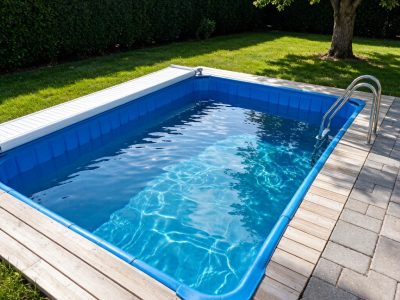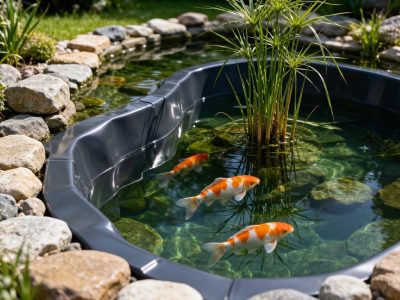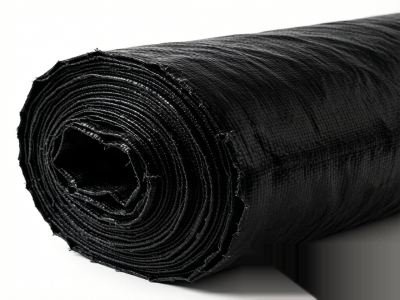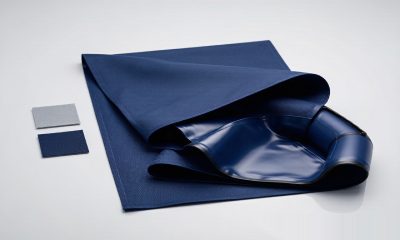
Stitched seams rely on perforations that can wick moisture and eventually leak, whereas welded seams fuse the material into a continuous, watertight bond. For pool liners exposed to chemicals and pressure, welding delivers markedly longer service life.
Kezhibo’s liner substrates are engineered for reliable welding, enabling fabricators to build custom-shaped pools with confident, leak-free construction.
The Physics of a Failed Seam: Why Needle Holes Leak
A stitched seam is, by its nature, a row of holes. The needle must pierce the liner material to carry the thread through, and every one of those perforations is a potential path for water. Whether that path becomes a leak is a question of time and environment — and a swimming pool is the most demanding environment a seam can be asked to live in.
The mechanism is wicking. Water does not rush through a needle hole; it travels along the thread, the yarn the hole exposed, and the microscopic channels between them, pulled by capillary action. In dry service, a stitched seam on a tarpaulin can hold for years. Submerged in a pool, the seam is permanently wet, permanently under pressure, and constantly working against that capillary pull.
The pool environment accelerates the process from three directions at once. Treated water — chlorinated or otherwise chemically balanced — attacks thread fibres and exposed yarn over time, weakening the very elements sealing the perforations. Temperature cycling flexes the seam thousands of times per season, fatiguing both thread and the material around each hole. And hydrostatic pressure keeps a steady head of water pushing at every weak point, so the seam never gets a rest.
A stitch does not fail on day one. It fails slowly, invisibly, and then suddenly: a slow loss that becomes a damp patch, a water bill, and eventually a drained pool with a repair crew in it.
What Welding Does Differently
Welding takes a different route entirely: instead of joining two pieces of material through holes, it fuses them into one. Heat or high-frequency energy softens the coating on both mating surfaces, pressure brings them together, and the material cools into a continuous, homogeneous bond. There is no thread, no needle, no hole — and therefore no built-in leak path.
Fabricators work with three main welding methods, and a properly specified liner fabric supports all of them:
- Hot air welding directs heated air between the overlapping panels and rolls the seam under pressure — the most common method for on-site and panel work.
- Hot wedge welding runs a heated element between the layers, giving consistent, fast, machine-driven seams on long straight runs.
- High-frequency welding uses dielectric energy to fuse PVC precisely, delivering strong, neat seams favoured in controlled workshop fabrication.
The result, whatever the method, is a seam whose strength and watertightness come from the material itself rather than from an added component. Done correctly, the welded zone is as waterproof as the sheet it joins — because chemically, it is the same material.
The Environment the Seam Must Survive
It is worth being specific about what a pool liner seam faces, because the specification should reflect it.
Chemistry. Pool water is treated water. Sanitisers, pH adjusters and algaecides keep swimmers safe, and the liner — especially at its seams — lives in permanent contact with that chemistry. A coating compound must resist it, and a seam must not depend on organic thread that the same water will degrade.
Pressure. A filled pool puts continuous hydrostatic load on every square metre of liner and every metre of seam. The seam sees that load forever, not intermittently.
Sunlight and temperature. Outdoor pools add UV exposure at the waterline and above, and seasonal temperature swings that flex the entire structure. Materials and seams must stay flexible through cold nights and stable through summer heat — which is why liner compounds use stabilised plasticiser systems rather than general-purpose formulations.
Mechanical traffic. Cleaning equipment, feet, ladders and pool covers all work the liner mechanically. Tear strength in the base fabric and seam strength at the joins carry this daily duty together.
What the Difference Adds Up To Over Service Life
Compare the two seam types against those demands and the outcome is not close. A stitched seam begins its service life with built-in perforations, sealed by organic thread, in water engineered to attack organic matter, under permanent pressure and flexing. A welded seam begins as a continuous bond with no penetrations at all. Both start waterproof; only one stays that way by design.
Industry experience is consistent on the pattern: liner leaks cluster at seams and penetrations, not in the field of the sheet. The practical conclusion for anyone specifying or fabricating pool liners is to treat seam quality as the specification’s centre of gravity — the choice that determines whether the liner delivers its potential service life or donates a few seasons of it to slow leaks.
Building for Weldability: The Material Side of the Equation
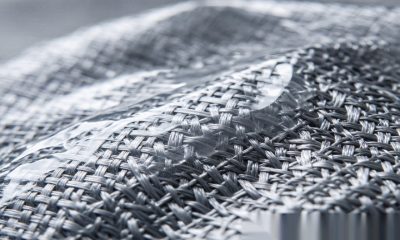
Welding quality is a partnership between the fabricator’s skill and the fabric’s consistency. The most experienced crew cannot produce reliable seams from material whose coating thickness wanders or whose formulation varies between rolls. That is why Kezhibo engineers its pool liner substrates specifically for welding performance:
- Uniform coating thickness, produced on knife-coating lines with controlled application, so the weld zone behaves the same at the panel edge as in the middle of the roll.
- Stabilised PVC compounds formulated for permanent water contact and pool chemistry, with plasticiser systems chosen to keep the seam zone flexible through years of service.
- Consistent weldability across hot air, hot wedge and high-frequency methods, so fabricators can match the joining process to the job — shop fabrication or on-site panel work.
That combination is what allows fabricators to build reinforced membrane pools in custom shapes — the freeform designs that make a pool a landscape feature rather than a rectangle — with seams they can trust under water from the first fill.
Practical Guidance for Fabricators
Material is half the outcome; process discipline is the other half. Crews working welded liners get the best results by treating the seam as a engineered joint:
- Clean and prepare overlap zones — contamination at the weld line is the most common avoidable cause of weak seams.
- Verify welding parameters on the actual material batch before production, not from memory of the last job.
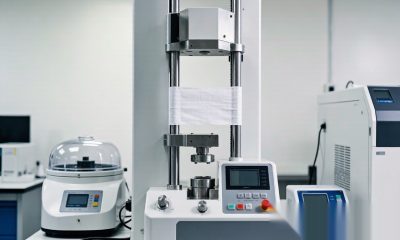
- Test welds as work proceeds: a quick peel check on a test seam costs minutes; a failed pool costs a season.
- Plan seam layout before cutting, orienting joins away from high-stress zones where the geometry allows.
Specify the Seam, Not Just the Sheet
When comparing liner materials, ask about the fabric’s weld behaviour with the same seriousness you ask about weight and colour. Request coating thickness data, welding parameter recommendations and seam peel performance — the numbers that predict how the liner will behave where it actually fails or succeeds: at the seam.
Contact Kezhibo for pool liner fabric datasheets, welding guidance and samples.