The bottom line
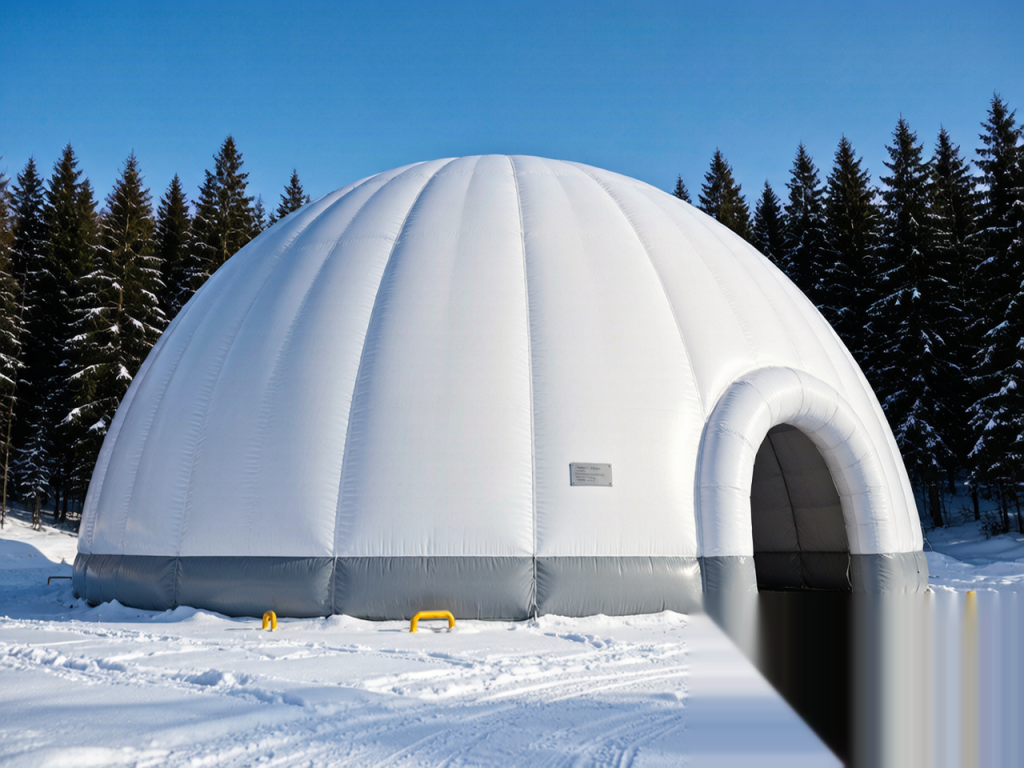
Inflatable tents — airbeam structures — are quickly replacing pole-frame tents in brand activations, emergency response and military field use. The core is not ‘inflated cloth’ but engineering: knife-coated PVC fabric airbeams pressurized to 3–7 PSI (0.2–0.5 bar) carry wind, snow and the structure’s own weight, erect in 5–15 minutes and collapse in under a minute. Specifying well means reading the airbeam type, fabric weight and seam method.
Background: from metal frames to airbeams
A traditional pole-frame tent needs a crew, a truck and an hour of assembly, and the heaviest, most awkward part is the frame. Inflatable tents swap the metal frame for airbeams — pressurized fabric tubes that self-erect when filled. In a real Munich Oktoberfest case, a 12 m × 4 m (about 48 m²) inflatable capsule pop-up was set on a heritage square where excavation was banned; it was ballasted with steel cables, the main structure inflated within 2 hours, and interior fit-out plus branding finished in a day, with zero ground damage. Munich’s changeable October weather — possible rain and strong wind — was handled by the 650 g/m² flame-retardant double-sided PVC cover rated wind level 7–8.
How it works: why PVC coated fabric suits airbeams
Covers commonly use 650 g/m² flame-retardant double-sided PVC knife-coated fabric — waterproof, UV resistant, rated -30 °C to +70 °C, wind resistance level 7–8. The broader weight bands: event tents 0.55–0.7 mm PVC, emergency and military 0.6 mm airtight, advertising spider tents 0.9 mm (supporting large-format full-color print). Seam treatment is decisive — heat-sealed seams in airtight models beat stitched seams at stopping water ingress and holding pressure, the lifeline in rain and field conditions.
Where it fits: three user types
① Brand activations: the UV-printed exterior is itself a billboard visible from hundreds of meters; sealed airbeams need no on-site blower, so the space stays quiet with no cable across the queue. ② Emergency response: airtight construction, compact storage, pre-positionable as disaster inventory; high-visibility colors aid search identification. ③ Military: 0.6 mm airtight, multi-scene, packable into standard transport cases for field HQ, medical and equipment shelter.
Deployment logistics that matter
The operational advantage is the schedule. An electric pump inflates the whole structure in 5–15 minutes; deflation is a relief valve and the tent collapses in under a minute. A compact deflated package fits a vehicle trunk or standard military container — the logistics profile that makes inflatables the shelter of choice for teams that move fast. For brand roadshows, a reusable design cuts repeat rental and build cost per city versus rebuilding each stop, and the same asset tours multiple events.
Maintenance and repair
Because the frame and the printed skin are separate, a torn or marked skin can be replaced without touching the airbeams, and a punctured beam can be patched locally. The failure mode to watch on sealed types is slow pressure loss — a sealed beam that leaks is the one thing nothing compensates for, so it must be checked standing, over time, before a live event. Sealed structures also need no power during the event itself, which is the whole point for a registration desk or VIP lounge.
Market and trend: reusable and fast
One event-tent maker reports a line with 135 sewing machines and 10 heat-sealing machines and an 85%-plus customer retention rate, a sign the weather-exposed manufacturing quality holds up. For brands, the reusable design sharply cuts repeat rental and build cost on global roadshows.
Spec checklist for buyers
① Confirm structure type: airtight sealed beams (no on-site blower) versus continuous-blow; the former is silent and suits occupied events. ② Pick weight by use: event 0.55–0.7 mm, advertising 0.9 mm, emergency/military 0.6 mm airtight. ③ Verify seam method — airtight sections must be heat-sealed, not stitched. ④ Match rigging and anchoring (ballast, stakes, cables) to the site (hard pavement vs lawn). ⑤ Request written temperature range, wind rating and flame-retardant grade (EN 13501 / CPAI-84 / NFPA 701 framing).
Airbeam versus pole-frame: the trade-offs
The gains are not free. A sealed airbeam structure depends entirely on its seals, so pre-event pressure checks are non-negotiable, and operators must respect wind limits — most makers stop use above roughly 8 on the Beaufort scale. Against that, a pole-frame tent needs no inflation but ships as bulky aluminum and needs a crew to raise. For single-day brand activations the inflatable’s pack-flat, two-person setup wins; for season-long static installs a framed structure may still be the steadier choice.
FAQ
Q1: Do inflatable tents really need no on-site blower?
A1: Sealed-airbeam types need the pump only twice — at setup and teardown — then valves close and the structure holds its own pressure; only continuous-blow models run a blower the whole time.
Q2: Why is knife-coated PVC fabric good for inflatable structures?
A2: It is strong, heat-sealable, waterproof and UV resistant; the 650 g/m² double-sided knife-coated spec is stable from -30 to +70 °C at wind level 7–8, and heat-sealed seams hold pressure and water better than stitching.
Q3: What about lifespan and reusability?
A3: It hinges on airbeam seal quality and fabric wear; quality commercial PVC airtight structures tour many events, damaged zones patch locally, and frame and printed skin separate for independent replacement.
Sources: Lingtong Structures (Munich inflatable pop-up case), AdInflatable (airbeam event tent), AirFunPro (inflatable tent technical guide).