
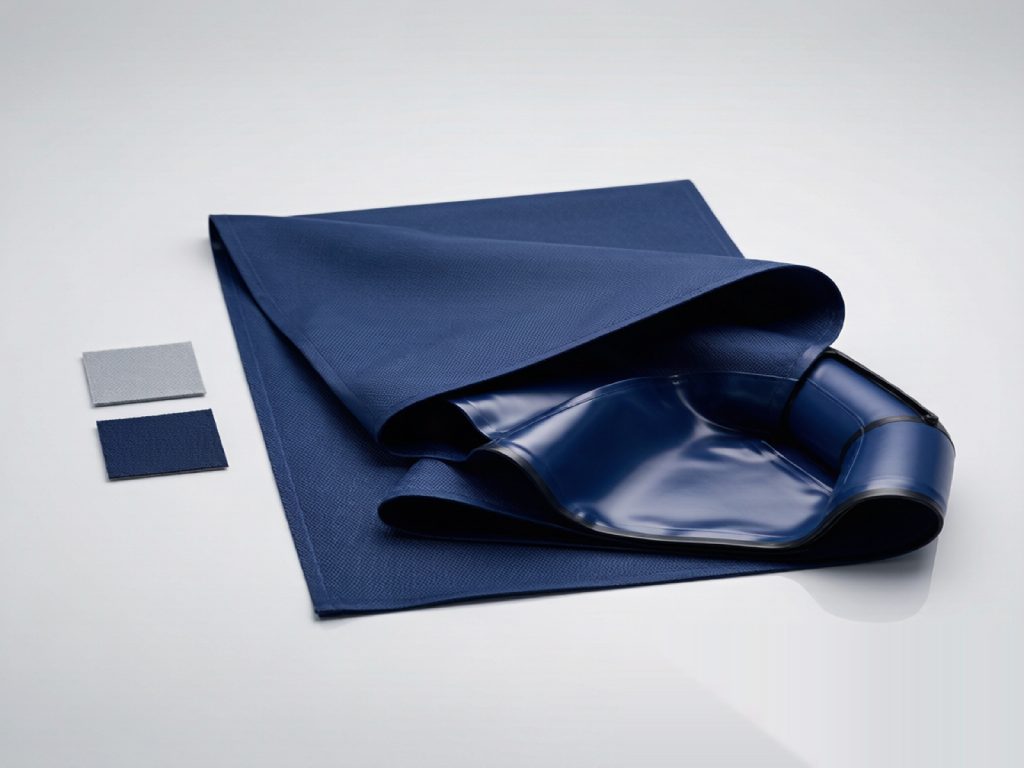
Iridescent PVC-coated mesh is ordinary PVC-coated polyester mesh with an optical layer added to the PVC face, so the same roll shifts between gradient, laser and pearl effects as the viewing angle changes. The material family does not change — high-tenacity polyester scrim, PVC on both faces — only the surface finish and its bond strength do. Today it goes into bouncy castles, photo-friendly inflatable installations, children’s obstacle courses, pop-up retail and cultural-tourism water attractions. Buyers want the camera-ready look; what decides whether it survives a full season is coating adhesion and seam integrity.
Why looks became a specification
A 2026 product note from Guansheng New Material puts it plainly: customers in tourism, family entertainment and commercial display have moved from “does it work” to “does it look good, feel premium, photograph well”. Plain or simply printed mesh looks flat, loses depth under changing light and performs poorly on video. Iridescent fabric builds a focal point through gradient, laser and pearl effects, which travels on social media (https://www.guanshengpvc.com/News/info.aspx?itemid=306&lcid=21). For operators, photogenic quality feeds footfall and repeat sharing, so the material becomes part of the marketing budget rather than a passive cover.
Where the manufacturing difficulty sits
It looks like an extra layer of gloss, but the process is considerably harder than standard mesh:
- Formulation: the optical coating must hold even gloss while bonding firmly to the PVC base, without powdering or cracking on folding. Compatibility between substrate, plasticiser and optical pigments has to be re-engineered.
- Process window: coating thickness, drying temperature and line speed all need tight control; drift in any one produces colour variation or uneven gloss.
- Scale-up consistency: the supplier notes that few Chinese producers can hold stable mass production, and that custom tones and gloss levels require a dedicated team and repeated trials.
For buyers, the subtext is that a sample panel and a production lot may not match in gloss. Write gloss level, colour-difference tolerance and retained batch samples into the technical agreement instead of approving from a well-lit sample photo.
Reading the specification
Iridescent is a surface effect; the fabric is still specified by four numbers — denier, finished weight, thickness and width. A listing updated in November 2026 quotes 840D×840D, 18×18 density, 580 g/m², 0.45 mm, 210 cm width, twelve-plus colours, B1 flame rating and −30 to +70℃ service range (https://www.china.cn/wangyanbu/4079245409.html). A second coated-mesh listing supplies thin 500D and heavy 1000D series with matte, glossy, transparent and embossed finishes, 0.8 mm thick, in 2.1 m and 3.6 m widths, for side curtains, inflatables, large halls, oil booms and printed media (https://www.china.cn/gongnongyeyongsulzp/1377712590.html).
A sourcing guide offers a useful cross-check: most commercial inflatables sit at 500–650 GSM with 500D–1000D scrim and 0.35–0.55 mm thickness; marine and high-pressure structures move to 1000D–1500D and 0.9–1.1 mm. It also warns that denier, GSM and thickness are three separate measurements, that none can be inferred from another, and that a weight label alone defines neither tear strength nor air retention (https://ly-trustlink.com/pvc-inflatable-fabric-guide). Because the iridescent layer adds a finishing step, ask for all three to be reported separately.
Compliance is not optional
However good the finish, inflatable play equipment remains a regulated product. The US looks to ASTM F2374-24 and CPSIA, the EU to EN 14960-1 and REACH, with NFPA 701 where flame propagation applies; REACH Annex XVII limits DEHP, DBP, BBP and DIBP in plasticised material to 0.1% by mass (https://camchinabridge.co.uk/zh/guides/sourcing-pvc-and-pu-coated-fabrics-from-china). Air retention is a system property — coating continuity, welded seams and valve seating together decide pressure hold; a thicker coating is not automatically a tighter one. Test trial seams separately, because the optical topcoat can change hot-air or RF welding parameters.
Checklist before placing an order
- State scrim, weight, thickness and width, and confirm whether the iridescent face is coated or laminated.
- Request flame and phthalate reports for the exact weight ordered, not a neighbouring grade.
- Agree on a gloss and colour-difference acceptance method, and retain batch samples.
- Ask for a trial weld and check both appearance and peel strength on the finished optical face.
FAQ
Why does iridescent mesh cost more than standard PVC mesh?
The premium comes from the optical formulation, process control and lower production yield, not the base scrim. For pop-up and photo-driven installations the premium is usually recovered through shared content; for permanent shade or cover applications, a standard coated fabric is better value.
How long does the iridescent effect last outdoors?
No single figure applies — it depends on the pigment system, UV package and actual sunlight. Ask for accelerated-weathering data on the specific colourway and put a colour-difference limit in the contract rather than accepting a verbal promise.
Can an iridescent fabric still meet B1 flame rating?
Yes, but the flame package and optical pigments must be designed together because flame retardants can disturb gloss uniformity. Insist on a report for the finished iridescent fabric, not a plain fabric of the same weight.












