
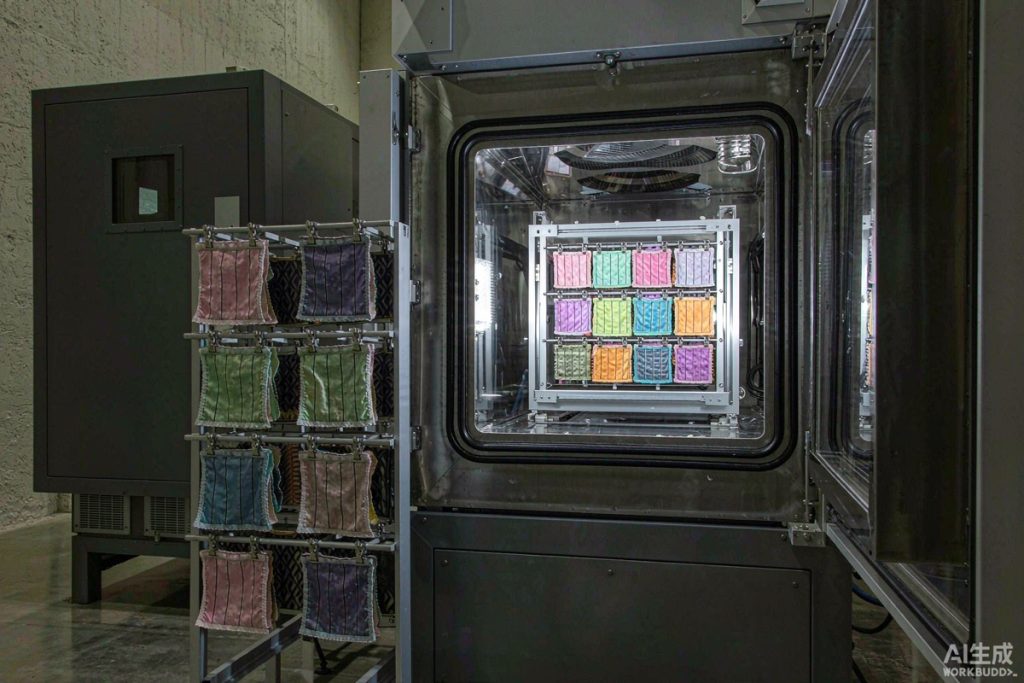
How is colour fastness verified for PVC coated fabric?
Colour fastness for PVC coated fabric is verified by ISO 105-B02 xenon arc exposure, which simulates outdoor sunlight under controlled humidity and temperature. After a specified exposure period, the tested sample is compared against the unexposed original using the ISO 105-A02 grey scale, where grade 5 means no change and grade 1 means severe change. Typical outdoor grades target 7-8.
- ISO 105-B02: xenon arc light fastness; typical exposure per EN ISO 4892-2 cycle — KB1 §2.2
- ISO 105-A02 grey scale: grade 5 = no colour change, grade 1 = severe change — KB1 §2.2
- Typical PVC coated fabric: grades 7-8 for premium outdoor grades — KB1 §2.2
What grey scale grade should outdoor PVC fabric achieve?
Outdoor PVC coated fabric should achieve grey scale grade 7 or higher per ISO 105-A02 after xenon arc exposure, with premium architectural and tensile membrane grades targeting grade 8. Grades below 6 indicate noticeable colour fading within the first year of outdoor exposure, which is unacceptable for permanent architectural applications and printed advertising.
- Premium outdoor grades: 7-8 per ISO 105-B02 / A02 — KB1 §2.2
- Advertising banner grades: lower colour fastness acceptable for short-term 3-6 month campaigns — KB2 §3.3
- Architectural membrane: long-term colour retention critical for 15+ year structures — KB1 §3.1
Does surface lacquer affect colour fastness in PVC fabric?
Surface lacquer significantly affects colour fastness because PVDF and acrylic topcoats filter UV radiation before it reaches the pigmented PVC layer, slowing colour degradation. PVDF lacquer provides superior colour retention and self-cleaning compared to acrylic, making it the preferred choice for long-life architectural membranes where colour stability over decades is a design requirement.
- Acrylic lacquer: shorter warranty range; PVDF: longer warranty range per KB1 §1.3 — KB1 §1.3
- PVDF topcoat: UV filtering + self-cleaning; acrylic: standard UV protection — KB1 §1.3
- Verify lacquer type in technical data sheet; affects both colour fastness and weldability — KB1 §1.3
How does ink type affect colour fastness in printed PVC banner?
Ink type directly affects colour fastness in printed PVC banners because different ink chemistries have inherently different UV stability. Solvent-based inks generally provide better outdoor colour fastness than water-based or latex inks, while UV-cured inks offer good initial colour density but may yellow over extended exposure. Always verify ink compatibility with the PVC topcoat before printing.
- Ink types: solvent / eco-solvent / UV / latex; solvent preferred for outdoor — KB2 §3.1
- Banner model life bands: 520/530 3-6 months, 550 6 months+, knife-coated 1-3 years — KB2 §3.3
- EN ISO 4892-2 ageing and ISO 105-B02 verify printed colour retention — KB1 §2.2
FAQ
What is ISO 105-B02 and how does it apply to PVC fabric?
ISO 105-B02 is the international standard for testing colour fastness to artificial light using a xenon arc lamp that simulates daylight. For PVC coated fabric, a sample is exposed under controlled temperature and humidity for a specified duration, then compared against an unexposed original using the ISO 105-A02 grey scale. The resulting grade (1-5, with 5 being best) indicates the fabric’s resistance to colour fading under sunlight.
What grey scale grade is acceptable for outdoor tarpaulin?
For outdoor tarpaulin intended for multi-year use, grey scale grade seven or higher per ISO 105-B02/A02 is recommended. Grades below six may show visible fading within the first year, which is acceptable for short-term covers but not for permanent structures or branded truck curtains where colour consistency matters. Always specify the required grade when ordering, and request the test report.
How does PVDF lacquer improve colour fastness?
PVDF lacquer acts as a UV-filtering topcoat that reduces the UV radiation reaching the pigmented PVC layer beneath it. This slows the photochemical degradation of pigments and the PVC matrix itself. PVDF also provides self-cleaning properties that reduce surface dirt accumulation, which can otherwise make colours appear faded even when the pigment itself is intact. PVDF typically carries a longer warranty than acrylic.
Can I use ISO 105-B01 instead of ISO 105-B02?
ISO 105-B01 uses a carbon arc lamp, while ISO 105-B02 uses a xenon arc lamp. Xenon (B02) is now the preferred method because its spectral output more closely matches natural daylight. Carbon arc (B01) is an older method that produces more UV-B and can overstate fading. Most modern specifications and test reports use B02. Confirm which standard your customer requires before testing.
What colour fastness grade should PVC advertising banners achieve?
For short-term advertising banners (three to six months outdoor life), a grey scale grade of five to six per ISO 105-B02 may be acceptable, because the banner will be replaced before significant fading occurs. For long-term backlit signage or architectural banners (one to three years), grade seven or higher is recommended. The ink type and PVC topcoat also affect the result; request printed sample testing rather than substrate-only testing.
How does coloured PVC coating differ from printed PVC in colour fastness?
Coloured PVC coating has pigment integrated throughout the coating layer, providing colour that persists even as the surface wears. Printed PVC has ink applied to the surface, which is more susceptible to UV fading and abrasion. For applications requiring long-term colour stability, integrally coloured PVC with a PVDF lacquer is superior to surface-printed PVC. Request ISO 105-B02 data for both the substrate and the printed ink.
Does dark-coloured PVC fabric fade faster than light-coloured?
Dark-coloured PVC fabric generally absorbs more UV and thermal energy than light-coloured fabric, which can accelerate surface degradation and colour shift. However, the pigment quality, UV stabilisers, and surface lacquer have a larger effect than colour depth alone. A well-formulated black PVC with PVDF lacquer may outperform a poorly formulated white without lacquer. Always verify with ISO 105-B02 test data rather than assuming.
What test duration should I specify for ISO 105-B02 on PVC fabric?
For PVC coated fabric, a common test duration is 500-1,000 hours of xenon exposure, corresponding to approximately 1-2 years of outdoor exposure in a temperate climate. For architectural membranes with 15+ year design life, request 2,000 hours or more per EN 15619 Annex A. The test report should specify the exposure cycle, irradiance level, and black-panel temperature used, as these affect comparability between reports.












