
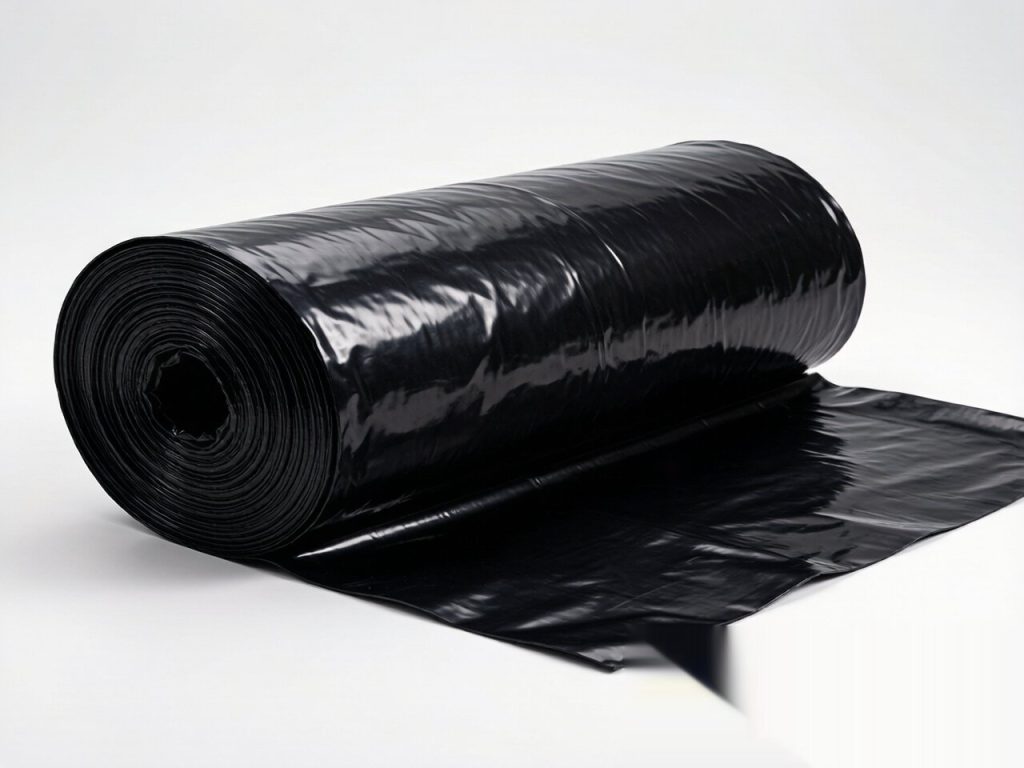
Background: why heap-leach pads pick PVC, not only HDPE
In copper, gold and uranium heap leaching, a liner sits beneath stacks of crushed ore tens of metres high to collect acidic or alkaline leach solution while stopping toxic seepage into groundwater. US EPA’s Subtitle D landfills often specify HDPE for primary liners, but on a leach pad that must follow irregular ground and carry enormous uneven load, PVC’s flexibility and weldability make it the more practical choice. The crushed ore is heavy and shifts; a liner that fights its substrate costs more in anchoring and still risks wrinkling and stress at the anchors.
How it works: thickness, compound, chemical resistance
Mining-grade PVC geomembrane is typically 2.0-3.0 mm (source: gscgeosynthetics.com). Looking Forward lists a broader 0.2-3.0 mm range, density 1.20-1.30 g/cm3, tensile strength >=15 MPa, elongation >=250%, tear >=60 N, service -20 to +60°C (source: qdlookingforward.com). PVC resists most waters, salts, mild acids/alkalis and common industrial effluents; in strong solvents, aromatics or oxidisers, immerse-test the actual site liquor first, because plasticiser migration can occur in aggressive organic environments (source: geogridgeocell.com).
The quiet advantage is environmental stress crack (ESC) resistance. PVC’s amorphous structure and plasticiser-enhanced flexibility make it far less prone than rigid crystalline polymers like HDPE to brittle fracture under sustained stress and chemicals – exactly the failure mode a leach pad is built to avoid (source: ronaldmark.com).
Seaming: the field-risk control point
PVC joins more flexibly than HDPE. Solvent welding brushes THF or cyclohexanone on a 50-75 mm overlap for peel strength of 5-10 N/mm; hot-air wedge welding at 300-400°C reaches 80-95% of parent strength; radio-frequency (dielectric) welding suits factory prefab; two-part epoxies or acrylics handle repairs and bonding to concrete or steel. Every seam is verified by vacuum box, spark test and destructive peel/shear per ASTM D6392 (source: gscgeosynthetics.com).
The bigger lever is prefabrication. Factory-fabricated panels reach 40,000 ft², cutting field seams and lowering leak risk by up to 80% while trimming total cost 30-40% once material, construction and construction-quality-assurance are counted (source: ronaldmark.com). Modular panels also adapt to complex geometries and custom anchor options, which is why they fit scalable, repeatable builds better than roll-after-roll field welding.
Where it is used
Copper/gold/uranium heap-leach pads, tailings storage, drinking-water reservoir floating covers, anaerobic lagoon biogas capture, aquaculture liners, tank-farm secondary containment, and irrigation canals where seepage drops from ~50% in earth channels to under 5%. PVC’s density (~1.25 g/cm3) is slightly above water, so floating covers need pontoons – a detail the design must plan for, not discover later.
Specifying the right liner
- Choose a chemical-grade compound from the leachate chemistry and temperature; lab-immerse if in doubt.
- Prefer large factory panels to minimise field seams.
- Anchor in a concrete trench, bentonite seal or clamped steel angle; add expansion loops for settlement.
- Dual nondestructive plus destructive seam testing; no welding in rain, extreme cold or on contaminated surfaces.
- Use a UV-stabilised formulation with ballast or cover for exposed installs.
Slopes deserve a separate check: a smooth impermeable liner is a low-friction interface, so geotextile protection, a textured membrane option or anchored cover improves interface friction and stops sliding. Ponding loads, saturation, seismic deformation and construction traffic all belong in the stability review.
Cost and risk, quantified
The saving is not only in the liner price. Ronald Mark frames the 30-40% total advantage as material plus construction plus construction-quality-assurance: fewer field seams mean fewer destructive tests, fewer repairs and less weather-dependent downtime. On a remote leach pad, that schedule certainty often outweighs the per-square-metre delta between PVC and HDPE. The offsetting risk is chemical. In aggressive organic liquors PVC can lose plasticiser, so specify a compound immersed-tested against the actual site solution and add a secondary containment layer rather than assuming the membrane alone is the barrier. Document batch traceability and third-party inspection; a liner with no QA paper trail is hard to defend if a regulator questions the closure or a neighbouring aquifer shows a trend. Treat the liner system, not the roll, as the deliverable.
Frequently asked questions
Q: How long does a PVC geomembrane last?
With chemical- and UV-resistant formulation in exposed service, 20+ years is realistic; the category has a 50-year track record and is recognised by EPA, USDA NRCS and ASTM.
Q: PVC or HDPE?
For complex shapes, high flexibility and easy welding choose PVC; for maximum lifespan, lowest permeability and aggressive chemistry choose HDPE. They are often combined in a composite system, with PVC as secondary liner, cap or temporary cover.
Q: How thick for a heap-leach pad?
Mining leach pads typically use 2.0-3.0 mm chemical-grade PVC, with large factory panels to cut field-seam leak risk and a tested chemical formulation for the site liquor.












