
When storage space cannot keep pace with a growing business and nobody wants to wait through the approvals and construction of a permanent building, an aluminium frame plus PVC-coated fabric warehouse tent is close to the only option delivered in weeks. The real question is not whether it can be built, but whether five parameters — clear span, eave height, snow load, wind resistance and envelope material — are matched to the site. A mature temporary-storage system, for example, offers clear spans of 3–60 m, lengths from 10 to over 100 m, eave heights of 2.5–8 m, snow loads up to 75 kg/m², wind resistance up to 120 km/h, an 850 g/m² PVC roof and a frame life over 20 years (KENTEN Structures, 2026).
Span and Eave Height Decide What You Can Store
A 60 m clear span removes the internal columns that would otherwise cut the floor into corridors, letting racking lines and forklift routes run continuously. On smaller sites the same logic applies at 3, 10 or 15 m: the span is chosen to fit the racking layout, not the other way round. Eave height is the other half. At 2.5 m the building behaves like a covered yard; at 5–8 m it accepts pallet racking with a working aisle underneath. Length beyond 100 m allows inbound, storage and dispatch to sit under one roof instead of three disconnected areas (KENTEN Structures, 2026).
Loads and Anchoring: Numbers Are Not Universal Guarantees
Snow load of 75 kg/m² and wind resistance of 120 km/h are envelope values, not promises that hold everywhere. They must be checked against the actual site: exposure category, terrain, the return period the local authority applies, and the anchoring available. Ground anchors suit sites where the surface can be penetrated; concrete ballast suits sealed yards, leased land or rooftops where excavation is impossible. Getting that calculation before signing separates a compliant temporary warehouse from an uninsurable structure. Chinese suppliers follow the same logic: high-strength aluminium frames with flame-retardant, windproof, rainproof and sun-resistant PVC fabric, in customisable sizes that can be combined and later relocated (NetEase / Huaye, 2026-11-11).
Envelope Material: What the 850gsm PVC Roof Does
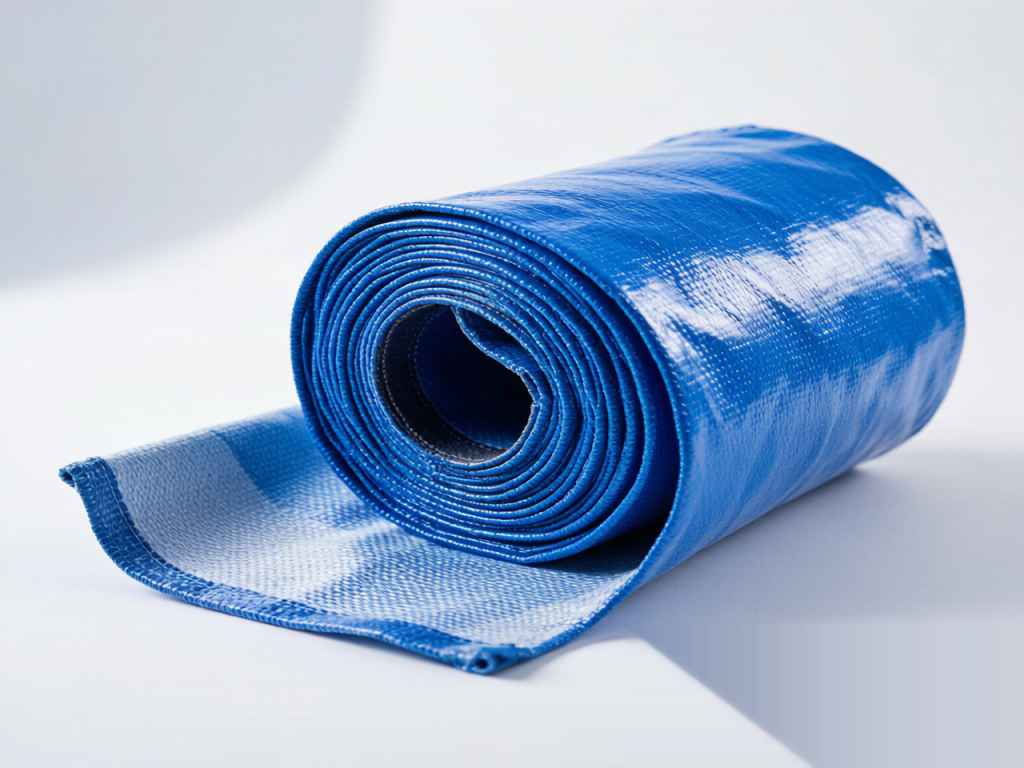
Roof and sidewall panels are cut from coated PVC fabric, and panel geometry is what lets the envelope close cleanly around a clear span. The 850 g/m² roof handles waterproofing, tensile strength and long-term UV performance. Wall systems handle everything else: PVC for fast, low-cost closure; glass for daylight and supervision; ABS for cleanable interiors; sandwich panels for thermal separation and appearance. Frames are generally 6061-T6 or 6082-T6 aluminium — a strength-to-weight balance that resists corrosion and survives repeated assembly without weld fatigue (KENTEN Structures, 2026).
- Flame rating: storage and logistics commonly require B1 flame-retardant blackout PVC, tied to fire inspection and insurance.
- Temperature: common specifications cover −40 to +50 °C outdoors, which spans most temperate and subtropical sites.
- Column-free interior: the full floor is usable, forklifts move freely, and wiring can follow fire-inspection requirements (Huaye Tent, 2026).
- Reusability: a frame life over 20 years shifts the purchase from consumable expense to reusable asset.
Cost and Deployment Logic
Modular design cuts production, transport and installation cost substantially — one supplier claims over 50% saving versus conventional construction — with no heavy plant or complex foundations (NetEase, 2026-11-11). For cross-border e-commerce fulfilment centres, seasonal inventory balancing, temporary workshops and equipment shelters, that fast-build fast-strip flexibility maps directly onto supply-chain resilience. One caveat: fabric life, frame corrosion protection and anchoring design together determine whole-life cost; the per-square-metre figure on a quotation is only one line of it.
Specification Checklist
- Set span and eave height from racking and forklift layout first, then ask suppliers to respond — not the reverse.
- Request wind and snow calculations for the specific site, including exposure category and return period.
- Fix the anchoring method: ground anchors or concrete ballast, depending on whether the surface may be disturbed.
- Verify roof weight, flame rating, temperature range and UV spec, with matching test reports.
- Ask for frame alloy grade, corrosion treatment and expected assembly cycles, and count reuse value into the cost.
FAQ
Can a warehouse tent replace a permanent building?
It works well as a medium-term transition or flexible expansion, but it is not fully equivalent to a permanent structure. It depends on local approval, fire acceptance and insurance, and its life is bounded by the fabric (typically around 8–12 years) and anchoring. Weigh budget, service life and the compliance path together.
How much snow can an 850 g/m² PVC roof carry?
The fabric itself does not set snow capacity. Capacity comes from the whole structure — span, roof pitch, frame section and anchoring. Systems can reach 75 kg/m², but the design must be calculated against the site’s basic snow pressure; snowy regions need drainage slopes and a clearing plan.
Can a warehouse tent be assembled repeatedly?
Yes. Aluminium frames are designed for repeated assembly without weld fatigue and can last over 20 years; the PVC fabric is usually the first part needing replacement. On relocation, keep panel numbering and tensioning records so original tension can be restored.












