
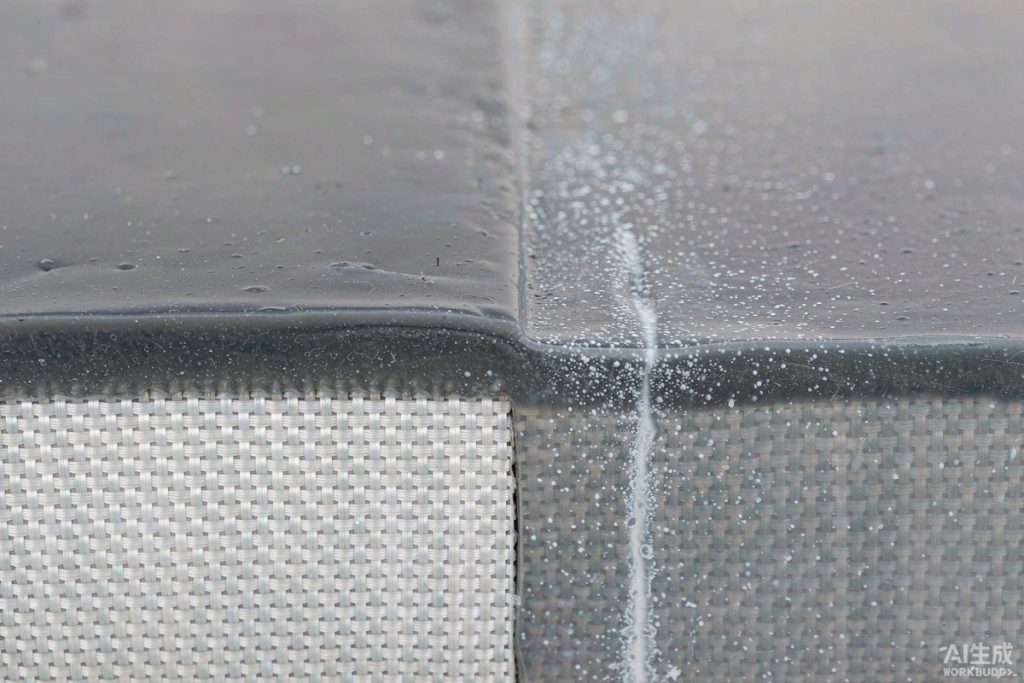
Antistatic PVC strip curtains are moving from electronics cleanrooms into data halls. They address a specific problem: charge built up by walking and material handling can destroy sensitive devices. A compliant curtain is not defined by the phrase ‘antistatic’ but by three measurable figures — surface resistance between 10⁶ and 10⁹ Ω, generated voltage below 50 V, and decay from 1,000 V to under 100 V in less than 0.5 seconds. Without a grounding path, none of those numbers hold.
What each number controls
A technical sheet from Taiwan’s Jiahon sets out a complete acceptance framework, including the measurement conditions. Surface resistance is read with a surface resistance meter at 25 cm electrode spacing, with an acceptance window of 10⁶–10⁹ Ω. Generated voltage is measured after rubbing with a standard cloth at fixed force and must stay under 50 V. Charge decay is timed from 1,000 V down to below 100 V and must complete within half a second. Visual inspection calls for no damage, no obvious scratching and a uniform conductive coating.
- Surface resistance decides whether charge drains gradually or dumps all at once. Below 10⁶ Ω discharge is too fast and carries safety risk; above 10⁹ Ω it is too slow to protect anything.
- Generated voltage simulates real rubbing during use and maps directly onto ‘will this damage a component’.
- Decay time is a dynamic measure and closer to service conditions than a static resistance reading.
The standard product is PVC, 0.5 mm thick, 30 m long and about 14 kg, available as fully clear, black mesh or semi-transparent mesh. On installation the bottom edge should sit 10–15 mm above the floor to avoid dragging. Where ESD grounding is required, a grounding clip on the rail gives charge a way out.
A curtain alone is not an ESD programme
This point cannot be overstated. Jiahon cites IEC 61340-5-1 and states explicitly that a complete cleanroom ESD setup needs the curtain, an antistatic table mat and a wrist strap, all sharing a common ground. Hang a curtain with a perfect resistance rating on an ungrounded aluminium frame and you have achieved nothing — the charge still has nowhere to go.
A second trap is conflating ‘antistatic’ with ‘antibacterial’ or ‘flame retardant’. These are different additive systems: antistatic performance comes from conductive fillers or antistatic agents that build a leakage path; flame retardancy relies on halogenated or phosphorus systems; antibacterial treatment involves biocidal active substances and BPR regulation. A datasheet claiming all three needs three separate test reports. One does not substitute for another.
How this differs from cold-chain strip curtains
We have covered cold-chain PVC strip curtains elsewhere, where the focus was low-temperature flexibility (polar grades to −40 °C), light transmission around 85 % to ASTM D1003, thermal conductivity near 0.16 W/m·K, and overlap ratios. That is thermal separation logic. The objective function for an antistatic curtain is entirely different: it does not chase minimum conductivity but a controlled surface resistance and fast decay, and light transmission may actually fall because of the conductive mesh.
A product published by Beijing-based XRHZ on 1 November 2026 offers a useful comparison. It is made with antistatic raw material or ink, in reinforced and mesh forms, mainly light-green reinforced, clear mesh, black mesh and orange mesh. Conductivity after effective grounding is quoted within 10⁴–11 ohms per square, with typical light transmission no higher than 75 % except for black and opaque variants. Common strip widths are 200 mm reinforced light green and 137 mm clear mesh; overlaps are usually 1/4 or 1/2, and frames can be iron, stainless steel, mobile, folding or fixed aluminium. Applications listed include electronics plants, cleanrooms, pharmaceutical workshops, hospitals and petrol stations.
Acceptance and maintenance in practice
- Measure once after installation to set a baseline, and record the conditions — temperature, humidity, electrode spacing and instrument model. Surface resistance is humidity-sensitive; a number without conditions is not comparable.
- Retest roughly every six months. If resistance drifts by more than one order of magnitude, for example from 10⁸ toward the 10⁹ edge, evaluate cleaning or replacement.
- Oil and dust raise surface resistance. Wipe with a neutral cleaner; avoid strong solvents that damage the conductive coating.
- Put earth resistance, clip position and curtain-to-floor clearance on the inspection sheet, not just product datasheet values.
Data centres add one more constraint: equipment casings are largely metal, so a curtain touching a cabinet or cable tray can create an unintended grounding path. Keep separation distances agreed with the M&E consultant during layout.
FAQ
Why is 10⁶–10⁹ Ω a range rather than lower being better?
Too low and charge discharges instantly, creating spark or shock risk; too high and it drains too slowly, leaving charge on devices. The 10⁶–10⁹ Ω window is the usual band for static-dissipative material, balancing safety and protection.
Can a standard clear PVC curtain serve as an antistatic one?
No. Ordinary PVC is an insulator with surface resistance typically above 10¹² Ω. Antistatic behaviour comes from conductive fillers, antistatic agents or conductive mesh, plus grounding, and must be confirmed by test reports.
How often should it be retested?
Industry practice is to establish a baseline at installation, then retest surface resistance, generated voltage and decay time about every six months. Retest earlier if resistance drifts more than an order of magnitude or the surface is visibly contaminated or scratched.
Sources: Jiahon antistatic PVC curtain technical page (https://jiahon.com.tw/product/%E9%98%B2%E9%9D%9C%E9%9B%BBpvc%E7%B0%BE-%E7%89%87/); Beijing XRHZ antistatic soft door curtain listing (1 November 2026, https://mip.bmlink.com/bjxrhz/supply-13950706.html); IEC 61340-5-1 general requirements for ESD control, cited in the above technical document.












