
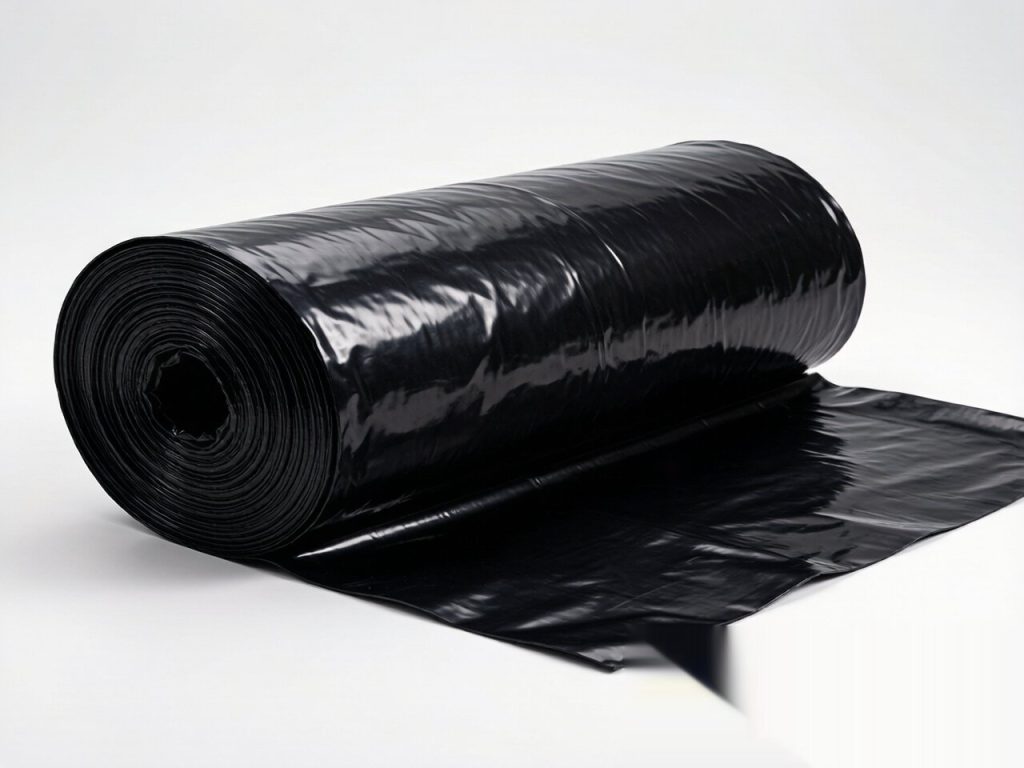
The core question: why PVC film for biogas systems
Biogas infrastructure—anaerobic digestion, gas storage, lagoon and digester covers—demands a hard set of properties: gas tightness, resistance to methane and hydrogen sulfide, UV stability, and the ability to expand and contract with gas production. HDPE is the go-to for the bottom liner; for flexible, weldable, conforming gas-collection covers, PVC-coated polyester fabric (often with a PVDF top layer) is a mainstream choice. DERFLEX offers knife-coated PVC biogas fabric in 900 / 1050 / 1200 gsm.
Material and how it works
The typical build is a high-tenacity polyester base cloth knife-coated with PVC on both sides, optionally lacquered with PVDF. DERFLEX specs: 900 gsm tensile ≥7500 N/5cm, tear ≥900 N; 1050 gsm ≥8500 / 1000 N; 1200 gsm ≥9500 / 1200 N. Temperature range −40°C to +70°C, UV grade 6 (ISO 4892), shrinkage <0.5%, claimed service life 10+ years, REACH and RoHS compliant.
Center Enamel (Shijiazhuang Zhengzhong Technology) builds membrane digester covers from PVC with PVDF lacquer, methane permeability below 400 cm³/m², pH tolerance 3–11 for high-H2S environments, operating pressure 0.5–5.0 mbar, engineered to Eurocode 1 / DIN 4112 / ASCE 7-22, certified to ISO 9001, WRAS, and NSF/ANSI 61.
- Inner membrane (gas holder): directly contains biogas—prioritize low permeability, chemical resistance, weldability.
- Outer membrane (weather shield): held at positive pressure by a blower; sheds rain, wind, snow, UV.
- Thermal buffer: the air gap between layers insulates, holding the mesophilic 35–40°C or thermophilic 50–55°C range microbes need.
Where it gets deployed
Double-membrane gas holders, anaerobic digester covers, floating biogas domes, lagoon and slurry covers, flexible gas bags, and municipal/industrial wastewater recovery all use it. BPM Geosynthetics notes the bottom liner should be HDPE (1.0–2.0 mm, tensile ≥20–27 kN/m, elongation ≥600%, 10–20 year life), while flexible covers use LLDPE or reinforced PVC.
Market and trend
Green-energy policy is pushing biogas capacity up across Europe, Asia, Latin America, and North America. Center Enamel has delivered 11,000 m³ projects in Saudi Arabia and 24,000 m³ facilities in China, spanning agricultural manure, food waste (OFMSW), and municipal sludge energy-neutral plants. Knife-coated PVC wins on reliable welding, gas tightness, and controlled cost.
Procurement checklist
- Layer the material: HDPE/LLDPE for the base liner, flexible PVC/LLDPE for the cover—don’t mix roles.
- Gas-tight data: ask for methane permeability (PVDF top can be <400 cm³/m²) and welding method (HF / hot-air / wedge).
- Chemical resistance: confirm pH range and H2S tolerance; prevent embrittlement in sour gas.
- Standards and pressure: design wind/snow/seismic per Eurocode/DIN/ASCE; operating pressure 0.5–5.0 mbar.
- Acceptance: CNC-cut, HF-welded seams with zero “holiday” defects; pressure-test before commissioning.
Practical notes from the field
Installation quality decides whether the spec pays off. Center Enamel cuts membranes on CNC laser systems and joins them by high-frequency welding, targeting uniform seam strength and zero holiday defects in the gas barrier; their engineering team runs site-specific Finite Element Analysis for every project rather than applying a generic factor of safety. That discipline is what separates a holder that holds pressure from one that leaks at a seam.
Application scale is growing fast. Agricultural biogas turns livestock manure and crop residue into on-site power; industrial wastewater (breweries, dairies, food processors) gets 100% odor and VOC containment; municipal sludge digestion pairs the cover with glass-fused-to-steel tanks for energy-neutral plants. The economics hinge on methane capture efficiency—every percentage point of permeability lost is fuel lost—so the PVDF top layer’s <400 cm³/m² figure is a buying criterion, not a footnote.
Failure concentrates in two places: poor welding letting methane escape, and wrong material selection causing chemical degradation. Both are solved by qualified welders and third-party test reports—not by adding thickness.












