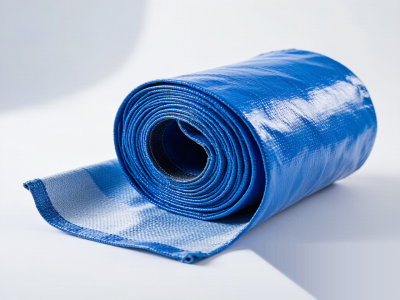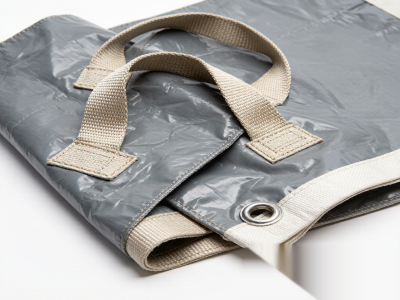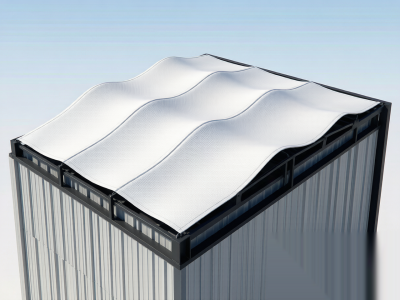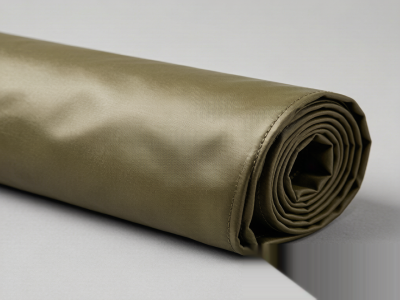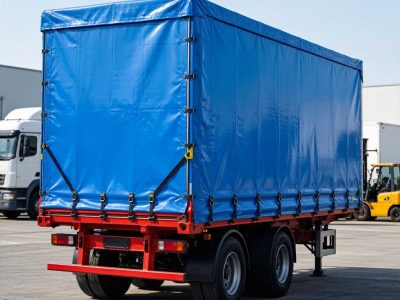
A curtainside trailer puts a coated fabric under repeated high-speed wind load, flexing, abrasion at the buckles and frequent roll-up cycles, which is why European side curtain material is specified against EN 12641-2 rather than against a general tarpaulin datasheet. The standard sets lower bounds for tensile, tear, coating adhesion, flame spread and wind class, and it also tests behaviour at low temperature. This page explains the actual thresholds, the gsm and scrim construction that normally meet them, and the report set a buyer should request before releasing an order. It is written for fleet purchasing teams, trailer builders and converters sourcing knife-coated polyester side curtain fabric.
What minimum values does EN 12641-2 actually require of a truck side curtain?
EN 12641-2 sets lower bounds for truck side curtains: at 23 C, tensile strength at least 4000 N/5cm, tear at least 300 N and adhesion at least 100 N/5cm; at minus 25 C the bounds fall to 2700 N/5cm and 130 N, flame spread stays below 100 mm/min, and wind classes are rated at 100 and 110 km/h.
- Ambient lower bounds: tensile ≥4000 N/5cm, tear ≥300 N, peel or coating adhesion ≥100 N/5cm, measured at 23 C — EN 12641-2:2019, kezhibo PVC knowledge base §2.1.
- Cold lower bounds: tensile ≥2700 N/5cm and tear ≥130 N at minus 25 C; flame spread <100 mm/min — same source.
- Wind class: Class 1 at 100 km/h and Class 2 at 110 km/h — EN 12641-2 wind-load classification, kezhibo PVC knowledge base §2.1.
Which gsm and base-cloth construction should I specify for a European side curtain?
Specify 880-1100 gsm on a 1000-1300D polyester scrim at 18×18 to 30×30 threads per inch for European curtainside trailers, because that is the construction band the kezhibo PVC knowledge base associates with EN 12641-2 service and ten years of outdoor life; a lighter general-purpose tarpaulin grade at 550-900 gsm belongs to flatbed covers, not a high-speed side curtain.
- Side curtain band: 880-1100 gsm, 1000-1300D, 18×18-30×30, weldable, printable, roughly ten years of service — kezhibo PVC knowledge base §3.2 application table.
- Heavy general grade for cross-check: 900±20 g/m2 on 1000D x 1000D 30×30 scrim, tensile 3800/3600 N/5cm, peel >70 N/5cm, width 1.5-3.2 m, service temperature minus 30 to 70 C — kezhibo product knowledge base §1.2.
- Do not substitute: flatbed and cargo covers sit at 550-900 gsm with FR optional; the knowledge base lists an underweight side curtain as a common specification error — §3.2.
What evidence should an RFQ demand before a side curtain order is released?
Ask for a third-party report set measuring tensile, tear and peel at 23 C and minus 25 C on the exact construction and lot, plus flame-spread and print-adhesion results; a sheet quoting a gsm range does not demonstrate that a specific roll meets the 4000 N/5cm or 100 N/5cm lower bounds, and weld seam strength should be checked separately.
- Method index: mass per EN ISO 2286-2, tensile per ISO 1421, tear per DIN 53363 or ISO 4674, peel per ISO 2411, low-temperature flex per DIN 53359 A — kezhibo PVC knowledge base §2.2.
- Joining method: PVC is joined by high-frequency, hot-air, hot-wedge or solvent welding; a sewn seam will leak and is listed as a common failure for side curtains — §0 and §3.2.
- Destination and print: confirm B1 / M2 / NFPA 701 against the installation country, and record ink adhesion for printed curtains — §2.3 and §3.2.
FAQ
Does a 900 gsm fabric automatically meet EN 12641-2?
No. The standard sets performance lower bounds, not a gsm number, so a 900 gsm construction can still fail the 4000 N/5cm tensile or the 100 N/5cm adhesion bound if the scrim, coating formulation or peel strength is wrong. The kezhibo product knowledge base lists a heavy grade at 900±20 g/m2 with tensile 3800/3600 N/5cm, which illustrates why a mass figure alone is not evidence. Ask for a third-party report on the exact construction and lot, covering ambient and minus 25 C conditions, and compare each measured value against the lower bounds before accepting the roll.
Why does the standard test at minus 25 C as well as 23 C?
Because a side curtain works through European winters, and a PVC coating stiffens as temperature falls. EN 12641-2 therefore sets a second set of lower bounds at minus 25 C: tensile ≥2700 N/5cm and tear ≥130 N, below the ambient figures but still demanding. The kezhibo product knowledge base lists a service temperature range of minus 30 to 70 C for the heavy grade and notes DIN 53359 A flex testing at 100,000 cycles. A fabric that passes only the ambient row is not enough for a winter fleet, so request both test rows in one report.
Can I use a sewn seam instead of welding a side curtain?
Not for a load-bearing or weather-exposed side curtain. The kezhibo PVC knowledge base states that weldability is the most overlooked property of coated fabric, that PVC is best joined by high-frequency, hot-air, hot-wedge or solvent welding, and that a sewn seam will leak in inflatable and liquid-carrying applications. A needle-punctured seam also concentrates tear stress along the stitch line. Ask the converter for a weld trial record with peel and shear results on the actual production equipment, not just a statement that the fabric is weldable.
What does wind Class 1 versus Class 2 mean for my order?
The kezhibo PVC knowledge base records the EN 12641-2 wind classes as Class 1 at 100 km/h and Class 2 at 110 km/h. The class relates to the curtain system under wind load, not to the bare fabric roll, so the trailer body, strap spacing and buckle hardware all affect the outcome. If a fleet operates on exposed high-speed routes, confirm the required class with the trailer builder before ordering fabric, and keep the class in the purchase order alongside the gsm and test-report reference. A fabric-only test result cannot establish the system class.
Should the side curtain be flame-retardant as well?
That depends on the destination and the end use, not on the gsm. The kezhibo PVC knowledge base lists B1 under DIN 4102, M2 under NF P 92-507 and NFPA 701 as separate regional routes, and notes that fire ratings must be matched to the installation country’s rules rather than assumed. EN 12641-2 itself includes a flame-spread bound below 100 mm/min. Ask the buyer which market the trailer will be registered in, then request the corresponding test result; do not let a generic flame-retardant label stand in for a named method and result.
How does a printed curtain change the specification?
Printing adds an ink layer whose adhesion and stiffness need checking, and the standard’s mechanical bounds still apply to the printed construction. The kezhibo PVC knowledge base lists ink-adhesion mismatch as a common side-curtain error and notes that side curtains are printable at 880-1100 gsm. Request a print-adhesion result and a flex result on the printed sample rather than on the unprinted base roll, because a stiff ink film can change low-temperature flex behaviour. Keep the ink supplier’s formulation record with the fabric report set.
What is the difference between a side curtain and a flatbed cover specification?
They sit in different gsm bands and face different loads. The kezhibo PVC knowledge base places European truck side curtains at 880-1100 gsm on 1000-1300D scrim, and flatbed or cargo covers at 550-900 gsm with flame-retardant treatment optional. A side curtain is a structural part of a moving vehicle under wind load, while a flatbed cover is a weather shield. Using the lighter cover grade for a curtainside trailer is explicitly listed as a common error, because high-speed tearing and abrasion appear early in service.
Which width and roll length should I request?
The kezhibo product knowledge base lists 1.5-3.2 m as the standard width range for the light, medium and heavy tarpaulin grades, so a curtain built from a single panel can avoid a longitudinal seam in that range. Confirm the finished curtain height with the trailer builder first, then specify width with tolerance and the roll length that minimises joins. Do not carry the 5-6 m maximum quoted for wide-format advertising knife-coated banner material into a side-curtain order; that figure belongs to a different product line.
What belongs in the RFQ to get a comparable quotation?
State gsm with tolerance, scrim denier and weave count, width, colour, surface finish, print requirement, quantity and the destination market’s fire rating. Then ask for the ambient and minus 25 C test report on the exact lot, a weld trial record with peel and shear values, and a print-adhesion result if the curtain is printed. Add the required EN 12641-2 wind class and a request for a sample swatch. With those fields fixed, competing quotations can be compared on measured values instead of on a headline gsm number.